Revelation of Jesus Christ
Ἀποκάλυψις Ἰησοῦ Χριστοῦ
The Book of Revelation was likely written by the Apostle John during his exile on Patmos near the end of Emperor Domitian’s reign, around A.D. 90 (commonly dated between A.D. 85–95), as affirmed by early church testimony (Irenaeus, Victorinus of Pettau, Eusebius, Jerome). While the exact year is uncertain, historical and textual evidence place its composition near the close of the 1st century. All existing manuscripts of the Book of Revelation are preserved in Greek, including early witnesses such as the Codices Sinaiticus and Alexandrinus. However, the text’s linguistic character is highly Semitic, displaying grammatical constructions, idioms, and patterns of parallelism that reflect a Hebrew or Aramaic texts. These features indicate that John was composing within that context. The book’s vocabulary and imagery draw heavily from the Hebrew Scriptures, giving Revelation a distinctly Jewish prophetic style.
Understand Revelation Version (URV) and URV Interlinear, produced by Kevin Dees, updated last 31 August 2026.
Greek manuscript resources: Center for New Testament Restoration, Center for the Study of New Testament Manuscripts, Codex Alexandrinus and Codex Sinaiticus.
Start here: How to Read This Study and How to Approach Reading Revelation.
The Revelation of Jesus Christ to the Churches: Overcome
The Greek verb σημαίνω carries the sense of “to give a sign,” “to signal,” “to point out,” “to indicate,” “to make clear,” “to make known,” “to communicate information,” “to report,” “to disclose,” or “to signify.” Thus, in Revelation 1:1, ἐσήμανεν may be understood as “He made it known,” “He communicated it,” or “He signified it.” The word can involve communication through signs, but it does not, by itself, require the meaning “to make symbolic.”
The draft renders ἐσήμανεν as “he signified it,” keeping the sign-root in view; the Greek could equally be heard as “he made it known,” “communicated it,” or “indicated it.” “Signified” does not, by itself, make the communication symbolic. This does not mean that every detail in Revelation is symbolic, but it does show that the book itself allows for symbolic communication. This is not only suggested in the opening verse; it is explicitly demonstrated when Jesus interprets the seven stars and the seven lampstands for John: “The seven stars are the angels of the seven churches: and the seven candlesticks which thou sawest are the seven churches.” (Revelation 1:20, KJV). Therefore, Revelation should not be forced into a purely literal reading at every point. The lampstands are real features within John’s vision, but they are not merely literal lampstands; they signify the churches, portrayed through the heavenly image of light-bearing stands before Christ.
Re 1:1, Re 1:3, Re 1:19, Re 4:1, Re 22:6, Re 22:10 — The primary direction of the word of Revelation is toward the future. However, it is set in the context of the current time. Notably, the past is not the concern of the book of Revelation, so we will not see anything here from John's time into the past.
Re 1:1, Re 22:16 — Bookend — "sent my messenger"
The Received Text reads ὅσα τε — "and as many things as" — where the critical text has a bare ὅσα, joining the clause with no conjunction at all. The King James renders the particle "and"; this edition keeps the word the particle buys visible as "even" and marks it, the same way 3:4 marks the Received Text's καί. The critical reading is simply asyndetic: "…of the testimony of Jesus Christ, of all things that he saw."
Reading would be out loud
Re 1:3, Re 22:10 — Bookending — "the time is near."
Re 1:1, Re 1:3, Re 1:19, Re 4:1, Re 22:6, Re 22:10 — The primary direction of the word of Revelation is toward the future. However, it is set in the context of the current time. Notably, the past is not the concern of the book of Revelation, so we will not see anything here from John's time into the past.
Message to the Seven Churches: Peace From The Father, Seven Spirits, and Jesus
The throne is the Father's in the immediate logic of Revelation 1:4-5. Grace and peace come from Him who is, and who was, and who is to come; from the seven Spirits before His throne; and from Jesus Christ. The greeting distinguishes the Father, the seven Spirits, and Jesus, even though Revelation will later speak of the throne of God and of the Lamb together.
Greek: ἀπὸ ὁ ὢν καὶ ὁ ἦν καὶ ὁ ἐρχόμενος. ἀπό takes the genitive — as it does later in this same verse, ἀπὸ τῶν ἑπτὰ πνευμάτων — but the threefold title stands in the nominative in both the NA28 and SBLGNT. The text does not say why. It is commonly read as the title being held in one fixed form, but that is interpretation, not something the text states.
He is not just King of Kings but also prince or ruler, ἄρχων, of the kings.
“Released” (λύω) appears in the Critical Text, while “washed” (λούω) is found in the Majority Text; in Greek, these two verbs differ by only a single letter. Within Revelation’s broader context, Christ is portrayed as the one who ransoms and redeems, while the saints are primarily described as those whose robes are washed in the blood of the Lamb (7:14; 12:11; 22:14). Revelation also describes the saints by patience, testimony, commandments, and faithfulness (12:17; 14:12; 20:4), but those works are not presented as the ground of their worthiness. This pattern suggests that, in this instance, the sense of Christ freeing rather than washing is the more contextually fitting reading.
Re 1:5, Re 3:14
Re 1:5, Re 3:14, Colossians 1:18, Colossians 1:15
Re 1:5, Re 20:9
Kingdom of Priests unto God
Important Note: Textual variants cause Revelation 1:6 in some translations, such as the NASB 2020, to read, "He made us into a kingdom, priests to His God and Father" (Revelation 1:6, NASB 2020). Likewise, Revelation 5:10 reads, "You have made them into a kingdom and priests to our God, and they will reign upon the earth" (NASB 2020). The evidence strongly suggests that the intended theme is "a kingdom of priests," not KJV's "kings and priests" echoing Exodus 19:6: "And ye shall be unto me a kingdom of priests, and an holy nation."
ἀμήν — "truly" for Amen
“[Of the ages]” follows the NA28’s own brackets ([τῶν αἰώνων]): Sinaiticus and Ephraemi carry the words, and SBL and the Received Text keep them, while Westcott-Hort and the Statistical Restoration omit them and Codex Alexandrinus lacks them. The doxology reads “unto the ages” or “unto the ages of the ages” accordingly.
The question also reaches 15:3, where the manuscripts split between “King of the [nations/ages].” Everywhere else in Revelation “ages” stands doubled — “unto the ages of the ages” — so if the words are absent here, the doxology’s bare “unto the ages” and 15:3’s “King of the ages” would be the book’s only two single uses of the word, and each makes room for the other. The settings match as well: both stand beside king and kingdom — “has made us a kingdom” here, “O King of the…” there. This study ranks the possibilities as fully equal — at 1:6 for the longer and the shorter reading, at 15:3 for “nations” and for “ages” — because the evidence is not strong enough to decide either place, and neither direction breaks the book’s continuity. So in both places the text is preserved as it stands.
Re 1:6, Re 5:13
Re 1:7, Re 10:1, Re 14:14-16, Daniel 7:13 — Jesus coming in the clouds.
Re 1:7, John 19:37, Zechariah 12:10 — This is making it very clear the type of death Jesus died and connecting him to the person who is coming in the clouds.
The KJV/TR adds "the beginning and the ending"; the critical text reads Ἐγώ εἰμι τὸ ἄλφα καὶ τὸ ὦ, λέγει κύριος ὁ θεός — the title continues without the expansion.
Companion in Tribulation
Important Note: John points out that, regarding the church, he is in tribulation, and the saints who will be in tribulation can be patient in Jesus as he is. The letters to the churches were present and future when delivered to the seven churches, and they are past to us only in that original historical setting. Revelation 1:19 frames the writing as “the things which you have seen,” “the things which are,” and “the things which are about to come to pass after these things,” so the letters can be read as applying to the original churches, to the present church, and to a future church in tribulation.
Tribulation for the church is not unique to what has been labeled as "the great tribulation" of 7 years. All Christians will face tribulation. When we read Revelation and John speaks of being a "fellow partaker in the tribulation," he is referring to that shared trouble we have in this world. But there is also a tribulation that is great, taking place over 7 years, and many will enter into it. So when we see reference to the "patience of the saints," we should not confuse the tribulation we face every day as the church with what is meant to be a very particular tribulation at a very particular time. This is why many use the special label "the great tribulation" to make that distinction clear. Even so, this study treats "great tribulation" as a descriptor, not a title — Matthew describes the peak, while Revelation 7:14's double-article Greek designates the span itself: "the tribulation, the great" (see 7:14). There are types and degrees of tribulation (2:22; 7:14; Matthew 24:21), and the seven years escalate from great at the opening to an all-time peak at the middle, the same way the earthquakes escalate across the seals, trumpets, and vials (8:5; 11:19; 16:18). Context, not the term alone, assigns each passage its place on that path. Here John is making a soft relation in the shared theme of waiting on Jesus (6:9; 12:17; 13:10; 14:12).
John says he is a “fellow partaker,” which appears to echo the language found in Paul’s writings, which were primarily addressed to the churches among the nations. Further, John is not just speaking about partaking in general tribulation; he is also including the kingdom and the patience in Jesus.
The KJV/TR reads "Jesus Christ" in both places; the critical text reads Ἰησοῦ — "Jesus" — without "Christ." At the first, the KJV/TR also reads "patience of Jesus Christ" (ὑπομονῇ Ἰησοῦ Χριστοῦ) where the critical text reads ὑπομονῇ ἐν Ἰησοῦ — "patience in Jesus."
“Your” here is plural (ὑμῶν): John writes to the seven churches together, not to one reader. English uses the same word for one person and for many, so where the Greek marks the plural and English cannot, this study records it in a note. The “your” of the seven letters (2:2; 3:1) is the singular σου, addressed to each church’s messenger.
Jesus Speaks with Trumpet Voice
Important Note: In verse 10, we learn that a voice is described as a trumpet. So, when we see messengers with trumpets, we can see them as voices of announcement and as literal trumpets. This does not exclude the idea that the 7 trumpet judgments could be literal trumpets, but this text here is leaning towards great and powerful voices rather than objects.
Re 1:10, Re 4:2, Re 17:3, Re 21:10 — Strong transition marker: ἐν πνεύματι, "in the spirit," marks a clean breakaway from the preceding thought into a new scene of the story, distinct from its surrounding parts: the opening voice on the Lord’s day (1:10), the transition into the throne scene (4:2), and the parenthetical visions of Babylon (17:3) and the holy city (21:10).
Re 1:10, Re 4:1
It is worth noting that the possible delivery route of the letter may correspond to the chiastic structure of the messages to the churches.
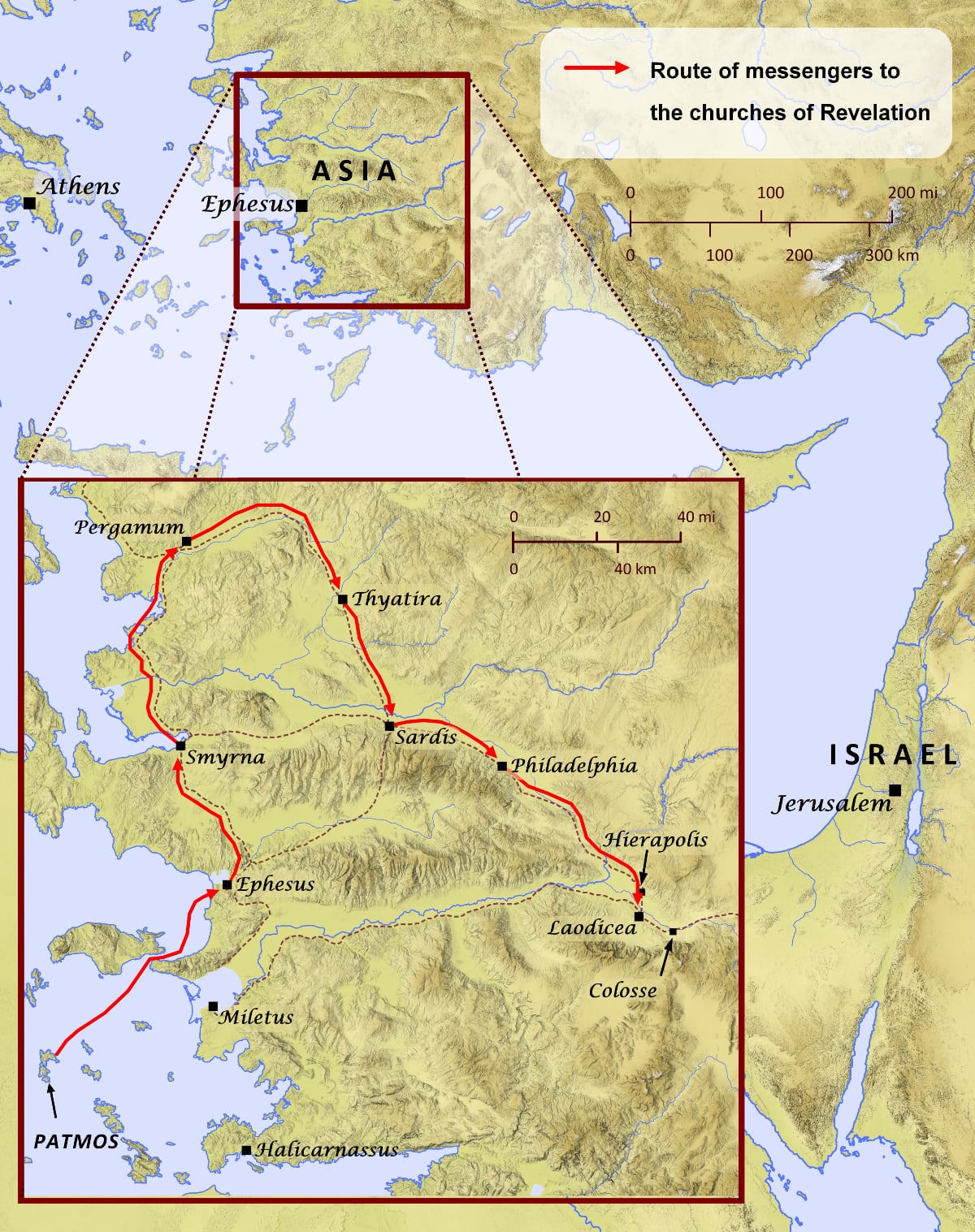
Image from https://biblemapper.com/
The KJV/TR opens the command with "I am Alpha and Omega, the first and the last: and," and addresses the churches "which are in Asia"; the critical text carries neither, reading ὃ βλέπεις γράψον εἰς βιβλίον καὶ πέμψον ταῖς ἑπτὰ ἐκκλησίαις — "What you see, write in a book and send to the seven churches." The opening clause is not a case of editions weighing manuscripts differently: the early Greek witnesses omit it without exception — Sinaiticus (01, c. 325–360), Alexandrinus (02), Ephraemi (04) — and the Byzantine Majority Text omits it as well. It is carried by the printed Received Text.
Re 2:1 — Ephesus
Re 2:8 — Smyrna
Re 2:12 — Pergamum
Re 2:18 — Thyatira
Re 3:1 — Sardis
Re 3:7 — Philadelphia
Re 3:14 — Laodicea
John Sees Glorified Jesus
The KJV/TR reads "seven lampstands" here; the critical text reads ἐν μέσῳ τῶν λυχνιῶν — "in the midst of the lampstands" — without the number.
Greek: ὅμοιον υἱὸν ἀνθρώπου. ὅμοιος ("like") ordinarily takes the dative — as it does elsewhere in Revelation — but here its object stands in the accusative in the NA28 and SBLGNT. The rendering is unaffected either way; the observation is recorded because the construction is irregular, not because the sense is in doubt.
Re 1:13, Re 14:14
Re 1:13, Re 15:6 — Soft link to priestly garments. Jesus is girded at the μαστοῖς "mastos," the upper chest, not the loins here. In 15:6, seven messengers have the same type of dress.
This is the only time wool is used and that is strictly related to the Lamb.
Does "white" apply to both head and hair? Yes, λευκαὶ applies to κεφαλή (head) + τρίχες (hairs)
"Fired" translates πυρόω (pyroō), the verb of πῦρ, fire: to put metal into the fire. English usually splits the word by the metal — bronze in a furnace is said to glow, gold in a fire is said to be refined — but the Greek says one thing in both places, and this edition keeps one word for it. The picture is not lost: the furnace stands in the verse, and what a furnace does to bronze is make it glow. The same fired word returns at 3:18, where the counsel to Laodicea is to buy gold fired by fire — gold that has been through the flame and come out proved. The glowing bronze of the vision and the proved gold of the counsel are the same word: metal in the fire, and shown true by it.
Re 1:15, Re 2:18, Re 10:1 — The Greek reinforces the shared fire imagery through the πυρ- word family. In Revelation 1:15, πεπυρωμένης comes from πυρόω, “to make fiery hot, burn, or refine,” a verb derived from πῦρ, “fire.” Revelation 2:18 repeats both the description of the feet as χαλκολίβανον (“burnished/fine bronze”) and the noun πῦρ in φλόγα πυρός (“a flame of fire”). Revelation 10:1 then describes the angel’s feet as στῦλοι πυρός (“pillars of fire”). Thus, the passages are linked by repeated fiery imagery and by the related Greek forms πυρόω–πῦρ–πυρός. The rare word χαλκολίβανον itself for brilliant bronze, however, does not contain the root πυρ-.
Re 1:15, Re 3:18
Re 1:16, Re 12:1 — This is like the woman with the 12 stars, but they are not the same. The 7 stars seem to represent Gentile church messengers or leaders, while the 12 stars in Revelation 12 appear to represent the heads of the tribes of Israel.
The KJV/TR reads λέγων μοι — "saying unto me"; the critical text reads λέγων — "saying" — without "unto me."
Re 1:17, Re 2:10
Re 1:5, Re 1:17, Re 2:8, 1 Corinthians 15:20-22, 1 Corinthians 15:45, Philippians 2:6-11 — This study takes a step of faith in siding with Codex Alexandrinus.
Given the context of Revelation and the pattern for identifying the Father at Revelation 22:13 and other passages, a drift toward “the first and the last” at 1:17 and 2:8 seems the more probable drift than a drift toward “firstborn.” Based on this study’s research, Alexandrinus shows greater overall accuracy than the other manuscripts, and that merit carries weight when judging “firstborn” the more likely reading. And having Jesus share a title with the Father, when Revelation keeps their identities distinct while still divine up to the disputed 22:13, makes Alexandrinus the less likely witness to have drifted from a theological standpoint. That drift toward converging the Father and the Son is not a guess — the tradition shows it happening. At 1:11 the Textus Receptus adds “I am Alpha and Omega, the first and the last” to the speaker’s words, an addition absent from the early codices and from the Majority Text alike — and the addition carries the very title in question. The sharing of the Father’s titles demonstrably grew over time, which makes the drift away from “firstborn” the highly likely one. The context of both verses points the same way: at 1:17 and 2:8 the title stands beside Jesus becoming dead and living again — firstborn-of-the-dead territory — and Revelation has already named him “the firstborn of the dead” at 1:5. On that reading, “the firstborn and the last” may be pointing to 1 Corinthians 15 as the main connection here: the firstfruits of the dead and the last Adam. Paul already places both halves of the pairing on Jesus, so the phrase “firstborn and last” is not an awkward one.
Re 1:17, Re 2:8, Re 22:13 — At Revelation 1:17 and 2:8, NA28 prints “the First and the Last” (ὁ πρῶτος καὶ ὁ ἔσχατος), a reading directly preserved in Codices Sinaiticus and Ephraemi. Codex Alexandrinus instead reads “the Firstborn and the Last” (ὁ πρωτότοκος καὶ ὁ ἔσχατος); hence [Firstborn/First]. P98 is missing this portion, so we cannot decide between the readings. At 22:13, NA28 prints “the First and the Last,” as preserved in Sinaiticus, whereas Alexandrinus omits both articles and reads “First and Last”; hence [the] First and [the] Last.
The KJV/TR closes the declaration with "Amen"; the critical text lacks it here.
Re 1:18, Re 4:9, Re 4:10, Re 10:6, Re 15:7 — ζάω with αἰῶνας — lives ages to the ages. Only 1:18 refers to Jesus. The Father is never noted as being dead and then alive; only Jesus is described as being dead and then alive, whereas the Father is always living without death. In 1:18, Jesus is to be “alive unto the ages of the ages”. So while Jesus claims to live unto the ages of the ages, it is not the same structure or meaning as the connection of the same lemma he shares with the Father. Thus, when Revelation speaks of him "who lives unto the ages of the ages" (4:9), it is referring to the Father, not Jesus.
Re 1:18, Re 6:8, Re 20:13-14 — The Greek term here is ᾅδης, rendered "hell" in the KJV tradition. Revelation distinguishes Hell from the lake of fire: Death and Hell give up the dead, and then Death and Hell are cast into the lake of fire.
In light of Revelation 1:19, chapters 1–3 focus on what is present and what will follow. When the vision reaches Revelation 4, the emphasis shifts exclusively to “the things which must come to pass after these things.”
Re 1:1, Re 1:3, Re 1:19, Re 4:1, Re 22:6, Re 22:10 — The primary direction of the word of Revelation is toward the future. However, it is set in the context of the current time. Notably, the past is not the concern of the book of Revelation, so we will not see anything here from John's time into the past.
Seven Churches
Important Note: It is not a highly important theological detail in the study of Revelation, but it is worth noting that there is debate over whether the seven stars in Revelation 1 represent angels or the human leaders of the churches. Also, all the churches are told to "hear." We will see this again in Revelation 13:9, when the saints are given the choice to worship the beast or likely be killed. This kind of connection might lead one to think the church is destined for the tribulation. Yet the call to "hear" is not a link to identity but to obedience — a call directed to a particular people, the saints, whether outside or inside the tribulation.
Bookends: There are bookends within the messages to the seven churches. The bookends are the opening and closing churches that need to return to God: Ephesus and Laodicea.
See the 12 stars in Chapter 12; these appear to point to the tribe heads of Israel in Chapter 12, while these 7 stars are connected to the messengers of the churches. If the church messengers are understood as human representatives, both star images would then involve human leaders within their respective groups.
The seven-and-twelve pattern also has support from the two feeding miracles. In the feeding of the five thousand, the setting is Jewish/Galilean and twelve baskets remain (Matthew 14:20; Mark 6:43; Luke 9:17; John 6:13), naturally fitting Israel's twelve tribes. In the feeding of the four thousand, the narrative follows Jesus' movement through Tyre, Sidon, and the Decapolis region, a Gentile or half-Gentile setting, and seven baskets remain (Matthew 15:29-39; Mark 7:31; 8:1-10). Jesus Himself keeps the twelve and seven basket counts distinct when He recalls both miracles (Matthew 16:9-10; Mark 8:19-20). This does not prove the Revelation imagery by itself, but it gives textual, historical, and geographical support for reading the seven stars as Gentile church messengers and the twelve stars as Israelite tribal heads.
“mystery” (μυστήριον) appears four times in Revelation and is applied specifically to the identity of two symbolic elements: the “seven stars” in Jesus’ right hand and “Mystery Babylon.” When we examine Mystery Babylon in its extended treatment (Revelation 17–19), she is set in deliberate contrast to the bride of Christ, the New Jerusalem. If the bride stands as the counterpart to this “mystery” city, and the seven stars are likewise called a “mystery,” the text may be suggesting a parallel in kind. In that case, the seven stars need not be understood strictly as heavenly angels, but could instead represent specific members within the body of the bride.
In the closing clause the KJV/TR repeats the relative clause — αἱ ἑπτὰ λυχνίαι ἃς εἶδες, "the seven lampstands which you saw"; the critical text reads αἱ λυχνίαι αἱ ἑπτὰ — "the seven lampstands" — without it.
Re 1:20, Re 10:7, Re 17:5, Re 17:7 — μυστήριον — Mystery is used four times. In Rev 1, the mystery concerns the seven stars and the seven lampstands, with the lampstands explicitly identified as the churches. In Rev 10, the "mystery of God" that is "finished" is unclear: whether the "mystery" refers broadly or specifically. When we look at the uses of mystery in Rev 17, both instances refer to Mystery Babylon. In 3/4 uses of "mystery," it is either tied to the churches or to Babylon. What is striking is that Mystery Babylon is directly contrasted with the image of New Jerusalem (17:3, 21:10). If there is meant to be a connection using the word μυστήριον, then it may be to reinforce the contrast of these two women. This may shed light on what Rev 10 describes as the mystery. The Mystery of God (that is, the one who is his) is the church (Ephesians 3:4-6). If this relation is true for Rev 10, then μυστήριον refers twice to the church and twice to Babylon.
#1 Left Jesus - Message to Ephesus: Left First Love
Important Note: This church is also shown to need to repent, and there is a promise of the tree of life.
Re 9:20, Re 14:13, Re 18:6, Re 20:12-13, Re 22:12 — The "works" mentions in 9:20, 14:13, 18:6, 20:12-13, and 22:12 seem related to those of the seven churches in 2:2, 2:9, 2:13, 2:19, 3:1, 3:8, and 3:15.
The KJV/TR reads "…and for my name's sake hast laboured, and hast not fainted"; the critical text reads καὶ ὑπομονὴν ἔχεις καὶ ἐβάστασας διὰ τὸ ὄνομά μου καὶ οὐ κεκοπίακες — "and you have patience, and have borne for my name's sake, and have not become weary" — without the separate "laboured" clause.
"Somewhat" is supplied in the KJV translation; the Greek reads ἔχω κατὰ σοῦ — "I have against you."
The KJV/TR reads "I will come unto thee quickly"; the critical text reads ἔρχομαί σοι — without "quickly" here, though it stands at 2:16 (ταχύ).
Re 2:5, Re 2:16
Re 2:6, Re 2:15 — Ephesus hates evil teachers
The KJV/TR places the tree "in the midst of the paradise of God"; the critical text reads ἐν τῷ παραδείσῳ τοῦ θεοῦ — "in the paradise of God."
The Greek here is ξύλον — wood — the word the Greek Old Testament uses for the tree of life in Genesis 2:9 and the New Testament uses for the cross (Acts 5:30; Galatians 3:13; 1 Peter 2:24). The natural trees of the plagues are a different word, δένδρον (7:1, 7:3, 8:7, 9:4).
Re 2:7, Re 2:11, Re 2:17, Re 2:29, Re 3:6, Re 3:13, Re 3:22, Re 13:9 — "Ear, let him hear" (ἔχει/ἔχων οὖς ἀκουσάτω) is specific to the 7 churches. When we see it again here, we see the same idea, "My people hear me! Do not worship the beast. Even if you must rest." This does not mean that the 7 churches are specifically present at this time; all the other links in Revelation must be considered alongside this phrase. The phrase "let him hear" appears to be for those who hear God, that is, the saints in general.
Re 2:7, Re 2:14, Re 2:20, Re 10:10, Re 17:16, Re 19:18 — Eat (ἐσθίω) - This word is used in 2:7 for eating of the tree of life for Ephesus, the first church. For Pergamum and Thyatira, the third and fourth churches (which run in parallel), the word refers to eating things sacrificed to idols. In 10:10, John eats the little scroll. In 17:16, the Mystery Babylon has her flesh eaten. In 19:18, the birds that fly eat the flesh of kings and others.
#2 Crown - Message to Smyrna: Ten Days of Tribulation
Important Note: Smyrna mirrors Philadelphia, yet Philadelphia is promised to escape "the hour of testing, which is about to come upon the whole inhabited-world." This is not the ordinary expected temptation of the church; this is the one that comes on the whole world. Yet here, Smyrna is told to be faithful unto death.
Re 1:5, Re 1:17, Re 2:8, 1 Corinthians 15:20-22, 1 Corinthians 15:45, Philippians 2:6-11 — This study takes a step of faith in siding with Codex Alexandrinus.
Given the context of Revelation and the pattern for identifying the Father at Revelation 22:13 and other passages, a drift toward “the first and the last” at 1:17 and 2:8 seems the more probable drift than a drift toward “firstborn.” Based on this study’s research, Alexandrinus shows greater overall accuracy than the other manuscripts, and that merit carries weight when judging “firstborn” the more likely reading. And having Jesus share a title with the Father, when Revelation keeps their identities distinct while still divine up to the disputed 22:13, makes Alexandrinus the less likely witness to have drifted from a theological standpoint. That drift toward converging the Father and the Son is not a guess — the tradition shows it happening. At 1:11 the Textus Receptus adds “I am Alpha and Omega, the first and the last” to the speaker’s words, an addition absent from the early codices and from the Majority Text alike — and the addition carries the very title in question. The sharing of the Father’s titles demonstrably grew over time, which makes the drift away from “firstborn” the highly likely one. The context of both verses points the same way: at 1:17 and 2:8 the title stands beside Jesus becoming dead and living again — firstborn-of-the-dead territory — and Revelation has already named him “the firstborn of the dead” at 1:5. On that reading, “the firstborn and the last” may be pointing to 1 Corinthians 15 as the main connection here: the firstfruits of the dead and the last Adam. Paul already places both halves of the pairing on Jesus, so the phrase “firstborn and last” is not an awkward one.
Re 1:17, Re 2:8, Re 22:13 — At Revelation 1:17 and 2:8, NA28 prints “the First and the Last” (ὁ πρῶτος καὶ ὁ ἔσχατος), a reading directly preserved in Codices Sinaiticus and Ephraemi. Codex Alexandrinus instead reads “the Firstborn and the Last” (ὁ πρωτότοκος καὶ ὁ ἔσχατος); hence [Firstborn/First]. P98 is missing this portion, so we cannot decide between the readings. At 22:13, NA28 prints “the First and the Last,” as preserved in Sinaiticus, whereas Alexandrinus omits both articles and reads “First and Last”; hence [the] First and [the] Last.
Re 2:8, Re 13:14 — ἔζησεν — is alive or did live
The KJV/TR opens "I know thy works, and…"; the critical text reads οἶδά σου τὴν θλῖψιν — "I know your tribulation" — without the works clause.
Re 9:20, Re 14:13, Re 18:6, Re 20:12-13, Re 22:12 — The "works" mentions in 9:20, 14:13, 18:6, 20:12-13, and 22:12 seem related to those of the seven churches in 2:2, 2:9, 2:13, 2:19, 3:1, 3:8, and 3:15.
Re 2:9, 2 Corinthians 8:9
Re 2:9, Re 3:9
Two details here anchor larger patterns. First, testing and tribulation are welded in one clause — "that you all may be tested; and you all shall have tribulation ten days" — and the same testing word returns in "the hour of testing" in 3:10. The book itself pairs the two ideas. Second, this testing is counted — ten days — a local, bounded tribulation for one church, while Philadelphia, Smyrna's mirror, is kept out of a designated world-wide hour (3:10). The two crown churches carry the two modes: a counted tribulation endured unto death with a crown of life promised (2:10), and a designated hour escaped with a crown held fast (3:11). Ten counted days here, a great one at the span's opening (7:14), and a greatest at the middle (Matthew 24:21) — tribulation comes in types and degrees.
Re 1:17, Re 2:10
Re 2:10, Re 3:11
Re 2:7, Re 2:11, Re 2:17, Re 2:29, Re 3:6, Re 3:13, Re 3:22, Re 13:9 — "Ear, let him hear" (ἔχει/ἔχων οὖς ἀκουσάτω) is specific to the 7 churches. When we see it again here, we see the same idea, "My people hear me! Do not worship the beast. Even if you must rest." This does not mean that the 7 churches are specifically present at this time; all the other links in Revelation must be considered alongside this phrase. The phrase "let him hear" appears to be for those who hear God, that is, the saints in general.
Re 2:11, Re 6:6, Re 7:3, Re 9:4 — Mentions of “not harming” or “not hurting” appear in Revelation 2:11, 6:6, 7:3, and 9:4. These references should not be treated as the same event or action simply because similar language is used. Revelation 7:3 and 9:4 may seem closely related because both involve the sealed servants of God, but they differ in the actors and purposes. In Revelation 7:3, the four angels are told not to harm the earth, sea, or trees “until” the servants of God are sealed. In Revelation 9:4, however, the locusts are commanded not to harm the grass, any green thing, or any tree "at all," but only the people who do not have the seal of God on their foreheads.
#3 Fornication - Message to Pergamum: Doctrine of Balaam
Important Note: Jesus will come to this church with the sword of his mouth. A mirror of Thyatira, false teachers, idols, and fornication.
The KJV/TR opens "I know thy works, and…"; the critical text reads οἶδα ποῦ κατοικεῖς — "I know where you dwell."
Re 9:20, Re 14:13, Re 18:6, Re 20:12-13, Re 22:12 — The "works" mentions in 9:20, 14:13, 18:6, 20:12-13, and 22:12 seem related to those of the seven churches in 2:2, 2:9, 2:13, 2:19, 3:1, 3:8, and 3:15.
Re 2:13, Re 3:8, 1 John 5:4-5 — Faith in Jesus and his name are deeply linked. This is the one who has faith in the name of the Son of God and believes in his name.
Re 2:7, Re 2:14, Re 2:20, Re 10:10, Re 17:16, Re 19:18 — Eat (ἐσθίω) - This word is used in 2:7 for eating of the tree of life for Ephesus, the first church. For Pergamum and Thyatira, the third and fourth churches (which run in parallel), the word refers to eating things sacrificed to idols. In 10:10, John eats the little scroll. In 17:16, the Mystery Babylon has her flesh eaten. In 19:18, the birds that fly eat the flesh of kings and others.
Re 2:14, Re 2:20
Re 2:14, Re 2:20
Re 2:6, Re 2:15 — Pergamum has some evil teachers.
Re 2:5, Re 2:16
The KJV/TR reads "to eat of the hidden manna"; the critical text reads δώσω αὐτῷ τοῦ μάννα — "I will give to him of the manna" — without the eating verb.
“Stone” here is ψῆφος (psēphos), a different word from λίθος, the book’s ordinary stone (4:3, 18:21, 21:11, 21:19): a small, smoothed stone. Its only other New Testament occurrence is a vote — Acts 26:10, “I cast my ψῆφον against them.” What this stone is for, the text does not say; it says only what it is: white, with a new name written, which none knows saving he who receives it.
Re 2:7, Re 2:11, Re 2:17, Re 2:29, Re 3:6, Re 3:13, Re 3:22, Re 13:9 — "Ear, let him hear" (ἔχει/ἔχων οὖς ἀκουσάτω) is specific to the 7 churches. When we see it again here, we see the same idea, "My people hear me! Do not worship the beast. Even if you must rest." This does not mean that the 7 churches are specifically present at this time; all the other links in Revelation must be considered alongside this phrase. The phrase "let him hear" appears to be for those who hear God, that is, the saints in general.
#4 Fornication - Message to Thyatira: Jezebel
Important Note: A mirror of Pergamum, false teachers, idols, and fornication.
Re 1:15, Re 2:18, Re 10:1 — The Greek reinforces the shared fire imagery through the πυρ- word family. In Revelation 1:15, πεπυρωμένης comes from πυρόω, “to make fiery hot, burn, or refine,” a verb derived from πῦρ, “fire.” Revelation 2:18 repeats both the description of the feet as χαλκολίβανον (“burnished/fine bronze”) and the noun πῦρ in φλόγα πυρός (“a flame of fire”). Revelation 10:1 then describes the angel’s feet as στῦλοι πυρός (“pillars of fire”). Thus, the passages are linked by repeated fiery imagery and by the related Greek forms πυρόω–πῦρ–πυρός. The rare word χαλκολίβανον itself for brilliant bronze, however, does not contain the root πυρ-.
If 7 is the number of completion, Jesus' listing of only 6 qualities here helps emphasize that something is lacking.
Re 9:20, Re 14:13, Re 18:6, Re 20:12-13, Re 22:12 — The "works" mentions in 9:20, 14:13, 18:6, 20:12-13, and 22:12 seem related to those of the seven churches in 2:2, 2:9, 2:13, 2:19, 3:1, 3:8, and 3:15.
The KJV/TR includes ὀλίγα — "a few things" (KJV "I have a few things against thee"); the critical text reads ἔχω κατὰ σοῦ ὅτι — "I have against you that…" — without it.
“[the woman/thy wife]” — Codex Alexandrinus and Robinson-Pierpont read τὴν γυναῖκά σου, “thy wife Jezebel”; Sinaiticus, Ephraemi, and the Received Text read “the woman.” With σου the charge falls on the messenger of Thyatira himself.
Re 2:14, Re 2:20
Re 2:7, Re 2:14, Re 2:20, Re 10:10, Re 17:16, Re 19:18 — Eat (ἐσθίω) - This word is used in 2:7 for eating of the tree of life for Ephesus, the first church. For Pergamum and Thyatira, the third and fourth churches (which run in parallel), the word refers to eating things sacrificed to idols. In 10:10, John eats the little scroll. In 17:16, the Mystery Babylon has her flesh eaten. In 19:18, the birds that fly eat the flesh of kings and others.
Re 2:14, Re 2:20
The KJV/TR closes the verse with "their deeds" (αὐτῶν); the critical text reads "her works" (αὐτῆς). Codex Alexandrinus carries the Received Text reading here, against Codex Sinaiticus and Codex Ephraemi, which read "her".
“[a bed/prison]” — Codex Alexandrinus alone reads φυλακήν, “prison” — the word of 2:10, “the devil is about to cast some of you into prison” — where Sinaiticus, Ephraemi, and every edition read κλίνην, “a bed.”
Both νεφρούς (kidneys) and καρδίας (hearts) are plural in Greek, reflecting an idiom for the totality of the inner life (“inner parts and hearts”), which English translations often render in the singular for smoothness.
“Your” here is plural (ὑμῶν) — the churches as a body, which is why the same sentence says “unto every one of you.” English cannot mark the difference between one and many in this word; the Greek does, so the number is recorded here rather than in the line.
The Received Text joins the two clauses with καί — "and who have not known" — where the critical text sets them side by side with none: Sinaiticus, Alexandrinus, Ephraemi, the Statistical Restoration, Westcott-Hort, NA28, SBL and Robinson-Pierpont all read ταύτην, οἵτινες with nothing between. Only Stephanus and the King James Received Text carry the conjunction, which is where the King James gets its "and which have not known."
The difference is small but it changes the joint. With καί the two descriptions are a list of two groups, or two things said of one; without it the second clause simply restates the first — the ones who do not hold this teaching, the ones who have not known the depths of Satan.
The verse's opening runs the other way, and the draft follows the critical text there too: the Received Text reads καὶ λοιποῖς, "and to the rest," while the critical text reads τοῖς λοιποῖς, "unto the rest," which is what stands above.
Re 2:27, Re 18:12
Re 2:28, Re 22:16
Re 2:7, Re 2:11, Re 2:17, Re 2:29, Re 3:6, Re 3:13, Re 3:22, Re 13:9 — "Ear, let him hear" (ἔχει/ἔχων οὖς ἀκουσάτω) is specific to the 7 churches. When we see it again here, we see the same idea, "My people hear me! Do not worship the beast. Even if you must rest." This does not mean that the 7 churches are specifically present at this time; all the other links in Revelation must be considered alongside this phrase. The phrase "let him hear" appears to be for those who hear God, that is, the saints in general.
#5 Dead - Message to Sardis: I Come as a Thief
Important Note: This church is given a chance to change and walk in white so that Jesus will not come to them as a thief.
Re 9:20, Re 14:13, Re 18:6, Re 20:12-13, Re 22:12 — The "works" mentions in 9:20, 14:13, 18:6, 20:12-13, and 22:12 seem related to those of the seven churches in 2:2, 2:9, 2:13, 2:19, 3:1, 3:8, and 3:15.
The KJV/TR carries ἐπὶ σέ in the first clause — "I will come upon you as a thief"; the critical text reads ἥξω ὡς κλέπτης — "I will come as a thief" — with "upon you" only in the second clause (ἥξω ἐπὶ σέ).
Re 3:3, Re 16:15 — Keep in mind this is an idiom for a time that is not expected.
"little" here is used instead of "few" to more closely reflect the Greek consistency for the word "ολιγος".
The KJV/TR includes καί — "even" — before "in Sardis"; the critical text reads ἔχεις ὀλίγα ὀνόματα ἐν Σάρδεσιν — "you have a few names in Sardis" — without it.
Re 3:4, Re 11:13 — ὀνόματα — persons counted as names: a few names in Sardis who have not defiled their garments (3:4), and seven thousand names of men killed in the earthquake (11:13). Revelation counts people by name — the same word that is written in, or blotted from, the scroll of life.
Re 3:4, Re 21:24 — The Lamb is the light of the city that the saints walk by.
Re 2:7, Re 2:11, Re 2:17, Re 2:29, Re 3:6, Re 3:13, Re 3:22, Re 13:9 — "Ear, let him hear" (ἔχει/ἔχων οὖς ἀκουσάτω) is specific to the 7 churches. When we see it again here, we see the same idea, "My people hear me! Do not worship the beast. Even if you must rest." This does not mean that the 7 churches are specifically present at this time; all the other links in Revelation must be considered alongside this phrase. The phrase "let him hear" appears to be for those who hear God, that is, the saints in general.
#6 Crown - Message to Philadelphia: Open Door
Important Note: This church is going to be given an "open door" and "I also will keep you from the hour of testing."
Important Note: Revelation 3:10 clearly identifies a distinct, global period—“the hour of testing” (τῆς ὥρας τοῦ πειρασμοῦ)—which is said to come upon “the whole inhabited-world.” The promise, therefore, is not merely about a general hardship, but about preservation in relation to a defined eschatological time.
The Greek reads, σε τηρήσω ἐκ τῆς ὥρας—“I will keep you from the hour.” The preposition ἐκ naturally carries the sense of “from” or “out of,” indicating separation from that hour. While this does not explicitly define the mechanism of preservation, it does point away from simple endurance within the period. If the intent were clearly to express preservation within the hour, more direct constructions such as ἐν (“in”) or διά (“through”) were available.
Thus, the grammar most plainly emphasizes separation in relation to a coming global hour, while leaving the precise manner of that deliverance unstated.
In Revelation’s own symbolic framework, the promise to Philadelphia—“I have given before you an open door”—seems to signify a heavenly opening. The only other “open door” (θυρα) occurs in Revelation 4:1, where John hears the heavenly summons Ἀνάβα ὧδε (“Come up here”) and is immediately taken into the throne room before the judgments begin. This upward-calling formula appears again with the two witnesses in Revelation 11:12 (Ἀνάβατε ὧδε), and both times it results in an instantaneous ascent into heaven. When this pattern is combined with the precise grammar of Revelation 3:10—Christ’s promise to keep them ἐκ τῆς ὥρας, “out of the hour” itself, not merely safe within it—a theme appears: the open door may be the means by which Philadelphia is removed prior to the coming global hour of trial. Revelation’s internal symbolism is consistent, and its language is deliberate: the open door reads most naturally as a heavenly upward summons rather than an earthly opportunity. The grammar of 3:10 carries the main weight here; the door connection to 4:1 is suggested by the only other open door, not demanded — though the two fit well together.
Re 9:20, Re 14:13, Re 18:6, Re 20:12-13, Re 22:12 — The "works" mentions in 9:20, 14:13, 18:6, 20:12-13, and 22:12 seem related to those of the seven churches in 2:2, 2:9, 2:13, 2:19, 3:1, 3:8, and 3:15.
Re 2:13, Re 3:8, 1 John 5:4-5 — Faith in Jesus and his name are deeply linked. This is the one who has faith in the name of the Son of God and believes in his name.
Re 2:9, Re 3:9
Here we see a direct link between "hour of testing" and what is "about to come upon the whole inhabited-world". It is not referring to the general temptation or trial of saints; it is one the whole world will face. The Greek carries Revelation's designating construction — τῆς ὥρας τοῦ πειρασμοῦ τῆς μελλούσης ἔρχεσθαι — "the hour of the testing, the one about to come upon the whole inhabited earth." This hour is designated, not counted: when Revelation counts, it scopes with a number ("one hour," 17:12; "ten days," 2:10) and means precision; when it designates, it uses the article ("the hour of his judgment," 14:7; "the hour is come … to reap," 14:15) and means a season. Its target class is also designated: "those who dwell on the earth" is the book's standing term for the settled, rebellious class (6:10; 8:13; 11:10; 13:8; 17:8) — the domain where Satan dwells (2:13) and demons make their dwelling (18:2), in contrast to those who tabernacle in heaven (7:15; 12:12; 13:6; 21:3). The hour tests that class; the kept-out are not in it. Finally, the testing word appears elsewhere in Revelation only at 2:2, testing those who say they are apostles, and at 2:10, where testing is welded to tribulation in one clause — so "the hour of testing" stands beside "the tribulation, the great" (7:14) as two designations of one span: the tribulation names the saints' side of it, the hour names the earth-dwellers' side.
πειρασμός - Temptation or trial
In Rev 3:10 the greek word here is "οἰκουμένη" for "the inhabited earth". The older sense of κόσμος is “order,” “arrangement,” or “adornment.” From the concept of an ordered arrangement it developed the sense “ordered universe” or “world.” The NT semantic range for κόσμος is much broader than that of οἰκουμένη.
| Greek | Basic idea | Typical NT emphasis |
|---|---|---|
| οἰκουμένη (oikoumenē) | “the inhabited land” | The inhabited earth, or known world of the given context |
| κόσμος (kosmos) | “order,” “arrangement,” hence “world” | The created order, humanity, human society, or the world-system |
Re 3:10, Re 14:7
The KJV/TR opens with "Behold"; the critical text reads ἔρχομαι ταχύ — "I come quickly" — without it.
Re 2:10, Re 3:11
The seal of the Father.
The Greek carries the verb once — γράψω ἐπ᾽ αὐτὸν — and it governs all three coordinated names; the new name follows in the same sweep, καὶ τὸ ὄνομά μου τὸ καινόν.
Re 2:7, Re 2:11, Re 2:17, Re 2:29, Re 3:6, Re 3:13, Re 3:22, Re 13:9 — "Ear, let him hear" (ἔχει/ἔχων οὖς ἀκουσάτω) is specific to the 7 churches. When we see it again here, we see the same idea, "My people hear me! Do not worship the beast. Even if you must rest." This does not mean that the 7 churches are specifically present at this time; all the other links in Revelation must be considered alongside this phrase. The phrase "let him hear" appears to be for those who hear God, that is, the saints in general.
#7 Left Jesus - Message to Laodicea: Jesus Outside
Important Note: Again, this church might need to be refined by fire, but he is telling them to repent and open the door; joining the wedding supper might be hinted at in the text, but we cannot know.
Re 1:5, Re 3:14
Re 1:5, Re 3:14, Colossians 1:18, Colossians 1:15
Re 9:20, Re 14:13, Re 18:6, Re 20:12-13, Re 22:12 — The "works" mentions in 9:20, 14:13, 18:6, 20:12-13, and 22:12 seem related to those of the seven churches in 2:2, 2:9, 2:13, 2:19, 3:1, 3:8, and 3:15.
“Made manifest” is φανερόω, found only here and at 15:4 — and the two occurrences stand in contrast: Laodicea is counseled to buy white garments and be clothed so that the shame of her nakedness be not made manifest, while at 15:4 the nations come and worship because God’s righteous acts are made manifest. The chain runs further: 15:4’s “righteous acts” (δικαιώματα) appears again at 19:8, where the fine linen is the righteous acts of the saints — righteousness worn as clothing. From the unrighteousness that must be covered, to the righteousness of God laid open, to the righteousness of the wife of the Lamb: the one is nakedness; the other is clothed.
Re 1:15, Re 3:18
Re 3:19, Re 22:15 — The only two uses of φιλέω — "hold dear" — in Revelation: the Lord holds dear those he rebukes and chastens (3:19), and outside the city is whosoever holds dear and makes a lie (22:15). A different Greek word from ἀγαπάω, "love."
It is unclear whether this is to the church at large, but in context, the text makes the invitation appear personal. If “any” and “unto him.” These are not congregational words; they are personal words within the context of the church of Laodicea, the last church. So this is the final call to the churches in general and to those within them. This makes the placement of this text worth noting.
“[And]” follows the NA28’s own brackets ([καὶ]): Sinaiticus, SBL, and Robinson-Pierpont carry the word — “and I will enter” — while Codex Alexandrinus, Westcott-Hort, and the Received Text lack it, which is why the KJV reads without it.
Re 3:20, Re 19:9, Re 19:17 — Sup (δειπνήσω, 3:20) and supper (δεῖπνον, 19:9; 19:17) are one Greek family: δειπνέω is the verb of δεῖπνον, the evening meal, and these three verses are the only places Revelation uses it. The sup of 3:20 is not the general eat-word (φαγεῖν — 2:7, 2:14, 2:20, 10:10, 17:16, 19:18); it is the supper-word. So the promise of 3:20 — "will sup with him, and he with me" — carries the same word that names the two suppers of Revelation 19. But the shared word does not make these the same supper: the supper of the marriage of the Lamb (19:9) and the great supper of God (19:17), to which the birds are assembled, are two different suppers set in contrast, and 3:20 is its own scene — Christ at the door. The Greek links the vocabulary, not the events.
Jesus is on the throne too, not just the Father, so in the white throne judgment, we can see how the Father and the Son being one demonstrates that Jesus could execute the white throne judgment once he has put all things under his feet after the 1000 years at the time of the final judgment.
Revelation 3:21 must also be considered, since Jesus says that he “sat down with” his Father on the Father’s throne. The verse, however, preserves a distinction between them: Jesus sat with the Father (μετὰ τοῦ πατρός μου), not instead of or in place of him, and the throne is expressly called the Father’s throne (ἐν τῷ θρόνῳ αὐτοῦ). There is also a grammatical difference between this statement and Revelation’s recurring designation of the Father as “the one seated on the throne.” In 3:21 Jesus uses forms of καθίζω—καθίσαι (to sit down) and ἐκάθισα (I sat down)—whereas “the one seated” is ὁ καθήμενος, from κάθημαι. This difference is consistent with Jesus's victorious taking of a place alongside the Father, while ὁ καθήμενος serves as Revelation’s established designation for the throne’s principal occupant. The distinction should not be pressed into an absolute difference in meaning, since καθίζω and κάθημαι overlap in referring to sitting or being seated. Nevertheless, the verse’s explicit relational language is decisive: Jesus shares the Father’s throne and royal authority with him, while remaining personally distinct from the Father who occupies the throne.
Re 3:21, Re 4:4, Re 11:16, Re 20:4 — All places where "thrones" is used in the plural are shown. In Matt 19:28, Jesus has told the 12 apostles that “in the regeneration when the Son of Man will sit on His glorious throne, you also shall sit upon twelve thrones, judging the twelve tribes of Israel” (NASB 1995). The "regeneration" is not the same word used for resurrection. So this does not explicitly mean the 12 disciples are among the 24 elders judging at this time, but it is very close, so we should consider it possible. 3:21 is included in this list not because it has the plural of thrones, but because the plural is implied in the text, so the "thrones" are not exclusive to the 24 elders or narrowed to the 24 elders alone in 20:4.
Re 2:7, Re 2:11, Re 2:17, Re 2:29, Re 3:6, Re 3:13, Re 3:22, Re 13:9 — "Ear, let him hear" (ἔχει/ἔχων οὖς ἀκουσάτω) is specific to the 7 churches. When we see it again here, we see the same idea, "My people hear me! Do not worship the beast. Even if you must rest." This does not mean that the 7 churches are specifically present at this time; all the other links in Revelation must be considered alongside this phrase. The phrase "let him hear" appears to be for those who hear God, that is, the saints in general.
The Open Door: Jesus Shares The Future With The Church
Linear Scene 1.2: Here is what an open door will look like into heaven. Jesus is showing things exclusive to the future. Further, we cannot miss something significant that just happened: Jesus was speaking to John on Earth about the 7 churches, and now that voice is suddenly in heaven. This lets us know that Jesus' movement from earth to heaven can be communicated through the location of His voice [1:10, 4:1].
Jesus is showing things exclusive to the future. This is crucial for Chapter 12, where the birth of Jesus might be seen as a flashback to Mary's birth; this is not the case. This birth is like those of Isaiah 26 and Isaiah 66:7.
Re 3:8, Re 4:1
Re 1:10, Re 4:1
Re 4:1, Re 11:12
Re 1:1, Re 1:3, Re 1:19, Re 4:1, Re 22:6, Re 22:10 — The primary direction of the word of Revelation is toward the future. However, it is set in the context of the current time. Notably, the past is not the concern of the book of Revelation, so we will not see anything here from John's time into the past.
The KJV/TR opens with καί — "And immediately"; the critical text reads Εὐθέως ἐγενόμην — "Immediately I was" — without the conjunction.
Re 1:10, Re 4:2, Re 17:3, Re 21:10 — Strong transition marker: ἐν πνεύματι, "in the spirit," marks a clean breakaway from the preceding thought into a new scene of the story, distinct from its surrounding parts: the opening voice on the Lord’s day (1:10), the transition into the throne scene (4:2), and the parenthetical visions of Babylon (17:3) and the holy city (21:10).
Re 4:2, Re 4:3, Re 4:9, Re 4:10, Re 5:1, Re 5:7, Re 5:13, Re 6:16, Re 7:10, Re 7:15, Re 19:4, Re 20:11, Re 21:5 — Throughout Revelation, “the one seated on the throne” is consistently distinguished from the Lamb and therefore identified as the Father (4:2–3, 9–10; 5:1, 7, 13; 6:16; 7:10, 15; 19:4; 21:5). This distinction is especially explicit in 5:7, where the Lamb approaches the one seated on the throne, and in 6:16, where “the face of the one seated on the throne” is distinguished from “the wrath of the Lamb.” Revelation 20:11 is less explicit: it introduces “a great white throne” rather than the heavenly throne previously surrounded by the four creatures and the twenty-four elders. Nevertheless, this difference does not require a different occupant. The reaction to the enthroned figure provides an important verbal connection: earth and heaven flee “from whose face” (οὗ ἀπὸ τοῦ προσώπου; 20:11). The same noun, πρόσωπον (“face” or “presence”), occurs in 6:16, after the sky has receded like a scroll (6:14), when the inhabitants of the earth call upon the mountains and rocks to hide them “from the face of the one seated on the throne” (ἀπὸ προσώπου τοῦ καθημένου ἐπὶ τοῦ θρόνου). This shared throne designation, together with the repeated description of creation recoiling from the enthroned one’s πρόσωπον, supports identifying the occupant of the great white throne in 20:11 with the Father, while recognizing that the verse itself does not explicitly name him.
Re 4:2, Re 4:3, Re 4:9, Re 4:10, Re 5:1, Re 5:7, Re 5:13, Re 6:16, Re 7:10, Re 7:15, Re 19:4, Re 20:11, Re 21:5 — Throughout Revelation, “the one seated on the throne” is consistently distinguished from the Lamb and therefore identified as the Father (4:2–3, 9–10; 5:1, 7, 13; 6:16; 7:10, 15; 19:4; 21:5). This distinction is especially explicit in 5:7, where the Lamb approaches the one seated on the throne, and in 6:16, where “the face of the one seated on the throne” is distinguished from “the wrath of the Lamb.” Revelation 20:11 is less explicit: it introduces “a great white throne” rather than the heavenly throne previously surrounded by the four creatures and the twenty-four elders. Nevertheless, this difference does not require a different occupant. The reaction to the enthroned figure provides an important verbal connection: earth and heaven flee “from whose face” (οὗ ἀπὸ τοῦ προσώπου; 20:11). The same noun, πρόσωπον (“face” or “presence”), occurs in 6:16, after the sky has receded like a scroll (6:14), when the inhabitants of the earth call upon the mountains and rocks to hide them “from the face of the one seated on the throne” (ἀπὸ προσώπου τοῦ καθημένου ἐπὶ τοῦ θρόνου). This shared throne designation, together with the repeated description of creation recoiling from the enthroned one’s πρόσωπον, supports identifying the occupant of the great white throne in 20:11 with the Father, while recognizing that the verse itself does not explicitly name him.
Re 4:3, Re 21:20 — sardius (σάρδιον)
Re 4:3, Re 10:1
The 24 Elders in White with Crowns
Important Note: When we see the saints, they are shown receiving crowns, wearing them, holding harps, and wearing white garments. The 24 elders seem deeply connected to the image of saints: crowns, thrones, and white garments. All very particular to saints. It would be safe to postulate that these 24 elders are linked to the church but distinct from the full body of saints, even if they are part of it.
At most, from an interpretive standpoint, these are leaders of saints, but cannot be, by the text itself, a "raptured church".
We should not read into the text what is not there or inferred by reference. For example, one might postulate that these are the twelve apostles (Matthew 19:28 and Luke 22:29-30) and the twelve leaders of Israel, making a total of 24 elders. But if John is observing them, how can he be one of them, as he is an apostle – basically, the text does not tell us their identity beyond their number and general characteristics.
In Greek it is θρόνος, which is better translated as throne. This makes the 24 elders, again, a closer match to saints like in Revelation 3:21.
This verse carries two Received Text words the critical text does not, and both are kept visible rather than dropped.
The KJV/TR adds "I saw"; the critical text seats the elders on the thrones in the same sweep as the vision of 4:2-3, without repeating the verb.
The TR also has a finite verb in the last clause — καὶ ἔσχον ἐπὶ τὰς κεφαλὰς αὐτῶν στεφάνους χρυσοῦς, "and they had on their heads crowns of gold," which is where the King James gets "they had." NA28 has no verb there at all: the accusatives simply continue the participial sweep that began with the elders sitting and clothed, so the clause reads "and upon their heads golden crowns." English needs a verb to stand that up, and the supplied "were" is translator English, not manuscript text — which is why it is not marked while "they had" is.
Re 3:21, Re 4:4, Re 11:16, Re 20:4 — All places where "thrones" is used in the plural are shown. In Matt 19:28, Jesus has told the 12 apostles that “in the regeneration when the Son of Man will sit on His glorious throne, you also shall sit upon twelve thrones, judging the twelve tribes of Israel” (NASB 1995). The "regeneration" is not the same word used for resurrection. So this does not explicitly mean the 12 disciples are among the 24 elders judging at this time, but it is very close, so we should consider it possible. 3:21 is included in this list not because it has the plural of thrones, but because the plural is implied in the text, so the "thrones" are not exclusive to the 24 elders or narrowed to the 24 elders alone in 20:4.
Re 3:21, Re 4:4, Re 11:16, Re 20:4 — All places where "thrones" is used in the plural are shown. In Matt 19:28, Jesus has told the 12 apostles that “in the regeneration when the Son of Man will sit on His glorious throne, you also shall sit upon twelve thrones, judging the twelve tribes of Israel” (NASB 1995). The "regeneration" is not the same word used for resurrection. So this does not explicitly mean the 12 disciples are among the 24 elders judging at this time, but it is very close, so we should consider it possible. 3:21 is included in this list not because it has the plural of thrones, but because the plural is implied in the text, so the "thrones" are not exclusive to the 24 elders or narrowed to the 24 elders alone in 20:4.
The Throne and Thunders and Spirits
Important Note: From a textual-critical standpoint, prophetic literature demands maximal restraint in translation because its symbolic vocabulary functions through repetition. Revelation 4:5 employs a tightly patterned lexical triad — ἀστραπαί / φωναί / βρονταί ("lightnings/voices/thunders"), that appear at key structural moments (4:5; 8:5; 11:19; 16:18).
| Witness / text | Rev 4:5 | Rev 8:5 | Rev 11:19 | Rev 16:18 |
|---|---|---|---|---|
| NA28 / modern critical pattern | L–V–T | T–V–L | L–V–T | L–V–T |
| Codex Alexandrinus A / 02 | L–V–T | T–L–V | L–V–T | L–V–T |
| Codex Sinaiticus א / 01 | L–V–T | T–V–L | L–V–T | T–L–V–T* |
| Stephanus 1550 / KJV order | L–T–V | V–T–L | L–V–T | V–T–L |
In Codex Sinaiticus, Revelation 16:18 reads: βρονταὶ καὶ ἀστραπαὶ καὶ φωναὶ καὶ βρονταί — “thunders and lightnings and voices and thunders.” The asterisk indicates that Sinaiticus has a duplicate thunder term, so this reading is not a simple three-item rearrangement such as L–V–T, T–V–L, or V–T–L. It effectively “frames” the sequence with thunder at both ends.
From λάμπω "to shine", λαμπάς = a torch, a blazing fire-lamp, a carried flame, not a stand; used for bright, fiery illumination.
Re 4:5, Re 10:3 — This is a massive leap in interpretation, but proximity suggests that the seven Spirits of God might be the thundering voices in 10:3.
Sea of Glass
Important Note: When we hear the word sea, we usually imagine a vast ocean, turbulent waters, chaos, and depth. But that is not what appears here. Instead, the "sea of glass" with its proximity to the heavenly temple seems closer in concept to the earthly temple's Molten Sea described in 2 Chronicles 4:2-6. But passages like Exodus 24:10, "And they saw the God of Israel: and there was under his feet as it were a paved work of a sapphire stone, and as it were the body of heaven in his clearness" (KJV), may push some readers toward understanding the sea of glass as a kind of pavement or platform. Yet Exodus never speaks of a sea at all; it speaks of a paved work. That makes it difficult to identify Revelation's imagery by symbols alone at this stage. It is not until Revelation 15 that we are given clearer detail about how the sea of glass actually functions, allowing the picture to come into sharper focus. And, of course, it remains possible that the sea of glass, or "glassy sea", is not meant to be fully resolved. Some aspects may intentionally remain mysterious.
Re 4:6, Re 15:2
Wings are mentioned in Revelation only a few times. First, the four creatures have wings around the throne (Rev. 4:8). If these creatures are connected with the cherubim of the Old Testament, then their wings may be associated with the movement of God’s heavenly throne. This connection is not merely later symbolism; it has biblical grounding. Ezekiel sees the living creatures, later identified as cherubim, moving with the wheels and the glory of YHWH (Ezek. 1:19–24; 10:15–20). Daniel also sees the Ancient of Days seated on a throne with wheels of burning fire (Dan. 7:9). Most directly, 1 Chronicles 28:18 speaks of “the golden chariot of the cherubim” (ESV) connected with the ark of the covenant. Thus, cherubim, wings, throne, movement, and chariot imagery are biblically connected.
Re 4:8, Re 9:9, Re 12:14 — Wings are mentioned only three times in Revelation: with the creatures around the throne (Rev. 4:8), with the locusts whose wings are as the voice of chariots running to war (Rev. 9:9), and with the woman who is given wings to flee into the wilderness (Rev. 12:14). In each case, the imagery is connected with movement, throne/chariot imagery, or flight. Thus, the wings of Revelation 9:9 likely emphasize the locusts’ warlike movement rather than merely describing literal insect anatomy.
"Thanksgiving" is εὐχαριστία, and it stands only twice in Revelation — here and at 7:12. Both times it is given to the one seated on the throne: here "to him who sat on the throne," and at 7:12 "be unto our God."
It is never given to the Lamb. The Lamb has a doxology of his own at 5:12 — worthy to receive "the might, and riches, and wisdom, and strength, and honor, and glory, and blessing," seven things, and thanksgiving is not among them. And at 5:13, the one place the book addresses both together, "unto him who sits on the throne and unto the Lamb," the list is "the blessing, and the honor, and the glory, and the dominion" — again without it. So the omission is not simply that the Lamb is never thanked alone; even where the two are named in one breath, thanksgiving is left out of the list.
The cognate verb keeps the same address: at 11:17 the twenty four elders say "We give you thanks, O Lord the God the Almighty." Thanks, in this book, goes to the Father.
Re 4:2, Re 4:3, Re 4:9, Re 4:10, Re 5:1, Re 5:7, Re 5:13, Re 6:16, Re 7:10, Re 7:15, Re 19:4, Re 20:11, Re 21:5 — Throughout Revelation, “the one seated on the throne” is consistently distinguished from the Lamb and therefore identified as the Father (4:2–3, 9–10; 5:1, 7, 13; 6:16; 7:10, 15; 19:4; 21:5). This distinction is especially explicit in 5:7, where the Lamb approaches the one seated on the throne, and in 6:16, where “the face of the one seated on the throne” is distinguished from “the wrath of the Lamb.” Revelation 20:11 is less explicit: it introduces “a great white throne” rather than the heavenly throne previously surrounded by the four creatures and the twenty-four elders. Nevertheless, this difference does not require a different occupant. The reaction to the enthroned figure provides an important verbal connection: earth and heaven flee “from whose face” (οὗ ἀπὸ τοῦ προσώπου; 20:11). The same noun, πρόσωπον (“face” or “presence”), occurs in 6:16, after the sky has receded like a scroll (6:14), when the inhabitants of the earth call upon the mountains and rocks to hide them “from the face of the one seated on the throne” (ἀπὸ προσώπου τοῦ καθημένου ἐπὶ τοῦ θρόνου). This shared throne designation, together with the repeated description of creation recoiling from the enthroned one’s πρόσωπον, supports identifying the occupant of the great white throne in 20:11 with the Father, while recognizing that the verse itself does not explicitly name him.
Re 1:18, Re 4:9, Re 4:10, Re 10:6, Re 15:7 — ζάω with αἰῶνας — lives ages to the ages. Only 1:18 refers to Jesus. The Father is never noted as being dead and then alive; only Jesus is described as being dead and then alive, whereas the Father is always living without death. In 1:18, Jesus is to be “alive unto the ages of the ages”. So while Jesus claims to live unto the ages of the ages, it is not the same structure or meaning as the connection of the same lemma he shares with the Father. Thus, when Revelation speaks of him "who lives unto the ages of the ages" (4:9), it is referring to the Father, not Jesus.
Re 1:18, Re 4:9, Re 4:10, Re 10:6, Re 15:7 — ζάω with αἰῶνας — lives ages to the ages. Only 1:18 refers to Jesus. The Father is never noted as being dead and then alive; only Jesus is described as being dead and then alive, whereas the Father is always living without death. In 1:18, Jesus is to be “alive unto the ages of the ages”. So while Jesus claims to live unto the ages of the ages, it is not the same structure or meaning as the connection of the same lemma he shares with the Father. Thus, when Revelation speaks of him "who lives unto the ages of the ages" (4:9), it is referring to the Father, not Jesus.
Re 4:2, Re 4:3, Re 4:9, Re 4:10, Re 5:1, Re 5:7, Re 5:13, Re 6:16, Re 7:10, Re 7:15, Re 19:4, Re 20:11, Re 21:5 — Throughout Revelation, “the one seated on the throne” is consistently distinguished from the Lamb and therefore identified as the Father (4:2–3, 9–10; 5:1, 7, 13; 6:16; 7:10, 15; 19:4; 21:5). This distinction is especially explicit in 5:7, where the Lamb approaches the one seated on the throne, and in 6:16, where “the face of the one seated on the throne” is distinguished from “the wrath of the Lamb.” Revelation 20:11 is less explicit: it introduces “a great white throne” rather than the heavenly throne previously surrounded by the four creatures and the twenty-four elders. Nevertheless, this difference does not require a different occupant. The reaction to the enthroned figure provides an important verbal connection: earth and heaven flee “from whose face” (οὗ ἀπὸ τοῦ προσώπου; 20:11). The same noun, πρόσωπον (“face” or “presence”), occurs in 6:16, after the sky has receded like a scroll (6:14), when the inhabitants of the earth call upon the mountains and rocks to hide them “from the face of the one seated on the throne” (ἀπὸ προσώπου τοῦ καθημένου ἐπὶ τοῦ θρόνου). This shared throne designation, together with the repeated description of creation recoiling from the enthroned one’s πρόσωπον, supports identifying the occupant of the great white throne in 20:11 with the Father, while recognizing that the verse itself does not explicitly name him.
Re 4:11, Re 5:13
The Scroll with Seven Seals
Important Note: The sealed scroll here is given to the Lion of the tribe of Judah, and he then opens it. Then, in Revelation 10, we see Jesus again with the voice of a Lion with an open scroll. That scroll in Revelation 10 is not the same scroll as this sealed one.
Re 4:2, Re 4:3, Re 4:9, Re 4:10, Re 5:1, Re 5:7, Re 5:13, Re 6:16, Re 7:10, Re 7:15, Re 19:4, Re 20:11, Re 21:5 — Throughout Revelation, “the one seated on the throne” is consistently distinguished from the Lamb and therefore identified as the Father (4:2–3, 9–10; 5:1, 7, 13; 6:16; 7:10, 15; 19:4; 21:5). This distinction is especially explicit in 5:7, where the Lamb approaches the one seated on the throne, and in 6:16, where “the face of the one seated on the throne” is distinguished from “the wrath of the Lamb.” Revelation 20:11 is less explicit: it introduces “a great white throne” rather than the heavenly throne previously surrounded by the four creatures and the twenty-four elders. Nevertheless, this difference does not require a different occupant. The reaction to the enthroned figure provides an important verbal connection: earth and heaven flee “from whose face” (οὗ ἀπὸ τοῦ προσώπου; 20:11). The same noun, πρόσωπον (“face” or “presence”), occurs in 6:16, after the sky has receded like a scroll (6:14), when the inhabitants of the earth call upon the mountains and rocks to hide them “from the face of the one seated on the throne” (ἀπὸ προσώπου τοῦ καθημένου ἐπὶ τοῦ θρόνου). This shared throne designation, together with the repeated description of creation recoiling from the enthroned one’s πρόσωπον, supports identifying the occupant of the great white throne in 20:11 with the Father, while recognizing that the verse itself does not explicitly name him.
The KJV/TR reads "to open and to read the book"; the critical text reads ἀνοῖξαι τὸ βιβλίον — without the reading clause.
The KJV/TR carries a second verb, "and to loose (λῦσαι) the seven seals"; the critical text reads ἀνοῖξαι τὸ βιβλίον καὶ τὰς ἑπτὰ σφραγῖδας αὐτοῦ — one "to open" governing both the book and its seven seals.
Re 5:5, Re 7:13
Re 5:5, Re 10:3
Slain Lamb: Seven Horns and Eyes are The Seven Spirits of God
Important Note: Keep an eye on "midst of the throne" or "around." We will see the key figures that appear there: the four creatures, the 24 elders, the Lamb, the harpers (5:8; 14:2; 15:2), and the great multitude with palms (7:9).
The KJV/TR reads "And I beheld, and, lo"; the critical text reads Καὶ εἶδον — "And I saw" — without the interjection.
Re 5:6, Re 7:17
Re 5:6, Re 13:3 — ὡς ἐσφαγμένην, "as if slain"
The KJV/TR supplies the object, "the book"; the critical text reads εἴληφεν ἐκ τῆς δεξιᾶς — "he took [it] out of the right hand."
Re 4:2, Re 4:3, Re 4:9, Re 4:10, Re 5:1, Re 5:7, Re 5:13, Re 6:16, Re 7:10, Re 7:15, Re 19:4, Re 20:11, Re 21:5 — Throughout Revelation, “the one seated on the throne” is consistently distinguished from the Lamb and therefore identified as the Father (4:2–3, 9–10; 5:1, 7, 13; 6:16; 7:10, 15; 19:4; 21:5). This distinction is especially explicit in 5:7, where the Lamb approaches the one seated on the throne, and in 6:16, where “the face of the one seated on the throne” is distinguished from “the wrath of the Lamb.” Revelation 20:11 is less explicit: it introduces “a great white throne” rather than the heavenly throne previously surrounded by the four creatures and the twenty-four elders. Nevertheless, this difference does not require a different occupant. The reaction to the enthroned figure provides an important verbal connection: earth and heaven flee “from whose face” (οὗ ἀπὸ τοῦ προσώπου; 20:11). The same noun, πρόσωπον (“face” or “presence”), occurs in 6:16, after the sky has receded like a scroll (6:14), when the inhabitants of the earth call upon the mountains and rocks to hide them “from the face of the one seated on the throne” (ἀπὸ προσώπου τοῦ καθημένου ἐπὶ τοῦ θρόνου). This shared throne designation, together with the repeated description of creation recoiling from the enthroned one’s πρόσωπον, supports identifying the occupant of the great white throne in 20:11 with the Father, while recognizing that the verse itself does not explicitly name him.
Harpers' New Song: 24 Elders and 4 Creatures
Harps are not an identity marker beyond being used exclusively by those who sing. Thus, harps let us know who is singing a given song, and not much more.
The URV renders ηγορασας as "bought" — the marketplace verb; the KJV has "redeemed" and the ESV "ransomed," all the same Greek word in the TR and CT.
In verse 9, a new song is sung about a "bought" group of people ("redeemed," KJV), and because the 144,000 are called "bought" multiple times in Revelation 14, we can understand how the TR/KJV might link us back to this moment in time, where we also see "a new song." The ESV, however, breaks this link slightly in English by saying "ransomed" instead of "redeemed." This is important because it suggests a shared redemptive theme between this new song and the one in Revelation 14. The two songs are not identical, as the song in Revelation 14 remains hidden and its learning is restricted, but they belong to the same redemptive category: both are Lamb-centered, both involve harps, and both are connected to the bought. The thematic resonance suggests that these two distant texts share a common thread.
ωδην καινην - "new song"
The bracketed rendering [–/us] reflects a textual variation in Revelation 5:9: the dash marks the reading followed — omission of the pronoun — while the word after the slash keeps the other reading in view. Sinaiticus and the Received Text include the first-person pronoun ἡμᾶς (“us”), yielding the sense “you purchased us for God,” while Codex Alexandrinus omits the pronoun, and the NA28 follows. When the pronoun is omitted, the “people” seen in translations like the ESV is not a separate Greek word replacing “us”; it is supplied in English from the phrase that follows, “out of every tribe, and tongue, and people, and nation.” The variations with "us" may reflect that ἡμᾶς was original and preserved, even though the pronoun creates a difficult reading in the mouths of the singers. It is also possible that ἡμᾶς was originally a marginal note, or that it was added because the absence of an explicit object seemed incomplete.
In terms of the oddity it creates for the singers, songs, and heavenly choruses in Revelation should be handled carefully, since their wording may not identify every singer in the same direct way as ordinary narrative dialogue. In other words, a song may be sung by individuals who are not themselves the subject of the song. In this case, the four creatures do not appear to be the likely referent of the possible “us,” though the twenty-four elders may be.
Re 5:9, Re 14:3 — "A new song" is sung about a bought group of people in both Chapter 5:9 and Revelation 14:3-5. In both cases, the song is set in the throne room of heaven with the 24 elders and 4 creatures. Both songs are Lamb-centered and connected to the bought. Both are "new". The thematic resonance suggests that these two distant texts share a common thread. This is important because it may suggest a parallel timing of events. The two songs are not identical, though; the words of the new song in Revelation 14:3 remain hidden, and we know the words to the new song in Revelation 5:9. The new song in Revelation 14:3 appears to be about the bought 144,000, and in Revelation 5:9 the new song is about "every tribe, and tongue, and people, and nation". That division of the songs by their subject groups deeply mirrors Revelation 7, where the 144,000 are initially sealed and the "multitude of many, which none could number, of all nations, and tribes, and people, and tongues" is seen coming out of that great tribulation.
Re 5:9, Re 7:9, Re 19:1, Re 19:6 — In both Revelation 5:9 and 7:9, the bought from every nation are mentioned before the sevenfold praise is heard around the throne. The multitude in Revelation 7:9 is explicitly innumerable, which distinguishes it from the numbered 144,000. In Revelation 19:1–6, it is not immediately clear whether the “multitude of many” is itself the wife of the Lamb, since the group speaks of her in the third person. However, the group may still be connected to the wife because Revelation 19 echoes the multitude scene of Revelation 7. The wording of a song or heavenly chorus should also be handled carefully; Revelation 5:9 provides a useful example, since some manuscripts, including Sinaiticus, include “us” in the new song, while other important witnesses omit it. This shows that the pronouns within a song do not always settle the identity of every singer as directly as ordinary narrative dialogue might.
However, that same group in 19:1 also says in 19:2 "... and has avenged the blood of his bond-servants at her hand," which would make the group refer to itself in the third person, making the dialogue coming from the servants unusual. But John does the same in 1:1 when he says of himself, "to His bond-servant John". Meaning, a person (or persons) can refer to themself by an identity such as being a servant. In that sense, the phrase "... and has avenged the blood of his bond-servants at her hand," confirms who the multitude is in 19:1; they are the servants.
In verse 10, the KJV says, "made us unto our God kings and priests," whereas the ESV says, "you have made them a kingdom and priests," which further links us to Exodus 19:6 in particular and also Daniel 7:18, Daniel 7:27, and Romans 8:17 — other textual criticism points aside. Because Revelation is deeply linked to the Old Testament, the ESV and CT seem to have the right words here. The ESV, in the case of this study, is more accurate in terms of the manuscripts here, and we should see this as not being the saints who sing it based on the manuscripts we have. It appears the 4 creatures and 24 elders are the ones who sing, as they have the harps, and they are not saints of "tribe, and tongue, and people, and nation".
Codex Sinaiticus and NA28 read βασιλεύσουσιν — “they shall reign.” Codex Alexandrinus reads βασιλεύουσιν, which places the saints on the earth at present; for the astute, the two Greek words differ by only one letter. The KJV/TR carries a third form, βασιλεύσομεν — “we shall reign” — which is why the King James reads “we” here where this translation reads “they.” Based on the story of Revelation, it seems the reigning on earth would be a future prospect and not a current one before the seals of the scroll are opened.
The bracket [–/unto our God] follows Codex Alexandrinus, which omits τῷ θεῷ ἡμῶν — "unto our God" — where Sinaiticus, the NA28, the Majority Text, and the Received Text all carry it.
Messengers Exalt the Lamb
Re 5:11, Re 5:12, Re 7:10, Re 7:11, Re 7:12 — There are 7 praises to the Father and Jesus in their respective chapters. Angels/messengers around the throne. The proclamation of both cases is sevenfold, and here one is to the Father, and the first is to the Lamb in 5:12. The article placement differs between the two lists: the Lamb’s seven praises stand under one shared article — τὴν δύναμιν καὶ πλοῦτον καὶ σοφίαν καὶ ἰσχὺν καὶ τιμὴν καὶ δόξαν καὶ εὐλογίαν — a single “the” gathering the whole list, while every praise to the Father carries its own — ἡ εὐλογία καὶ ἡ δόξα καὶ ἡ σοφία καὶ ἡ εὐχαριστία καὶ ἡ τιμὴ καὶ ἡ δύναμις καὶ ἡ ἰσχὺς — each quality made definite on its own. The Greek here seems to point to the Father having the absoluteness of the qualities — each one individually THE — while the Lamb has them as well, though not as emphasized; probably marking the Father as higher than the Son, and yet the praise is the same sevenfold praise, marking them as one and the same by what they receive.
Re 5:12, Re 7:12 — ἰσχύς (strength) is only used twice in Revelation.
Re 5:12, Re 7:10, Re 7:12 — In 7:10, praise is directed to both God and the Lamb, and it might serve as a bridge between the 7 praises in 5:12 (7 praises for the Lamb) and 7:12 (7 praises for the Father). This is important because the 7 praises (x), by their similarity, do not confirm sameness of timing, especially since the praises in 5:12 and 7:12 have different subjects. But 7:10 provides a possible bridge for the subjects: the Father and the Lamb. Thus, with the bridge at 7:10, the similar setting and action in the 7 praises make it highly likely that there is a sameness in timing for 5:12 and 7:12.
Re 5:12, Re 5:11, Re 7:10, Re 7:11, Re 7:12 — There are 7 praises to the Father and Jesus in their respective chapters. Angels/messengers around the throne. The proclamation of both cases is sevenfold, and here one is to the Father, and the first is to the Lamb in 5:12. The article placement differs between the two lists: the Lamb’s seven praises stand under one shared article — τὴν δύναμιν καὶ πλοῦτον καὶ σοφίαν καὶ ἰσχὺν καὶ τιμὴν καὶ δόξαν καὶ εὐλογίαν — a single “the” gathering the whole list, while every praise to the Father carries its own — ἡ εὐλογία καὶ ἡ δόξα καὶ ἡ σοφία καὶ ἡ εὐχαριστία καὶ ἡ τιμὴ καὶ ἡ δύναμις καὶ ἡ ἰσχὺς — each quality made definite on its own. The Greek here seems to point to the Father having the absoluteness of the qualities — each one individually THE — while the Lamb has them as well, though not as emphasized; probably marking the Father as higher than the Son, and yet the praise is the same sevenfold praise, marking them as one and the same by what they receive.
κτίσμα — a created thing.
Two brackets here follow witness splits. Codex Sinaiticus omits "and under the earth" (καὶ ὑποκάτω τῆς γῆς), which Alexandrinus, the NA28, and the Received Text carry — hence [and under the earth,]. And Sinaiticus reads "in the sea" (ἐν τῇ θαλάσσῃ) where Alexandrinus and the NA28 read "upon" (ἐπὶ τῆς θαλάσσης) — hence [in/upon].
Re 4:11, Re 5:13
Re 5:13, Psalms 146
Re 5:13, Re 14:7
Re 4:2, Re 4:3, Re 4:9, Re 4:10, Re 5:1, Re 5:7, Re 5:13, Re 6:16, Re 7:10, Re 7:15, Re 19:4, Re 20:11, Re 21:5 — Throughout Revelation, “the one seated on the throne” is consistently distinguished from the Lamb and therefore identified as the Father (4:2–3, 9–10; 5:1, 7, 13; 6:16; 7:10, 15; 19:4; 21:5). This distinction is especially explicit in 5:7, where the Lamb approaches the one seated on the throne, and in 6:16, where “the face of the one seated on the throne” is distinguished from “the wrath of the Lamb.” Revelation 20:11 is less explicit: it introduces “a great white throne” rather than the heavenly throne previously surrounded by the four creatures and the twenty-four elders. Nevertheless, this difference does not require a different occupant. The reaction to the enthroned figure provides an important verbal connection: earth and heaven flee “from whose face” (οὗ ἀπὸ τοῦ προσώπου; 20:11). The same noun, πρόσωπον (“face” or “presence”), occurs in 6:16, after the sky has receded like a scroll (6:14), when the inhabitants of the earth call upon the mountains and rocks to hide them “from the face of the one seated on the throne” (ἀπὸ προσώπου τοῦ καθημένου ἐπὶ τοῦ θρόνου). This shared throne designation, together with the repeated description of creation recoiling from the enthroned one’s πρόσωπον, supports identifying the occupant of the great white throne in 20:11 with the Father, while recognizing that the verse itself does not explicitly name him.
Re 1:6, Re 5:13
The KJV/TR ends "worshipped him that liveth for ever and ever"; the critical text ends at προσεκύνησαν — "fell and worshipped." The TR also numbers the elders here — εἴκοσι τέσσαρες, "twenty four" — where the critical text reads οἱ πρεσβύτεροι — "the elders" — alone.
The Seal Plagues
Linear Scene 1.2a: All the plagues, seals, trumpets, and vials do not overlap or nest; they go in a linear order forward: seals 1-7, then trumpets 1-7, then vials 1-7. Each of the plague sets ends with the lightnings, voices, and thunders together with an earthquake — the order of the three varies by verse (see the witness table at 4:5) — showing the same kind of bookending structures as other parts of the book of Revelation. In fact, we also see in heaven this same triad without an earthquake in Chapter 4 before these plagues, which further adds symmetry to the writing. So the pattern is: the opening triad, Seals, triad, Trumpets, triad, Vials, final triad — Revelation 4:5, 8:5, 11:19, 16:18.
Bookends: Forming the story about the 7 years, we see the white horse of overcoming, and then in chapter 19, we see the end of the first white horse and its following horsemen with the white horse rider Jesus and his army of horses.
Lamb Opens Seals
Important Note: There is an important phrase in the first four seals that seems to bind them together, as though those seals are broken in sequence, but also as a whole. That phrase is "Come and see" in KJV or "Come" in ESV by the four creatures in Revelation 6:1, 6:3, 6:5, 6:7. We will see the same kind of binding in the first four trumpets, but with the 1/3 of the earth, sea, waters, and heavenly lights.
A second phrase runs across that binding. "And I saw, and behold" stands before the white horse (6:2), the black (6:5), and the green (6:8), and each time it opens a seeing of its own. The red horse does not carry it in the critical text; it goes out as "another" horse inside the vision already running, which could mark the white and the red as a pair within the four. That reading is weakened by Codex Sinaiticus, which carries the phrase at the red horse as well, so that all four open alike there (see the note at 6:4).
The phrase should not be pressed into a rule in any case. "I saw" and "behold" stand together eight times in the book — 4:1, 6:2, 6:5, 6:8, 7:9, 14:1, 14:14 and 19:11 — and they fall in every kind of setting: opening a major section at 4:1, inside this linear run of seals, inside a parenthetical at 7:9, and where the main storyline resumes at 19:11. That does not make the phrase idle. In each of the eight it puts a break in place: something new begins there, and the reader is meant to feel the join. It is a verbal tool for dividing the text at the right moment. What it will not say is what kind of break — whether the new thing follows in sequence or tells again what has already been given — and it does not ask for the surrounding context to be set aside. Here the seals are already divided by the seal being opened and the creature saying "Come," so the phrase marks a break the passage has made rather than making one of its own.
The four therefore still stand as a sequence and as a whole.
While the original Greek manuscripts lack verses and chapters, we see the same cadence in each horseman, which comes through in Greek and is reflected in the verse counts of our current editions. That cadence is: two verses per horseman. This is another example of Revelation's high level of structure overall.
Zechariah 6:1-8 may provide an important Old Testament background for the horsemen in Revelation 6. In Zechariah, the prophet sees four chariots drawn by colored horses, and the angel identifies them as “the four spirits of the heavens” going out from before “the Lord of all the earth” (Zechariah 6:5, KJV). The Hebrew word is רוּחַ, which can be translated as spirit, wind, or breath. So Zechariah’s horse/chariot vision already carries both horse imagery and wind/spirit language.
This matters when reading Revelation 6 and 7 together. Revelation 6 presents four horsemen in an opening judgment sequence. Then Revelation 7 shows four angels at the four corners of the earth holding back the four winds of the earth, so that the wind does not blow on the earth, the sea, or any tree. These may be literal winds, but they are also restrained by heavenly agents in a judgment setting.
Zechariah also connects the horse/chariot movement to the settling of God’s displeasure. After the horses go out, the Lord says those going toward the north country “have quieted my spirit” (Zechariah 6:8, KJV). The Hebrew phrase is הֵנִיחוּ אֶת־רוּחִי, meaning “they have caused my spirit to rest,” which the NASB renders as “have appeased My wrath.” That rendering is interpretive, but it shows the contextual force of the passage: the horse/chariot agents are connected with divine judgment and the settling of God’s wrath.
So we should not ignore the shared pattern. Zechariah 6 brings together four horse-related agents, wind/spirit language, directional movement, worldwide scope, and God’s wrath/displeasure. Revelation 6-7 brings together four horsemen, four angels, four corners of the earth, four winds, worldwide harm, and divine restraint before judgment is released. This does not require the horsemen of Revelation 6 to be identical to the four winds of Revelation 7, but it does make the connection meaningful. The horsemen may be understood as part of the opening movement of God’s judgment, with Revelation 7 showing that even the winds connected to that judgment remain under God’s authority until His servants are sealed.
The KJV/TR reads "Come and see" in each of the four summons (6:1, 3, 5, 7); the critical text reads ἔρχου — "Come" — alone.
Re 6:1, Re 7:1 — Likely, the 4 messengers of 7:1 are the four creatures, and the four winds are connected to the four horsemen. The four winds are possibly an unseen force that sweeps over the whole earth. The four horsemen and the four winds are not equivalent but are connected through cause and effect. These connections fit the scene, but the text does not demand them — though one might.
Re 6:1, Re 6:3, Re 6:5, Re 6:7, Re 7:1 — The 4 creatures (subject) calling up the 4 horsemen (object) is the only time we see the pattern of Revelation 7:1's 4 messengers (subject) and 4 winds (objects). Likely, the 4 messengers of 7:1 are the four creatures, and the four winds connected to the four horsemen. In no other place do we see these numbers match up like 6:1-8 and 7:1.
The First Seal: White Horse
Important Note: The identity of this white horse rider is disputed. To claim this as Jesus or even the Antichrist is an interpretive decision. And, it is unnecessary to reach for such a claim, as these horses mirror those in Zechariah 1:8 "I saw by night, and behold a man riding upon a red horse, and he stood among the myrtle trees that were in the bottom; and behind him were there red horses, speckled, and white." and also Zechariah 6:1-8. Thus, they appear to serve as a symbolic link to the prophet's visions rather than to a specific individual.
Re 6:1, Re 9:7, Re 9:16, Re 19:11 — Horse imagery in Revelation is repeatedly connected with judgment and war: the first four seals bring conquest, sword, famine, and death through horsemen (Rev. 6:1–8); the fifth trumpet describes the locusts as “like horses prepared unto war” (Rev. 9:7); the sixth trumpet involves a vast mounted army (Rev. 9:16–19); and Christ returns on a white horse as the One who “does judge and war” in righteousness (Rev. 19:11). This pattern shows that, within Revelation itself, horses function as a recurring image of war-like judgment and large-scale conflict.
The Second Seal: Fiery-Red Horse
The KJV/TR reads "Come and see" in each of the four summons (6:1, 3, 5, 7); the critical text reads ἔρχου — "Come" — alone.
Re 6:3, Re 6:1, Re 6:5, Re 6:7, Re 7:1 — The 4 creatures (subject) calling up the 4 horsemen (object) is the only time we see the pattern of Revelation 7:1's 4 messengers (subject) and 4 winds (objects). Likely, the 4 messengers of 7:1 are the four creatures, and the four winds connected to the four horsemen. In no other place do we see these numbers match up like 6:1-8 and 7:1.
“And I saw, and behold” stands at the head of this verse in Codex Sinaiticus alone. Codex Alexandrinus, Codex Ephraemi and the printed editions begin simply “And there went out another horse” (καὶ ἐξῆλθεν ἄλλος ἵππος).
Without the phrase, the red horse is not given a seeing of its own. It goes out inside the vision opened at 6:2, which leaves open that the white horse and the red come out together rather than one after the other. Sinaiticus divides them and gives each its own seeing; the other witnesses do not.
The same division shapes the rest of the run. In the text followed here three of the four horses open with that formula — the white at 6:2, the black at 6:5, the green at 6:8 — and the red does not, being introduced instead as “another” horse going out. In Sinaiticus all four open alike. Either way each horse has its own seal opened and its own creature saying “Come,” so the fourfold sequence is not in question; what the reading affects is whether the second horse is bound to the first.
On the bracket form itself — words kept in view that the text followed here does not carry — see How to Read This Study.
Re 6:4, Re 12:3
The Third Seal: Black Horse
The KJV/TR reads "Come and see" in each of the four summons (6:1, 3, 5, 7); the critical text reads ἔρχου — "Come" — alone.
Re 6:5, Re 6:1, Re 6:3, Re 6:7, Re 7:1 — The 4 creatures (subject) calling up the 4 horsemen (object) is the only time we see the pattern of Revelation 7:1's 4 messengers (subject) and 4 winds (objects). Likely, the 4 messengers of 7:1 are the four creatures, and the four winds connected to the four horsemen. In no other place do we see these numbers match up like 6:1-8 and 7:1.
Re 6:6, Re 18:13 — All uses of "wheat" (σῖτος)
Re 2:11, Re 6:6, Re 7:3, Re 9:4 — Mentions of “not harming” or “not hurting” appear in Revelation 2:11, 6:6, 7:3, and 9:4. These references should not be treated as the same event or action simply because similar language is used. Revelation 7:3 and 9:4 may seem closely related because both involve the sealed servants of God, but they differ in the actors and purposes. In Revelation 7:3, the four angels are told not to harm the earth, sea, or trees “until” the servants of God are sealed. In Revelation 9:4, however, the locusts are commanded not to harm the grass, any green thing, or any tree "at all," but only the people who do not have the seal of God on their foreheads.
Re 6:6, Re 18:13 — Oil and wine pairing: only instances of oil. Another example of the patterning in Revelation. Every time "oil" (ἔλαιον) is used, it is paired with wine.
The Fourth Seal: Pale Horse
Important Note: Death and Hell will later go into the lake of fire. Hell should not be confused with the lake of fire itself; Revelation treats Death and Hell as being cast into the lake at the final judgment.
The KJV/TR reads "Come and see" in each of the four summons (6:1, 3, 5, 7); the critical text reads ἔρχου — "Come" — alone.
Re 6:7, Re 6:1, Re 6:3, Re 6:5, Re 7:1 — The 4 creatures (subject) calling up the 4 horsemen (object) is the only time we see the pattern of Revelation 7:1's 4 messengers (subject) and 4 winds (objects). Likely, the 4 messengers of 7:1 are the four creatures, and the four winds connected to the four horsemen. In no other place do we see these numbers match up like 6:1-8 and 7:1.
Re 1:18, Re 6:8, Re 20:13-14 — The Greek term here is ᾅδης, rendered "hell" in the KJV tradition. Revelation distinguishes Hell from the lake of fire: Death and Hell give up the dead, and then Death and Hell are cast into the lake of fire.
The Fifth Seal: Mid-Tribulation Martyrs Rest
Unless otherwise indicated, life translates ζωή (zōē), denoting life as possessed or imparted. Lifeᵖ translates ψυχή (psychē), denoting the living self, person, or one’s personal life. The superscript p is an editorial marker for psychē and is not part of the Greek text.
Re 6:9, Re 20:4 — These are not those on the sea of glass; they are under the altar and should not be confused with the saints of 15:1-2. This group appears to be the group raised at the first resurrection, which comes after all the vials are poured out and the sea beast goes into the lake of fire.
This cry for "judgment" for God to execute seems to be reflected in the 7th seal with the prayer of the saints in 8:3 and the trumpets that follow the 7th seal. Then this call for judgment appears to be finished after the 7th trumpet when the 7th vial messengers pour their vials out. In this way the text seems to communicate the judgment of God spanning from the first trumpet to the last vial. This is also affirmed in the text in 6:17 when it is declared "for the great day of [their/his] wrath has come" after the 6th seal is opened.
Re 6:10, Re 11:18 — The phrase ὁ καιρὸς τῶν νεκρῶν κριθῆναι means “the time for the dead to be judged.” Yet in biblical judicial language, “to be judged” does not necessarily mean “to be condemned.” Judgment may include a verdict rendered in favor of the righteous. In Revelation 11:18, this is shown by the following clauses: God gives reward to His servants, prophets, saints, and those who fear His name, while destroying those who destroy the earth. Thus, the righteous dead may be said to “be judged” in the sense that God renders judgment on their behalf, vindicating them and answering the cry for justice in Revelation 6:10. We see this same type of vindication judgment in Revelation 18:20 as well where κρίνω is used for the saints.
Re 6:10, Re 19:2 — These, 6:10 and 19:2, are the only occurrences of “avenge” (ἐκδικέω), creating a strong verbal link that warrants asking whether the passages run chronologically parallel. The contexts, however, identify the responsible parties differently. Revelation 19:2 concerns “the blood of His bond-servants at her hand,” specifically identifying Mystery Babylon, whereas Revelation 6:10 asks God to avenge “our blood on those who dwell on the earth,” without explicitly connecting them to Babylon. The shared word and action therefore cannot by themselves establish that the two passages describe the same chronological event.
χρονον - time, period of time, an epoch, era, marked duration. Here translated as "season".
Re 6:11, Re 14:13 — The only time rest (ἀναπαύω) is used in Revelation matches exactly to the time of (p) "Here is THE patience".
Re 6:11, Re 10:6, Re 12:14, Re 14:15 — A bounded remaining period — the theme, not one Greek word. The group is thematic: χρόνος at 6:11 ("a small season") and 10:6 ("there shall be season no longer"), καιρός ×3 at 12:14 ("for a time, and times, and half a time"), ὥρα at 14:15 ("the hour has come to reap"). It links the coming about of judgment to the time when the season ends in Revelation 10. 20:3's μικρὸν χρόνον is not in the group.
Re 6:11, Re 13:10 — The theme of the killing of the saints is linked in these two events: the 5th seal and the time of the sea beasts' authority.
The Sixth Seal: Terror Before That Day of The Lord, Wrath of God and Lamb
Important Note: Here, the wrath is acknowledged. Meaning that the world knows the great day of wrath has come at this point. We see these events together as the Earth is hurt: an earthquake, the sun turning black, the moon turning to blood, and stars falling from heaven.
Finally, the length of time for this plague is not indefinite nor eternal; we know this because when the trumpet plagues come, the 4th smites the sun and moon and stars, darkening a third of them — thus the sun is no longer black at the 4th trumpet. Therefore, the 6th seal plague is a moment in time: minutes or days, we do not know.
Also, the stars falling seem to communicate a large event, but not a total one. It never says "all the stars of heaven," only "the stars," so the number of fallen stars is unknown. And we see some stars still in place in the trumpet plagues. They are a marker of a pivotal turning point in the outpouring of wrath as marked by "hide us from the face of him who sits on the throne, and from the wrath of the Lamb".
As we enter Revelation 7, remember that this earthquake is already harming the earth. So when Revelation 7 says that the earth should not be hurt until the 144,000 are sealed, the passage likely hints that the sealing of the 144,000 happened before the earthquake of the sixth seal, at the latest.
The KJV/TR reads "and, lo"; the critical text reports the earthquake without the interjection.
Joel 2:31, Matthew 24:29 — We do not need to expect Matthew 24:29 to take place, and then, seconds, minutes, or hours later, for people to "see the Son of Man coming on the clouds of heaven." When Jesus speaks in Matthew 24, he describes a series of events to come, but he does not specify the timeframe between them. The time between them can be short, or it could be long. We are not told timeline details in Matthew 24 like we are in Revelation. The book of Revelation appears to place at least 5 months (Rev 9:4-5) between the 6th seal (when the sun became black) and the 7th trumpet, when Jesus appears to come to reap in the clouds (Rev 11:12, 14:16, 15:1-4). This means the timespan of the events in Matthew 24:29-31 is bounded: at least 5 months, and no more than about 3.5 years. But we cannot know the exact duration of time within those bounds, because the reaping comes at the end of the "time, and times, and half a time" (Rev 12:14), a span Revelation deliberately leaves uncounted. The bounds are knowable from the counts the book does give; the count itself is not. As for "immediately after the tribulation of those days" (Matthew 24:29): the tribulation of those days is the peak persecution, the beast's war on the saints (Matthew 24:21; 13:5-7). Jesus promised those days would be cut short for the elect's sake (Matthew 24:22) without saying how, and the phrase should not be loaded beyond that. Without interpreting it, Revelation shows the progression of the time as God intervenes. It begins at the 6th seal, where the whole social order hides from the face of the Lamb, appealing to creation for cover, and acknowledges that the great day of wrath has come (6:15-17); it turns fully at the 7th trumpet, when the kingdoms become the Lord's (11:15) and the reaping gathers the elect (14:14-16; Matthew 24:31; 2 Thessalonians 2:1) before any vial is poured; the vials then fall on the marked (16:2); and the white horse ends it (19:11-21). One guard rail: Matthew's gathering (ἐπισυνάγω) at the trumpet is not the catching up of 1 Thessalonians 4 at the span's opening (see Revelation 7). Two events, two words, two times.
In Revelation 16:20, the mountains are removed entirely, whereas here the mountains are still present and used as places to hide. This shows that the events of Revelation 6:14 and 16:20 are distinct from one another.
We will later learn about the fall of Mystery Babylon, which falls early in Revelation. Revelation 6:15 is not the time of the destruction of Mystery Babylon. Everyone here is focused on themselves, not on Mystery Babylon's fall.
δοῦλος — servants or bond-servant — is not used exclusively for saints in Revelation, so when we see this word used later in Revelation 6:15, it does not imply that the bond-servants of Jesus are present at that moment; to make such a claim, other support needs to be supplied, of which this study has not found enough through exegesis to make that claim. Meaning, in Revelation 6:15, we cannot interpret the bond-servant in that verse as being saints going through the tribulation.
The KJV/TR repeats "every"; the critical text reads πᾶς δοῦλος καὶ ἐλεύθερος — one "every" governing both, bond-servant and free.
In 6:16 and 12:14, the theme of hiding from a face is mirrored between the Lamb and the serpent. In Revelation 6, people ask creation to hide them from the face of the Lamb. In Revelation 12:14, the woman is hidden from the face of the serpent by the Creator. This reflects a form of idolatry, appealing to creation for deliverance rather than turning to the Creator.
Re 4:2, Re 4:3, Re 4:9, Re 4:10, Re 5:1, Re 5:7, Re 5:13, Re 6:16, Re 7:10, Re 7:15, Re 19:4, Re 20:11, Re 21:5 — Throughout Revelation, “the one seated on the throne” is consistently distinguished from the Lamb and therefore identified as the Father (4:2–3, 9–10; 5:1, 7, 13; 6:16; 7:10, 15; 19:4; 21:5). This distinction is especially explicit in 5:7, where the Lamb approaches the one seated on the throne, and in 6:16, where “the face of him who sits on the throne” is distinguished from “the wrath of the Lamb.” Revelation 20:11 is less explicit: it introduces “a great white throne” rather than the heavenly throne previously surrounded by the four creatures and the twenty-four elders. Nevertheless, this difference does not require a different occupant. The reaction to the enthroned figure provides an important verbal connection: earth and heaven flee “from whose face” (οὗ ἀπὸ τοῦ προσώπου; 20:11). The same noun, πρόσωπον (“face” or “presence”), occurs in 6:16, after the sky has receded like a scroll (6:14), when the inhabitants of the earth call upon the mountains and rocks to hide them “from the face of him who sits on the throne” (ἀπὸ προσώπου τοῦ καθημένου ἐπὶ τοῦ θρόνου). This shared throne designation, together with the repeated description of creation recoiling from the enthroned one’s πρόσωπον, supports identifying the occupant of the great white throne in 20:11 with the Father, while recognizing that the verse itself does not explicitly name him.
In the KJV, the singular "his" suggests the wrath belongs only to the Lamb, but the ESV—following earlier manuscript evidence—reads "their wrath," indicating both the Father and the Lamb. This reading fits the context more naturally, given the reference to the face of the Father, and it also harmonizes with Revelation 6:16, where the wrath is already explicitly attributed to the Lamb. In Essays on Revelation, 2011, Chapter 8, Stevens argues that Revelation 6:17 originally read "their wrath," noting that both external and internal evidence favor the plural, and suggesting that later scribes likely shifted it to the singular for theological reasons. Finally, if this is "their" wrath, then the reading in 15:1 — "for in them is finished the fury of God" — makes more sense, vs. the KJV saying the angel's plagues were "in them is filled up the wrath of God" (KJV). The wrath of God has been a looming event at the very least from seal 6 to the first vial being poured out, when it will be finishing.
This is not the end of the tribulation. Rather, it marks a moment of recognition by those on the earth; they understand who is judging them, and they realize that further wrath is still to come.
“[their/his]” — the manuscripts split. Sinaiticus and Ephraemi read “their wrath” (αὐτῶν) — the wrath of him who sits on the throne and of the Lamb together, from 6:16 — and the critical editions follow them. Codex Alexandrinus reads “his wrath” (αὐτοῦ) with Robinson-Pierpont and the Received Text, which is the KJV’s “his wrath.”
Re 6:17, Re 16:14 — The phrase “the great day” appears explicitly in Revelation 6:17 and 16:14. In 6:17, it is spoken by the nations in fear as they perceive the onset of divine wrath, "the great day of [their/his] wrath has come," whereas in 16:14 John uses it narratively to describe the assembling for its climactic outworking, "to assemble them [the kings of the earth] to the war of the great day." This suggests not a mere looming concept in the minds of the nations throughout the book, but a thematic thread that begins with human recognition of impending judgment (6:17) and culminates in the final confrontation orchestrated by God (16:14 onward). The day appears to run from the 6th seal to the 7th vial: at the 6th seal it dawns, and at the 7th-vial complex it ends in the war the rider fights (19:19, "the war," with the article pointing back to 16:14). And it carries no count — like "the hour of testing" (3:10) and the hour to reap of 14:15, it designates an appointment, not a length, so its span need not be 24 hours. It appears the day runs from the 6th seal to the 7th vial; in the 6th seal it appears, and at the 7th vial it ends.
Before Seal Plagues: 144,000 Sealed & Immense Multitude Come Out of Great Tribulation
Parenthetical Scene 1.1: This happens before a new song is sung in Revelation 14. This is made known because Revelation 14 provides the timeline for many events, and a new song is sung after the seal of the Father is seen on the 144,000 in Revelation 14:1; here in chapter 7, the seal of the Father is not yet given. Also, note that the 6th seal has already affected the earth through an earthquake, so we know this must be before that earthquake at the very least.
Important Note: The fuller support for placing this chapter before the seal plagues comes from Revelation 12 and 14. The completed sealing is what allows the seven years to open: the four messengers hold back harm until the servants of God are sealed (7:1-3). Revelation 12 places Jesus' appearing before the first 1260 days begin (12:5), an appearing unto salvation (Hebrews 9:28), and Revelation 14 shows Him on earth with the sealed 144,000 (14:1) before Mystery Babylon falls (14:8). It is also important to note that no harm appears to come on the earth until the destruction of Mystery Babylon. Her fall appears to be the first violent event of the period, aside from the distress of the woman with the twelve stars as the dragon draws near her (12:1-4). So the saints here are not exiting something that has not started. They are in the seven years at its eve — for a time that cannot be measured, perhaps minutes or hours, but not long — and they come out no later than the fall of Mystery Babylon (14:8). This is not the ordinary tribulation all saints face (1:9); it is the tribulation of the seven years itself, and they exit at its opening, before the seal plagues begin. This also aligns with the promise to Philadelphia: "I also will keep you from the hour of testing, which is about to come upon the whole inhabited-world, to test those who dwell on the earth" (3:10). What they are kept from is that world-wide hour, not tribulation altogether — they are in the seven years at its eve, and they are out before the hour comes on the whole world.
Bookends: In this parenthetical scene, the bookends are the 12 tribes about to enter tribulation under protection, and the other is the church that comes out of the tribulation, the great. Two groups are being protected by a seal or escape. Further, the first group is countable (144,000 exactly), and the other is an "multitude of many" that is not countable.
The KJV/TR opens with καί and reads μετὰ ταῦτα — "And after these things"; the critical text reads Μετὰ τοῦτο — "After this" — singular, without the conjunction.
Re 7:1, Re 7:2
Re 7:1, Re 8:7, Re 9:4 — Revelation often refers to all creation by using the terms earth, sea, and heaven together (5:13, 10:6, 12:12, etc.). All creation is represented by these three together, and when divided, heaven is distinct from the earth and sea. When the text here says, "earth, nor on the sea, nor on any tree," it is excluding heaven. The inclusion of the tree in the text appears to specify that this is not just withholding harm from man on earth but also from creation itself. Then, in 7:2, we see the scope reduced to "earth and the sea" once the point is made, and then back again in 7:3. This kind of use for "tree" appears a few times in Revelation 8:7 and 9:4. In these instances, tree is again providing scope of effect rather than being used to describe a particular moment. So, when the 144,000 are sealed before any "tree" is hurt, it is not by necessity referring to the first few trumpet plagues or the first woe. The word "tree" in these cases is used only to help define the scope of effect. This is also how the terms earth, sea, and heaven are used.
Re 6:1, Re 7:1 — Likely, the 4 messengers of 7:1 are the four creatures, and the four winds are connected to the four horsemen. The four winds are possibly an unseen force that sweeps over the whole earth. The four horsemen and the four winds are not equivalent but are connected through cause and effect. These connections fit the scene, but the text does not demand them — though one might.
Re 7:1, Re 6:1, Re 6:3, Re 6:5, Re 6:7 — The 4 creatures (subject) calling up the 4 horsemen (object) is the only time we see the pattern of Revelation 7:1's 4 messengers (subject) and 4 winds (objects). Likely, the 4 messengers of 7:1 are the four creatures, and the four winds connected to the four horsemen. In no other place do we see these numbers match up like 6:1-8 and 7:1.
Angel Ascends From The East
“The rising” (Greek ἀνατολή) is the ordinary term for “east,” derived from the direction of the sun’s rising. Thus “from the rising of the sun” (ἀπὸ ἀνατολῆς ἡλίου) is a more explicit expression meaning “from the east,” preserving a vivid and literal manner of speech.
They are told not to hurt "the earth and the sea." It does not include the heavens. This points to effects on the lower earth.
Re 7:1, Re 7:2 — These four messengers in 7:2 may initially feel similar to the first four of the seven trumpet messengers in Revelation 8. In 8:6-12, using wind instruments, the first four angels hurt the earth's grass and trees, the sea, the fresh waters, and the heavens. However, the four messengers in 7:2 are not four out of seven messengers (a subset); they are the foremost four out of four messengers, according to the text. Thus, these two groups, the seven messengers of 8:6-12 and the four of 7:2, should not be conflated without first exploring other, more fitting examples like the four creatures that summon the 4 horsemen.
Re 7:2, Re 14:1 — The name of the Father and the Son on the forehead of the 144,000 exclusively from the twelve tribes of Israel (Dan replaced by Manasseh).
"We" seems to indicate a leader angel among equals.
Re 2:11, Re 6:6, Re 7:3, Re 9:4 — Mentions of “not harming” or “not hurting” appear in Revelation 2:11, 6:6, 7:3, and 9:4. These references should not be treated as the same event or action simply because similar language is used. Revelation 7:3 and 9:4 may seem closely related because both involve the sealed servants of God, but they differ in the actors and purposes. In Revelation 7:3, the four angels are told not to harm the earth, sea, or trees “until” the servants of God are sealed. In Revelation 9:4, however, the locusts are commanded not to harm the grass, any green thing, or any tree "at all," but only the people who do not have the seal of God on their foreheads.
The 144,000: Dan Missing
Important Note: Judah is listed first. The tribe of Dan is missing, like Judas in John 17.
Re 7:4, Re 9:16 — Only times a number is heard
The KJV/TR repeats "were sealed" with every tribe; the critical text writes ἐσφραγισμένοι only at the first and the last — Judah (7:5) and Benjamin (7:8) — bookending the list, with the ten tribes between carrying only the count.
Immense Multitude Come Out of Great Tribulation
Parenthetical Scene 1.2: This mirrors Revelation 19:1-5. A multitude of many saying, "The salvation, and the glory, and the might, of our God" (19:1). As we read Revelation 7:9-12, it is very possible that the angels in 7:11 are the same group described in Revelation 5:11. It is also important to understand that Revelation 7:9-17 may not be telescoping into the far future; rather, it may show that the two groups—the 144,000 and the great multitude—are being shown together near the same time right after the sealing of the 144,000. This next group comes after the 144,000 are sealed. In biblical studies, telescoping refers to the compression of events that occur at different times into a single scene, making them appear simultaneous even though they unfold separately in history. Again, telescoping is an interpretive decision in Revelation 7, and telescoping is not required by the text on its own.
These are not the angels in Revelation 5:11 because they have a number and this multitude has no number. The text is making the distinction clear.
Psalms 92:12, John 12:13 — Palms — The symbol of victory and salvation. Note these do not have harps; this does not mean they never could. Song singers in Revelation hold harps exclusively. It seems the object of salvation is this great multitude with palms. In all instances of the salvation proclamation, only these have palms. This seems like a signal to the object of all of those salvation proclamations. Thus each of the salvation proclamations in 12 and 19 could point us back to this group.
Re 7:9, Re 5:9, Re 19:1, Re 19:6 — In both Revelation 5:9 and 7:9, the bought from every nation are mentioned before the sevenfold praise is heard around the throne. The multitude in Revelation 7:9 is explicitly innumerable, which distinguishes it from the numbered 144,000. In Revelation 19:1–6, it is not immediately clear whether the “multitude of many” is itself the wife of the Lamb, since the group speaks of her in the third person. However, the group may still be connected to the wife because Revelation 19 echoes the multitude scene of Revelation 7. The wording of a song or heavenly chorus should also be handled carefully; Revelation 5:9 provides a useful example, since some manuscripts, including Sinaiticus, include “us” in the new song, while other important witnesses omit it. This shows that the pronouns within a song do not always settle the identity of every singer as directly as ordinary narrative dialogue might.
However, that same group in 19:1 also says in 19:2 "... and has avenged the blood of his bond-servants at her hand," which would make the group refer to itself in the third person, making the dialogue coming from the servants unusual. But John does the same in 1:1 when he says of himself, "to His bond-servant John". Meaning, a person (or persons) can refer to themself by an identity such as being a servant. In that sense, the phrase "... and has avenged the blood of his bond-servants at her hand," confirms who the multitude is in 19:1; they are the servants.
Re 7:9, Re 7:15 — Standing "before the throne" is a location statement: this is the throne room of Revelation 4-5, where the sea of glass also lies "before the throne" (4:6). The multitude’s position places them in heaven itself — consistent with the temple service of 7:15, a heavenly scene before the New Jerusalem descends (21:22).
Re 4:2, Re 4:3, Re 4:9, Re 4:10, Re 5:1, Re 5:7, Re 5:13, Re 6:16, Re 7:10, Re 7:15, Re 19:4, Re 20:11, Re 21:5 — Throughout Revelation, “the one seated on the throne” is consistently distinguished from the Lamb and therefore identified as the Father (4:2–3, 9–10; 5:1, 7, 13; 6:16; 7:10, 15; 19:4; 21:5). This distinction is especially explicit in 5:7, where the Lamb approaches the one seated on the throne, and in 6:16, where “the face of the one seated on the throne” is distinguished from “the wrath of the Lamb.” Revelation 20:11 is less explicit: it introduces “a great white throne” rather than the heavenly throne previously surrounded by the four creatures and the twenty-four elders. Nevertheless, this difference does not require a different occupant. The reaction to the enthroned figure provides an important verbal connection: earth and heaven flee “from whose face” (οὗ ἀπὸ τοῦ προσώπου; 20:11). The same noun, πρόσωπον (“face” or “presence”), occurs in 6:16, after the sky has receded like a scroll (6:14), when the inhabitants of the earth call upon the mountains and rocks to hide them “from the face of the one seated on the throne” (ἀπὸ προσώπου τοῦ καθημένου ἐπὶ τοῦ θρόνου). This shared throne designation, together with the repeated description of creation recoiling from the enthroned one’s πρόσωπον, supports identifying the occupant of the great white throne in 20:11 with the Father, while recognizing that the verse itself does not explicitly name him.
Re 7:10, Re 7:11
Re 5:12, Re 7:10, Re 7:12 — In 7:10, praise is directed to both God and the Lamb, and it might serve as a bridge between the 7 praises in 5:12 (7 praises for the Lamb) and 7:12 (7 praises for the Father). This is important because the 7 praises (x), by their similarity, do not confirm sameness of timing, especially since the praises in 5:12 and 7:12 have different subjects. But 7:10 provides a possible bridge for the subjects: the Father and the Lamb. Thus, with the bridge at 7:10, the similar setting and action in the 7 praises make it highly likely that there is a sameness in timing for 5:12 and 7:12.
Re 7:10, Re 12:10, Re 19:1 — The proclamation of “salvation” (σωτηρία, sōtēria) forms a distinct thematic link across Revelation 7:10, 12:10, and 19:1—the only occurrences of this term in the book. In each case, it is declared in a heavenly context: the multitude of many before the throne (7:10), the heavenly voice following the accuser’s casting down (12:10), and the multitude of many in heaven (19:1). This shared language and setting suggest a deliberate literary and theological unity, and may indicate that these passages present the same heavenly reality from complementary perspectives, though the text does not explicitly require them to be the same chronological moment, and each scene keeps its own cast and occasion.
Re 7:10, Re 5:11, Re 5:12, Re 7:11, Re 7:12 — There are 7 praises to the Father and Jesus in their respective chapters. Angels/messengers around the throne. The proclamation of both cases is sevenfold, and here one is to the Father, and the first is to the Lamb in 5:12. The article placement differs between the two lists: the Lamb’s seven praises stand under one shared article — τὴν δύναμιν καὶ πλοῦτον καὶ σοφίαν καὶ ἰσχὺν καὶ τιμὴν καὶ δόξαν καὶ εὐλογίαν — a single “the” gathering the whole list, while every praise to the Father carries its own — ἡ εὐλογία καὶ ἡ δόξα καὶ ἡ σοφία καὶ ἡ εὐχαριστία καὶ ἡ τιμὴ καὶ ἡ δύναμις καὶ ἡ ἰσχὺς — each quality made definite on its own. The Greek here seems to point to the Father having the absoluteness of the qualities — each one individually THE — while the Lamb has them as well, though not as emphasized; probably marking the Father as higher than the Son, and yet the praise is the same sevenfold praise, marking them as one and the same by what they receive.
Re 7:11, Re 11:16 — In Revelation 7:11, the ones who fall on their faces are grammatically “all the messengers”: πάντες οἱ ἄγγελοι … καὶ ἔπεσαν … καὶ προσεκύνησαν (“all the messengers … and they fell … and worshiped”). The elders and the four creatures are in the genitive case, τῶν πρεσβυτέρων καὶ τῶν τεσσάρων ζῴων, because they belong to the phrase κύκλῳ τοῦ θρόνου καὶ τῶν πρεσβυτέρων καὶ τῶν τεσσάρων ζῴων — “around the throne and around the elders and the four creatures.” They are not the grammatical subject of ἔπεσαν in this verse. This differs from Revelation 11:16, where οἱ εἴκοσι τέσσαρες πρεσβύτεροι — “the twenty four elders” — are the nominative subject, and the text explicitly says ἔπεσαν ἐπὶ τὰ πρόσωπα αὐτῶν καὶ προσεκύνησαν τῷ θεῷ, “they fell on their faces and worshiped God.” Thus, a similar action appears in both passages, but the grammatical subject differs: in 7:11, it is the messengers; in 11:16, it is the elders.
Re 7:11, Re 5:11, Re 5:12, Re 7:10, Re 7:12 — There are 7 praises to the Father and Jesus in their respective chapters. Angels/messengers around the throne. The proclamation of both cases is sevenfold, and here one is to the Father, and the first is to the Lamb in 5:12. The article placement differs between the two lists: the Lamb’s seven praises stand under one shared article — τὴν δύναμιν καὶ πλοῦτον καὶ σοφίαν καὶ ἰσχὺν καὶ τιμὴν καὶ δόξαν καὶ εὐλογίαν — a single “the” gathering the whole list, while every praise to the Father carries its own — ἡ εὐλογία καὶ ἡ δόξα καὶ ἡ σοφία καὶ ἡ εὐχαριστία καὶ ἡ τιμὴ καὶ ἡ δύναμις καὶ ἡ ἰσχὺς — each quality made definite on its own. The Greek here seems to point to the Father having the absoluteness of the qualities — each one individually THE — while the Lamb has them as well, though not as emphasized; probably marking the Father as higher than the Son, and yet the praise is the same sevenfold praise, marking them as one and the same by what they receive.
Re 5:12, Re 7:12 — ἰσχύς (strength) is only used twice in Revelation.
Re 5:12, Re 7:10, Re 7:12 — In 7:10, praise is directed to both God and the Lamb, and it might serve as a bridge between the 7 praises in 5:12 (7 praises for the Lamb) and 7:12 (7 praises for the Father). This is important because the 7 praises (x), by their similarity, do not confirm sameness of timing, especially since the praises in 5:12 and 7:12 have different subjects. But 7:10 provides a possible bridge for the subjects: the Father and the Lamb. Thus, with the bridge at 7:10, the similar setting and action in the 7 praises make it highly likely that there is a sameness in timing for 5:12 and 7:12.
Re 7:12, Re 5:11, Re 5:12, Re 7:10, Re 7:11 — There are 7 praises to the Father and Jesus in their respective chapters. Angels/messengers around the throne. The proclamation of both cases is sevenfold, and here one is to the Father, and the first is to the Lamb in 5:12. The article placement differs between the two lists: the Lamb’s seven praises stand under one shared article — τὴν δύναμιν καὶ πλοῦτον καὶ σοφίαν καὶ ἰσχὺν καὶ τιμὴν καὶ δόξαν καὶ εὐλογίαν — a single “the” gathering the whole list, while every praise to the Father carries its own — ἡ εὐλογία καὶ ἡ δόξα καὶ ἡ σοφία καὶ ἡ εὐχαριστία καὶ ἡ τιμὴ καὶ ἡ δύναμις καὶ ἡ ἰσχὺς — each quality made definite on its own. The Greek here seems to point to the Father having the absoluteness of the qualities — each one individually THE — while the Lamb has them as well, though not as emphasized; probably marking the Father as higher than the Son, and yet the praise is the same sevenfold praise, marking them as one and the same by what they receive.
Re 5:5, Re 7:13 — This clearly distinguishes the 24 elders from the saints. The 24 elders do not represent the saints in Revelation 5, though they might be saints.
ESV says "coming out" instead of "came out". The ESV is better here than the KJV. The Greek identifies the multitude as οἱ ἐρχόμενοι ("the ones coming out") using a present participle, not a completed aorist. The ESV preserves this ("coming out"), while the KJV smooths it to "came out," likely because the group is already seen in heaven. The Greek, however, intentionally holds both together: the multitude is already present in heaven and yet defined by their act of emergence. This overlap signals a transitional moment, not a prolonged process. Read in context with the immediate counting of the 144,000 (Rev 7:1-8), the grammar points to a single coordinated event, with the sealing/counting on earth and the appearance of the great multitude in heaven occurring at the same time. This same "coming out" motif reappears in Rev 18:4 ("Come out of her, my people"), reinforcing the idea of a divinely commanded, quick exit rather than a drawn-out migration. Also, note how these are not described as slain or dead, nor as coming from under the altar. Revelation describes death plainly when it intends it — slain (6:9), beheaded (20:4) — and where death is not described, it should not be read in without stronger context. This group is described only as coming out, standing, and serving: living. This also answers how they can be "coming out of the tribulation, the great" so early: they are in the seven years at its very opening — briefly, at its eve — and they come out before the seal plagues begin.
τῆς θλίψεως τῆς μεγάλης — the double article in the second attributive position (article, noun, article, adjective), Greek's emphatic construction: "the tribulation, the great." The phrase is definite and particular, with the greatness stressed, and this is the only place in the New Testament where this phrase carries the definite form — Matthew 24:21 and Revelation 2:22 are without the article. The KJV's "out of great tribulation" under-translates the articles, so the URV renders them exactly. The articles mark a known, particular tribulation; which one is assigned by context — in this study's reading, the seven years just opening. This construction also follows a pattern Revelation uses for major entities: the city, the great (17:18); the day, the great (6:17; 16:14); the river, the great (9:14; 16:12); the winepress, the great (14:19); the supper, the great (19:17) — and here, the tribulation, the great. Each instance of the pattern designates an entity inside Revelation's own narrative. Note that Matthew 24:21's specificity comes instead from its relative clause, "such as was not since the beginning of the world," a unique description in a clause where Greek naturally drops the article. The two texts are definite by different means: Matthew describes the peak; Revelation designates the span, and the peak sits inside it (13:5-7).
Re 7:14, Re 22:14
Re 7:14, Re 18:4 — ἔρχομαι — to come. Used in many places and not distinct to 7:14 and 18:4, but a connection in the language nonetheless. The call at 18:4 follows the prophets’ come-out-of-Babylon wording (Jeremiah 51:45; Isaiah 48:20), and the group called out is then seen in heaven directly after her fall (19:1) — the arrival standing on Revelation 19’s own scene, whichever way the verb is read.
Re 7:14, Re 12:11 — The only time we see the exact phrase "the blood of the Lamb" is in 7:14 and 12:11. It links the established identity of the saints with salvation — each scene stands beside one of heaven's salvation declarations (7:10; 12:10). The phrase marks the washing that makes the saints God's own; the timing of each scene is weighed in its own context.
This is not the same moment as 21:22. In the New Jerusalem there is no temple (Revelation 21:22), yet in Revelation 7:15 the bought are described as serving God "in his temple." That distinction matters. Revelation 7 is therefore not describing the eternal state after the thousand years, but a scene in heaven prior to the final descent of the New Jerusalem. The presence of a temple in 7:15 indicates a heavenly setting before the consummation of Revelation 21-22. For that reason, and many others, we should not telescope these passages into one identical event. Instead, the text itself encourages us to see the sealing of the 144,000 (Revelation 7:1-8) and the great multitude before the throne (7:9-17) as occurring within the same redemptive moment — two perspectives on a coordinated heavenly and earthly scene — rather than forcing them into a later, post-millennial framework where no temple exists.
Re 7:15, Re 21:22
Re 4:2, Re 4:3, Re 4:9, Re 4:10, Re 5:1, Re 5:7, Re 5:13, Re 6:16, Re 7:10, Re 7:15, Re 19:4, Re 20:11, Re 21:5 — Throughout Revelation, “the one seated on the throne” is consistently distinguished from the Lamb and therefore identified as the Father (4:2–3, 9–10; 5:1, 7, 13; 6:16; 7:10, 15; 19:4; 21:5). This distinction is especially explicit in 5:7, where the Lamb approaches the one seated on the throne, and in 6:16, where “the face of the one seated on the throne” is distinguished from “the wrath of the Lamb.” Revelation 20:11 is less explicit: it introduces “a great white throne” rather than the heavenly throne previously surrounded by the four creatures and the twenty-four elders. Nevertheless, this difference does not require a different occupant. The reaction to the enthroned figure provides an important verbal connection: earth and heaven flee “from whose face” (οὗ ἀπὸ τοῦ προσώπου; 20:11). The same noun, πρόσωπον (“face” or “presence”), occurs in 6:16, after the sky has receded like a scroll (6:14), when the inhabitants of the earth call upon the mountains and rocks to hide them “from the face of the one seated on the throne” (ἀπὸ προσώπου τοῦ καθημένου ἐπὶ τοῦ θρόνου). This shared throne designation, together with the repeated description of creation recoiling from the enthroned one’s πρόσωπον, supports identifying the occupant of the great white throne in 20:11 with the Father, while recognizing that the verse itself does not explicitly name him.
Re 7:15, Re 7:9 — Standing "before the throne" is a location statement: this is the throne room of Revelation 4-5, where the sea of glass also lies "before the throne" (4:6). The multitude’s position places them in heaven itself — consistent with the temple service of 7:15, a heavenly scene before the New Jerusalem descends (21:22).
Note that "shall hunger no more" is a future proposition, not a present one, for this group.
ESV again is more accurate: "will be their shepherd" vs. "shall feed them"; in Greek, ποιμαίνει means "to shepherd, take care of sheep," or "rule" rather than "shall feed them" in the KJV.
Re 5:6, Re 7:17 — The Lamb is described in Revelation 7:17 as being “in the midst of the throne.” This recalls Revelation 5:6, the only earlier place where the Lamb is specifically located in the midst of the throne, where John sees “a Lamb standing, as if slain,” “in the midst of the throne.” The Greek wording is not identical—Revelation 5:6 uses ἐν μέσῳ τοῦ θρόνου, while Revelation 7:17 uses ἀνὰ μέσον τοῦ θρόνου—but both expressions use forms built on μέσος, meaning “middle” or “midst,” and both place the Lamb in the same central throne-region. This is significant because these are the only two places in Revelation where the Lamb is described as being in the midst or center of the throne. The connection is also strengthened by the immediate context, since Revelation 7:14 has just spoken of those who “washed their robes and made them white in the blood of the Lamb.” Thus, Revelation 7:17 may be drawing the reader back to the heavenly throne scene in Revelation 5:6, where the Lamb is seen not merely as enthroned, but as the slain Lamb.
Re 7:17, Re 21:4
The Seventh Seal: Voices, Thunders, Lightnings, & Earthquake
Linear Scene 1.3: Picking up the linear story from seal 6, we come to seal 7, which is the last of the seals. At the 7th of each plague group (seals, trumpets, and vials), there are always "voices, and thunders, and lightnings, and an earthquake" with growing intensity. There is also hail that follows the earthquake. For the 7th seal, there is no hail following the earthquake until the first trumpet blows in 8:7. There is not just symmetry between the 7th seal, 7th trumpet, and 7th vial. There is symmetry throughout, but we should not mistake that symmetry for the simultaneous occurrence of the different plagues all at once.
Important Note: We can see that the text prevents us from reading a simultaneous occurrence, because the seven angels who blow the 7 trumpets appear at the time of the 7th seal plague. This eliminates the possibility of those angels sounding at the time of the 1st seal, as they do not appear until the 7th. So, trumpets cannot appear before seal judgments (as some interpreters suggest). The plagues simply transition smoothly into the next symbolic set, and their symmetry exists to communicate God's order in what appears to be chaos. The symmetry also poetically conveys His authority over all creation: the earth and trees and grass that give life, sea life, the waters of life, and the heavenly lights (Revelation 14:7).
Note: These trumpet plagues might mirror Ezekiel 5:2, 5:12's thirds: one third by fire (falling fiery stars), one third by sword (200,000,000 army also with fire), and then in the 7th trumpet, the final third "thou shalt scatter in the wind; and I will draw out a sword after them…".
Re 8:1, Zephaniah 1:7 — ημιωριον — half an hour — Interestingly, this is the only place in the New Testament where ημιωριον is used. The theme here seems to fit Zephaniah 1:7 "Hold thy peace at the presence of the Lord GOD: For the day of the LORD is at hand: For the LORD hath prepared a sacrifice, He hath bid his guests" (KJV). While this is almost certainly made out to be 30 minutes, it is suspiciously placed near the middle of "the hour of judgments" in the 7-year tribulation. Could this be a poetic double entendre?
Was there "silence in heaven before the wrath begins for half an hour at the half point of the hour of judgment in the 7-year tribulation?" We are not told, nor is it critical to us, that we try to interpret what is being said too deeply. But it does attest to the book of Revelation's high level of structure.
Now, not every word (like ημιωριον) is meant to be astonishing, and not every connection is meant to be bound together. Drawing out of the text what it does not clearly say must be done with extra care, even if it aligns with a particular interpretive framework. Thus, using this as evidence for the contention that this is the middle of the seven years is a leap, and an unnecessary one, since a mountain of other evidence already points to this moment of the 7 trumpets being near the middle of the tribulation.
In 8:2, it says, "seven messengers who stand before God." This phrase may not seem significant, but it is if it is assumed that the first four messengers of these seven are the same as those in Revelation 7:1 who are holding back the four winds of the earth. Note the messengers' position: In 8:2 "before God" and in 7:1 "standing on the four corners of the earth". While the messengers need not be seen in a fixed position at all times, 8:2 places them before God within the context of the blowing of the trumpets, not on the earth. This does not mean the messengers are unable to relocate to earth for their blowing of trumpets (Revelation elsewhere gives opportunity for this type of movement from heaven to earth), but the direction of the text does not appear to be giving opportunities for that movement for all of chapter 8.
Re 8:2, Re 8:6 — The "silence" like half an hour, and the censer with fire appears to be the judgments of the 7th seal. We do see the seven messengers who have the seven trumpets appear at the 7th seal, but they do not act until after the "thunders, and voices, and lightnings". Thus, their blows are not encapsulated in the 7th seal; the blows come after. The text further pushes this understanding by saying that they "prepared them to blow" after those things. The text does not say they "had blown" or even that they "did blow". Thus, the text is very clear: the 7 seals and 7 trumpets are not nested and do not overlap; one set transitions into the next in sequence.
Seven Trumpet Plagues
Linear Scene 1.3a: Each time Revelation transitions into a new set of plagues, the text makes it clear that the judgments do not nest inside one another but instead unfold sequentially. Each series leads directly into the next at its final member. At the end of the seventh seal, we see seven angels introduced, and those same seven angels appear at the beginning of the trumpet judgments. Likewise, in the seventh trumpet, we see "your wrath has come" (11:18) and the temple of God opened in heaven (11:19), and that same scene appears again when "the temple of the tabernacle of the testimony in heaven was opened" (15:5), just before the seven vials are poured out.
Re 8:6, Re 8:2 — The "silence" like half an hour, and the censer with fire appears to be the judgments of the 7th seal. We do see the seven messengers who have the seven trumpets appear at the 7th seal, but they do not act until after the "thunders, and voices, and lightnings". Thus, their blows are not encapsulated in the 7th seal; the blows come after. The text further pushes this understanding by saying that they "prepared them to blow" after those things. The text does not say they "had blown" or even that they "did blow". Thus, the text is very clear: the 7 seals and 7 trumpets are not nested and do not overlap; one set transitions into the next in sequence.
The First Trumpet: One Third Trees and Grass
Important Note: Like many things in Revelation, it's easy to push interpretations too far if we aren't careful with the details. The blood mixed with fire in the first trumpet is no exception. Still, for due diligence, it's worth asking what this blood represents. Whose blood is it?
Most likely, it is simply part of the judgment imagery itself, fulfilling Joel 2:30: "And I will shew wonders in the heavens and in the earth, blood, and fire, and pillars of smoke" (KJV). In that sense, it is not anyone's specific blood. To assume this is "the blood of the saints," the moon, or the Lamb goes beyond what the text actually allows. The safest conclusion is that this blood functions as an element of divine judgment, not as an identification of a particular group. And it likely points to Joel 2.
The KJV/TR reads "the first angel sounded"; the critical text reads Καὶ ὁ πρῶτος ἐσάλπισεν — "and the first blew" — without "angel" (the trumpets of 8:8, 10, 12 carry it).
Re 8:7, Re 16:2 — The larger point is that the trumpet and vial plagues both affect the whole earth. That is why they often feel similar. It is not necessarily because they are retelling the same story from a different angle or perspective.
Re 8:7, Joel 2:30
Re 7:1, Re 8:7, Re 9:4 — Revelation often refers to all creation by using the terms earth, sea, and heaven together (5:13, 10:6, 12:12, etc.). All creation is represented by these three together, and when divided, heaven is distinct from the earth and sea. When the text here says, "earth, nor on the sea, nor on any tree," it is excluding heaven. The inclusion of the tree in the text appears to specify that this is not just withholding harm from man on earth but also from creation itself. Then, in 7:2, we see the scope reduced to "earth and the sea" once the point is made, and then back again in 7:3. This kind of use for "tree" appears a few times in Revelation 8:7 and 9:4. In these instances, tree is again providing scope of effect rather than being used to describe a particular moment. So, when the 144,000 are sealed before any "tree" is hurt, it is not by necessity referring to the first few trumpet plagues or the first woe. The word "tree" in these cases is used only to help define the scope of effect. This is also how the terms earth, sea, and heaven are used.
The Second Trumpet: One Third Sea
Re 8:8, Re 16:3 — The larger point is that the trumpet and vial plagues both affect the whole earth. That is why they often feel similar. It is not necessarily because they are retelling the same story from a different angle or perspective.
Unless otherwise indicated, life translates ζωή (zōē), denoting life as possessed or imparted. Lifeᵖ translates ψυχή (psychē), denoting the living self, person, or one’s personal life. The superscript p is an editorial marker for psychē and is not part of the Greek text.
The Third Trumpet: One Third Fresh Waters
λαμπὰς — a lamp — "Burning like a torch" or "burning like a flaming torch" as a "light source".
Re 8:10, Re 16:4 — The larger point is that the trumpet and vial plagues both affect the whole earth. That is why they often feel similar. It is not necessarily because they are retelling the same story from a different angle or perspective.
Re 8:11, Deuteronomy 29:18, Proverbs 5:4, Jeremiah 9:15, Jeremiah 23:15, Lamentations 3:15, Lamentations 3:19, Amos 5:7 — Wormwood is strongly linked to Israel's exile from Jerusalem. There are key moments in Revelation when we see similar exile-type events that could relate to Wormwood: the flight of the tribes of Israel into exile as the dragon pursues them as the woman and they are given eagle wings to fly into the wilderness (Revelation 12:14), the killing of the two witnesses (Revelation 11:8), and the patience of the saints (Revelation 13:9-10). This further places the trumpet plagues near or just after the middle of the tribulation.
Re 8:11
The Fourth Trumpet: One Third Heaven's Lights
Important Note: With this, the fourth trumpet has finished the plagues that are directed toward creation: the earth, the sea, the waters, and the heavens.
Woe, Woe, Woe
Important Note: The three woes seem to indicate that the trumpets 5, 6, and 7 are distinct from one another and that their timing is also separated, unlike trumpets 1-4, which seem to be grouped together like seals 1-4.
The Critical Text calls this flying messenger an "eagle" (αετου). The Received Text behind the King James uses a more general term, "angel/messenger" (ἄγγελος); the Byzantine Majority Text reads "eagle" here as well, so the difference is with the printed Received Text alone. The Critical Text is not out of place with its priority for eagle. This is because "flying" (πετομένου) in the book of Revelation is used almost exclusively when describing birds or eagles. Thus, because we see "πετομένου", it is safe to expect the Greek with it to also be "αετου" (eagle). Also, because of this pattern of flying being related to birds, even if the original Greek was ἄγγελος (messenger) and not αετου (eagle), we could infer the messenger is an eagle using that pattern, even if the word for "eagle" is not present.
The Fifth Trumpet: Bottomless Pit Opened
Important Note: The critical text seems to have preserved the text better here. The star is already "fallen"; this positions it as likely an angel that fell prior to this moment, or as the Wormwood star. Let's explore those two options, but note that stars in Revelation can be literal stars, humans (the twelve stars on the woman's crown in Revelation 12), and heavenly beings such as Satan and his angels.
Option 1: Wormwood — Literal stars are very unlikely to be given keys to the bottomless pit — the bottomless pit is connected to spiritual beings. Unless the Wormwood star is an angel, then it seems unlikely that the star here is that star.
Option 2: Fallen Angel — This seems more likely, given the bottomless pit's spiritual nature.
Is this fallen star Wormwood, or a fallen angel? Or maybe it is both? I'll let you consider it. But who the angel is will not be the point. The main focus of the 5th trumpet is the locusts.
When the locusts come out of the bottomless pit, it is also fitting that they be demonic, as they seem to come from a supernatural place. Yet it should not be ignored that the locusts are linked to the material world by their ability to sting men. So, the spiritual and material worlds meet at the 5th trumpet and the first woe.
These locusts plague the earth for five months and only touch "the men who have not the seal of God on their foreheads." This implies the 144,000 are present at this time.
Revelation 9 distinguishes the locusts with two types of identifiers: direct statements and comparative descriptions. Some details are stated directly: the locusts come out of the smoke, receive power, are restricted from harming vegetation, target men without the seal of God, are not permitted to kill, torment for five months, have a king, and are ruled by the angel of the abyss named Abaddon/Apollyon. Other details are given through comparison: their appearance is like horses prepared unto war, their crowns are like gold, their faces are like men’s faces, their hair is like women’s hair, their teeth are like lions’ teeth, their breastplates are like iron, their wings are as the voice of chariots and many horses running to war, and their tails are like scorpions. This matters because the comparisons describe what the creatures resemble, while the direct statements define their origin, limits, target, duration, and ruler.
| Distinct attribute / idea | Occurrence | Category | Textual basis |
|---|---|---|---|
| Scorpion-like power, torment, sting, and tail-hurt | 4 | Mixed: like + sure | Rev. 9:3, 5, 10 |
| Men/human beings are the target | 3–4 | Sure/direct | Rev. 9:4, 5, 6, 10 |
| Five-month limit | 2 | Sure/direct | Rev. 9:5, 10 |
| Battle-horse / cavalry imagery | 2 | Like/as comparison | Rev. 9:7, 9 |
| They come out of the smoke | 1 | Sure/direct | Rev. 9:3 |
| They are forbidden to hurt vegetation | 1 | Sure/direct | Rev. 9:4 |
| They target men without God’s seal | 1 | Sure/direct | Rev. 9:4 |
| They are forbidden to kill | 1 | Sure/direct | Rev. 9:5 |
| They have crown-like objects | 1 | Like/as comparison | Rev. 9:7 |
| They have human-like faces | 1 | Like/as comparison | Rev. 9:7 |
| They have women-like hair | 1 | Like/as comparison | Rev. 9:8 |
| They have lion-like teeth | 1 | Like/as comparison | Rev. 9:8 |
| They have iron-like breastplates | 1 | Like/as comparison | Rev. 9:9 |
| Their wings are as the voice of chariots / battle movement | 1 | Like/as comparison | Rev. 9:9 |
| They have a king | 1 | Sure/direct | Rev. 9:11 |
| Their king is the angel of the abyss | 1 | Sure/direct | Rev. 9:11 |
| Their king is Abaddon/Apollyon | 1 identity, 2 names | Sure/direct | Rev. 9:11 |
“Shaft of the bottomless pit” (τὸ φρέαρ τῆς ἀβύσσου) — φρέαρ (phrear) denotes a “well,” “pit,” or more precisely a vertical shaft or opening, not the abyss itself. The phrase describes an access point leading to the abyss (ἄβυσσος). The term ἄβυσσος (abyssos) means “deep,” “unfathomable,” or “bottomless,” referring to a depth without measure rather than a “pit” as such. The traditional English rendering “bottomless pit” (e.g., KJV) reflects this idea interpretively and has been retained due to longstanding usage, though “abyss” more directly represents the Greek term.
The Greek does not decisively distinguish between Wormwood, “it,” in Revelation 8:10-11 and the star in Revelation 9:1 as “him.” In both passages, the noun is ἀστήρ, “star,” which is grammatically masculine. Therefore, masculine agreement by itself does not prove personhood. In Revelation 9:1, αὐτῷ is dative singular and agrees naturally with ἀστήρ, but it can be rendered “to him” or “to it” depending on context. Likewise, Revelation 9:2 does not contain an explicit pronoun “he”; ἤνοιξεν is simply third-person singular, “he/she/it opened.” The reason English often uses “him/he” is not the pronoun or verb form alone, but the agency in the context: the star is given a key and opens the abyss. Thus, the grammar permits “it,” but the action favors a personal heavenly being. So, the star can be a "he" or an "it" depending on the interpretive position one takes.
Re 9:1, Re 12:9, Re 12:12 — This list follows one theme: a single figure coming down from heaven — the star fallen at 9:1, the dragon cast out at 12:9, the devil come down at 12:12. It is a connection of theme, not of identity: it does not mean the star of 9:1 is Satan. And it tracks individuals, not groups — at 12:9 the list follows the dragon himself, not the angels cast out with him, and the third of the stars drawn down at 12:4 is a group falling outside this theme. Not all fallings — individuals falling.
Re 9:1, Re 20:1 — Key of the bottomless pit.
Re 9:2, Re 16:10 — Darkness is a theme of Revelation. This theme is connected to the "day of the Lord" and does not imply that these events are the same. They mainly display the characteristics of the day of the Lord.
Re 9:3, Re 12:14, Deuteronomy 8:15 — Scorpions in Deuteronomy 8:15 are linked to Israel’s time in the wilderness: “Who led thee through that great and terrible wilderness, wherein were fiery serpents, and scorpions, and drought, where there was no water; who brought thee forth water out of the rock of flint;” This may provide background for Revelation 9:3, where the locusts are given power like scorpions. If the scorpion imagery is meant to recall the wilderness, then this plague may relate to the same broad period as Revelation 12:14, when the woman is given “two wings of the great eagle” to “fly into the wilderness” after Satan is cast down from heaven. Deuteronomy 8 also frames the wilderness as a warning about allegiance: if Israel forgets the LORD and goes after other gods, they will “surely perish,” even “as the nations which the LORD destroyeth before your face” (Deut. 8:19–20).
The Received Text adds μόνους (“only”) after “the men,” and it stands struck here. No Greek manuscript at this verse carries it — 𝔓115, Sinaiticus, 0207 and Alexandrinus all read εἰ μὴ τοὺς ἀνθρώπους οἵτινες — and the Majority Text does not carry it either, so this is a Received-Text addition rather than a divided reading. Without it the exception reads simply “but the men who have not the seal of God.”
Re 2:11, Re 6:6, Re 7:3, Re 9:4 — Mentions of “not harming” or “not hurting” appear in Revelation 2:11, 6:6, 7:3, and 9:4. These references should not be treated as the same event or action simply because similar language is used. Revelation 7:3 and 9:4 may seem closely related because both involve the sealed servants of God, but they differ in the actors and purposes. In Revelation 7:3, the four angels are told not to harm the earth, sea, or trees “until” the servants of God are sealed. In Revelation 9:4, however, the locusts are commanded not to harm the grass, any green thing, or any tree "at all," but only the people who do not have the seal of God on their foreheads.
Re 7:1, Re 8:7, Re 9:4 — Revelation often refers to all creation by using the terms earth, sea, and heaven together (5:13, 10:6, 12:12, etc.). All creation is represented by these three together, and when divided, heaven is distinct from the earth and sea. When the text here says, "earth, nor on the sea, nor on any tree," it is excluding heaven. The inclusion of the tree in the text appears to specify that this is not just withholding harm from man on earth but also from creation itself. Then, in 7:2, we see the scope reduced to "earth and the sea" once the point is made, and then back again in 7:3. This kind of use for "tree" appears a few times in Revelation 8:7 and 9:4. In these instances, tree is again providing scope of effect rather than being used to describe a particular moment. So, when the 144,000 are sealed before any "tree" is hurt, it is not by necessity referring to the first few trumpet plagues or the first woe. The word "tree" in these cases is used only to help define the scope of effect. This is also how the terms earth, sea, and heaven are used.
Re 9:4, Re 16:2 — Seal of God to mark of beast pivot. In Rev 9:4, the 144,000 appear to be present, and in Rev 16:2, they are not because the mark of the beast is the identifiable mark.
The draft reads “when it strikes a man” for παίω (paiō), the plain blow-verb, which stands only here in Revelation. The scorpion’s sting-word is a different Greek word, the noun κέντρον (kentron), and John holds it back for the tails of 9:10; “smite” belongs to πατάσσω (patassō) at 11:6 and 19:15. So the draft says “strikes” here and “stings” there, keeping the blow and the sting apart where most English versions read “stings” at both.
Re 9:5, Re 16:2 — Revelation 9:5 and 16:2 may suggest a connection between the mark of the beast and the locusts in Revelation 9, as both relate to pain rather than explicit death. This does not mean the first woe occurs at the same time as the first bowl. Both passages involve a marked or sealed distinction. In Revelation 9, the mark of the beast is not yet mentioned; instead, the locusts are permitted to harm only those who do not have the seal of God on their foreheads. This absence should be noticed, though it should be handled carefully. The text does not explicitly say the mark is not present yet; it simply has not introduced it here.
By Revelation 16:2, however, after what appears to be the reaping of the saints, the text speaks directly of those who have “the mark of the beast” and who worship his image. Both passages also involve painful harm rather than immediate death: Revelation 9 describes torment like the sting of a scorpion, while Revelation 16 describes a loathsome and malignant sore on those who have the mark of the beast. This may suggest that Revelation 9 prepares for, or is connected to, the later mark-of-the-beast judgment, without requiring the first woe and first bowl to be the same event.
Re 9:5, Re 9:10
Re 6:1, Re 9:7, Re 9:16, Re 19:11 — Horse imagery in Revelation is repeatedly connected with judgment and war: the first four seals bring conquest, sword, famine, and death through horsemen (Rev. 6:1–8); the fifth trumpet describes the locusts as “like horses prepared unto war” (Rev. 9:7); the sixth trumpet involves a vast mounted army (Rev. 9:16–19); and Christ returns on a white horse as the One who “does judge and war” in righteousness (Rev. 19:11). This pattern shows that, within Revelation itself, horses function as a recurring image of war-like judgment and large-scale conflict.
Re 2:10, Re 3:11, Re 4:4, Re 4:10, Re 6:2, Re 9:7, Re 12:1, Re 14:14 — The locusts are said to have “crowns like gold” on their heads (Rev. 9:7). Revelation is often specific when speaking of crowns, so the wording should be noticed. John does not simply say they had golden crowns, but crowns “like” gold. This may suggest that they appear to have a measure of authority, but they are not identified as kings themselves. Their authority is real enough to act, but it is limited and derived. This also distinguishes them from the ten kings later in Revelation, who are explicitly called kings and receive authority as kings (Rev. 17:12).
Re 9:7, Daniel 7:8 — The phrase “faces like the faces of men” may be important for understanding the identity or form of the locusts. Like Daniel 7:8, where the little horn has “eyes like the eyes of a man” and a mouth speaking great things, the human-like feature may point to more than appearance; it may indicate personal, intelligent, human-like identity within the symbol. Thus, while the locusts are described with many symbolic features, their faces may suggest that they are not ordinary insects, nor should they be reduced to modern machines such as the popular “attack helicopter” interpretation. The vision appears to present a symbolically rich force, possibly involving men or human agents, who are given authority to move quickly and administer a painful sting against those who do not have the seal of God. This should be held carefully, since Revelation 9 does not explicitly identify the locusts as men; nevertheless, the “as the faces of men” language gives textual reason to look for intelligent, personal agents behind the imagery rather than literal locusts or technological speculation.
Re 9:8, Re 9:7 — Rev 9:7–8, "hair like women's hair" — The description of the locusts is a sustained series of ὡς/ὅμοιος comparisons — like horses prepared unto war, as it were crowns like gold, like men's faces, like women's hair, like lions' teeth, like iron breastplates, wings sounding like chariots — each contributing a single visual stroke to one composite portrait of dread. No clause in the series is developed allegorically, and the hair should not be made to bear more interpretive weight than its neighbors. Its plain sense is long, loose, unbound hair on beings with the faces of men — a detail whose function within the portrait is wildness and dishonorable form. In its register of degradation, unshorn male hair canonically marks the man reduced to a feral, beast-like state — the precedent case being Nebuchadnezzar, whose "hair grew like eagles' [feathers]" in his bestial humbling (Dan 4:33 [MT 4:30]). Daniel supplies the category — dehumanized wildness — not a quotation. The surrounding details cooperate: the crowns are doubly hedged, "as it were crowns like gold" (ὡς στέφανοι ὅμοιοι χρυσῷ, 9:7), a qualification John notably drops for the elders' genuine golden crowns (4:4) — the horde is quasi-crowned above and feral below, not kings but a wild, dishonorable mass. Taken together, the portrait depicts administrators of anguish in terrible form: a locust-invasion in the prophetic idiom of a human wave (Joel 1:6, "a nation... its teeth are the teeth of a lion"; cf. Jer 51:14; Nah 3:15–17), yet pointedly not natural locusts — they spare the vegetation locusts devour (9:4) and have a king, which locusts do not (Prov 30:27; theirs is the angel of the abyss, 9:11). Their mandate is torment without death (9:5, "they should not kill them, but that they should be tormented"), distinguishing this first woe from the second, in which a third of mankind is killed (9:15, 18). The sequence is therefore anguish before slaughter: a wild, long-haired, quasi-royal horde that breaks men without killing them, followed by the army that kills.
Re 9:8, Joel 1:6 — Again, more links to Israel being cast out of the land, "For a nation has invaded my land... its teeth are the teeth of a lion."
The wings in Revelation 9:9 should probably be understood symbolically, not merely as literal insect wings. In Revelation, wings are connected with movement. The four creatures have wings around the throne (Rev. 4:8), and if they are connected with the cherubim of the Old Testament, their wings recall the movement of God’s heavenly throne and glory. Ezekiel sees the living creatures moving with the wheels and the glory of YHWH, and he later identifies those living creatures as cherubim (Ezek. 1:19–24; 10:15–20). Daniel also sees the Ancient of Days seated on a throne with wheels of burning fire (Dan. 7:9), and 1 Chronicles 28:18 connects the cherubim with “the chariot” of the ark.
This helps frame the wings in Revelation 9:9. The locusts’ wings are not described for decoration, but for motion and force: “the voice of their wings was as the voice of chariots, of many horses running to war.” These are symbols of a hostile power taking flight, moving forward, and acting in war-like judgment. The comparison to chariots shows that the wings communicate movement, speed, and military force.
This same movement idea appears again in Revelation 12:14, where the woman is given “two wings of the great eagle” so that she may fly into the wilderness to be nourished away from the serpent. In Revelation 9:9 the wings move the locusts into judgment; in Revelation 12:14 the wings move the woman into preservation. Thus, the wing imagery is not random. Revelation uses wings to communicate motion in the form of flight as its symbol. In Revelation 4:8 the throne itself is not shown taking flight, but the winged creatures belong to the throne setting. In Revelation 9:9 and 12:14, however, wings are directly connected with movement: one force moves to harm those not sealed by God, while the woman moves to safety under God’s protection.
Re 4:8, Re 9:9, Re 12:14 — Wings are mentioned only three times in Revelation: with the creatures around the throne (Rev. 4:8), with the locusts whose wings are as the voice of chariots running to war (Rev. 9:9), and with the woman who is given wings to flee into the wilderness (Rev. 12:14). In each case, the imagery is connected with movement, throne/chariot imagery, or flight. Thus, the wings of Revelation 9:9 likely emphasize the locusts’ warlike movement rather than merely describing literal insect anatomy.
Re 6:1, Re 9:7, Re 9:16, Re 19:11 — Horse imagery in Revelation is repeatedly connected with judgment and war: the first four seals bring conquest, sword, famine, and death through horsemen (Rev. 6:1–8); the fifth trumpet describes the locusts as “like horses prepared unto war” (Rev. 9:7); the sixth trumpet involves a vast mounted army (Rev. 9:16–19); and Christ returns on a white horse as the One who “does judge and war” in righteousness (Rev. 19:11). This pattern shows that, within Revelation itself, horses function as a recurring image of war-like judgment and large-scale conflict.
The Received Text carries ἦν ("were") and a second καί which the critical text lacks — both stand struck in the text — reading "and there were stings in their tails: and their power was to hurt men" (KJV). Without them the critical text joins the stings to "they have" and locates the power in the tails.
Re 9:5, Re 9:10
Abaddon/Apollyon is best understood here by function: an abyssal, demonic angelic ruler, the king over the locusts from the bottomless pit. The names mean destruction/destroyer, but Revelation 9 does not identify him as Satan, the sea beast, or the false prophet.
Revelation 9:11 calls Abaddon/Apollyon “the messenger of the bottomless pit” and presents him as king over the locusts. His Hebrew name, Abaddon, is connected with destruction, and his Greek name, Apollyon, means “Destroyer.” This title fits the nature of the judgment in Revelation 9, where the locusts are not random creatures but an organized host under a destroying king.
This should not be collapsed into an identification with Satan. Revelation names Satan elsewhere as the dragon, the old serpent, the Devil, and Satan (Rev. 12:9; 20:2), but Revelation 9:11 gives this figure a different title and role: the angel of the abyss who rules the locusts. Abaddon/Apollyon should therefore be treated as a distinct abyssal ruler unless the text itself gives stronger reason to identify him otherwise.
A related possibility is that Abaddon/Apollyon is also the fallen star at the beginning of Revelation 9. John sees “a star, out of heaven fallen unto the earth,” and the key of the bottomless pit is given to him (Rev. 9:1). If this fallen star is the same figure later named Abaddon/Apollyon, then the picture may be that the angel of the abyss is given limited authority to open the bottomless pit and release the locusts for this specific judgment. However, Revelation 9 does not explicitly identify the fallen star with Abaddon/Apollyon, so this should be held as a possible inference rather than a stated fact.
The clearer theme is that this destroying king is still restrained by God. The locusts are allowed to torment those who do not have the seal of God, but they are forbidden to harm those who are sealed (Rev. 9:4). Thus, the king of destruction may harm those who belong to the realm of rebellion, but he cannot harm those who belong to God. Abaddon/Apollyon is not acting independently; his authority is limited by God’s command.
The KJV/TR opens with καί — "And they had"; the critical text reads ἔχουσιν ἐπ᾽ αὐτῶν βασιλέα — "they have over them a king" — without the conjunction.
Job 26:6 — God is greater than Abaddon.
The Sixth Trumpet: 200,000,000 Army
Important Note: Again, we seem to be in the theme of supernatural plagues and yet still literal ones too. The spiritual and material worlds meet here again. These are judgments on the whole earth, as it says "the third part of the men." If this is not the whole world, the scope points to those men previously "who have not the seal of God on their foreheads."
The bracket [four] follows the NA28’s own [τεσσάρων]. The two oldest copies of the verse disagree: Papyrus 115, the earliest witness here, carries the numeral δ (“four”), and Papyrus 47, a generation later, does not — which is what the bracket records. Among the later witnesses, 0207, Codex Alexandrinus and the SBLGNT also lack “four,” while the Majority Text and the Received Text carry it plainly. Codex Sinaiticus drops the whole stretch from “one” through “horns,” leaving only a voice of the golden altar.
Re 9:13, Re 16:7
The voice commanding the release may be the altar messenger of 8:3, since Revelation often presents angels or creatures as having delegated authority to announce and bring about judgment, as when the creatures say "Come" in Revelation 6. This would fit the role of messengers in Revelation as servants who deliver God's messages and administer His judgments. The four bound messengers themselves should not be identified with the saints; in context they are released as agents of judgment connected with the killing of a third part of mankind.
Re 9:14, Re 16:12, Isaiah 8:7-8 — The Old Testament background of the Euphrates strengthens the connection between Revelation 9:14 and 16:12, but it does not require the two passages to describe the same event. In the Old Testament, the Euphrates is the great boundary river of the promised land, the edge of Israel’s dominion, and the direction from which hostile imperial powers such as Assyria and Babylon are associated. Isaiah 8:7-8 even uses the waters of the Euphrates as an image of Assyria’s invading power overflowing the land.
Therefore, when Revelation returns to “the great river Euphrates,” the imagery is not random. The river evokes boundary, empire, invasion, and judgment. In Revelation 9:14, the Euphrates is the place where bound destructive powers are released. In Revelation 16:12, the Euphrates is dried up so the way is prepared for the kings from the east. These passages share an Old Testament judgment setting, but their actions are distinct. The shared Euphrates imagery points to a common theme of whole-earth judgment and war, not necessarily to a one-to-one retelling of the same plague.
The phrase "for the hour, and day, and month, and year" shows precise appointed timing — the critical text's single article binds the four into one appointed moment. Revelation repeatedly marks time carefully, so its time markers should not be flattened into vague symbolism where the text presents them with this level of specificity.
Re 9:15, Re 9:18
ESV, "The number of mounted troops was twice ten thousand times ten thousand; I heard their number." The ESV renders the phrase idiomatically ("twice ten thousand times ten thousand"), preserving the apocalyptic numeric form of δισ μυριαδες μυριαδων. However, the added clause "I heard their number" (ηκουσα τον αριθμον αυτων) indicates an explicitly enumerated total, not a vague expression of magnitude. This supports the KJV's inference of a precise count, even while the Greek presents that count in a stylized, idiomatic form.
The KJV/TR joins the clauses with καί — "and I heard"; the critical text reads ἤκουσα τὸν ἀριθμὸν αὐτῶν — "I heard the number of them" — without it.
Re 9:16, Joel 2:11 — Not the army of Joel 2:11; it is the army of the LORD, not the four angels: "The LORD utters his voice before his army." Joel 2:11 better fits 19:14.
Re 6:1, Re 9:7, Re 9:16, Re 19:11 — Horse imagery in Revelation is repeatedly connected with judgment and war: the first four seals bring conquest, sword, famine, and death through horsemen (Rev. 6:1–8); the fifth trumpet describes the locusts as “like horses prepared unto war” (Rev. 9:7); the sixth trumpet involves a vast mounted army (Rev. 9:16–19); and Christ returns on a white horse as the One who “does judge and war” in righteousness (Rev. 19:11). This pattern shows that, within Revelation itself, horses function as a recurring image of war-like judgment and large-scale conflict.
Re 7:4, Re 9:16 — Only times a number is heard
In the TR/KJV the word "plagues" (πληγή) does not appear here, but it is present in the TR at 9:20.
The Greek has one preposition here, not three: ἐκ τοῦ πυρὸς καὶ τοῦ καπνοῦ καὶ τοῦ θείου — one ἐκ governing all three genitives, so the English reads "by the fire, and the smoke, and the brimstone." The King James says "by" three times because the Received Text repeats the preposition before each item.
This verse is a good place to watch how such repetitions come about. Count the prepositions in the manuscripts and the early copies do not agree with each other: Papyrus 47, the oldest witness here, has all three; Codex Ephraemi has two; Sinaiticus and Alexandrinus have only the first. Papyrus 115 is damaged at this point and gives no evidence either way.
That scatter is the tell. A word that belongs to the text tends to be either present or absent across a family of copies together. A word that scribes supply shows up in differing amounts in different copies, because each scribe supplies it on his own — and repeating a preposition before every item in a list is one of the most natural things a copyist can do. Notice too that the pattern does not track the age of the manuscripts: the earliest copy here has the most prepositions, not the fewest, so this is not a case of the text growing steadily over time but of the same small addition occurring independently more than once.
Every modern critical edition prints the single ἐκ, and this edition follows it. The two extra prepositions are not offered as an alternative reading, because the evidence does not show a text divided between two forms; it shows an ordinary expansion, caught at different stages in different copies.
Re 9:15, Re 9:18
Re 9:20, Re 14:13, Re 18:6, Re 20:12-13, Re 22:12 — The "works" mentions in 9:20, 14:13, 18:6, 20:12-13, and 22:12 seem related to those of the seven churches in 2:2, 2:9, 2:13, 2:19, 3:1, 3:8, and 3:15.
John Eats the Diminutive-Scroll & The 7th Voice
Parenthetical Scene 2: This is parenthetical because it clearly breaks the theme and changes the focus to other prophetic details, even though it will cover the coming seventh trumpet. This is a foreshadowing declaration of Jesus coming in the cloud in Revelation 14:16. Jesus gives John a diminutive-scroll before the 7th trumpet sounds. So, the end of this time (season of waiting for judgment) comes during the days following the 7th trumpet. Finally, this also tells us that trumpets can be voices.
ἄγγελος, ἀγγέλου = "messenger"; this is Jesus as a messenger. He is a strong messenger but not the same as the first "strong" angel in 5:2.
Matches Jesus in 14:14: "behold a white cloud, and on the cloud one sat like a Son of man".
Matches Jesus in 1:15: "his feet like brilliant bronze, as in a furnace fired"; "legs" in the ESV.
Re 1:7, Re 10:1, Re 14:14-16, Daniel 7:13
Re 4:3, Re 10:1
Re 1:15, Re 2:18, Re 10:1 — The Greek reinforces the shared fire imagery through the πυρ- word family. In Revelation 1:15, πεπυρωμένης comes from πυρόω, “to make fiery hot, burn, or refine,” a verb derived from πῦρ, “fire.” Revelation 2:18 repeats both the description of the feet as χαλκολίβανον (“burnished/fine bronze”) and the noun πῦρ in φλόγα πυρός (“a flame of fire”). Revelation 10:1 then describes the angel’s feet as στῦλοι πυρός (“pillars of fire”). Thus, the passages are linked by repeated fiery imagery and by the related Greek forms πυρόω–πῦρ–πυρός. The rare word χαλκολίβανον itself for brilliant bronze, however, does not contain the root πυρ-.
His position to the sea and earth is also linked to the position of His hands raised to heaven. His position is setting up for His "swear" that it will be upon all creation, that is, heaven, earth, and sea. So, the meaning of the earth and sea here is their connection in his posture to the power of the "swear". The point is that this "swear" is to be very powerful and sure.
The term rendered “diminutive-scroll” translates the Greek βιβλαρίδιον (biblaridion), a diminutive form of βιβλίον (“scroll”). The suffix -άριδιον marks a reduced or derived form of the base noun. While such diminutives can indicate smaller size, in Koine Greek they often function to distinguish a related but separate object rather than to imply insignificance. The rendering “diminutive-scroll” is used here to preserve a consistent one-to-one correspondence between Greek and English terms, avoiding the reuse of common size descriptors (e.g., “little,” “small”) while retaining the grammatical force of the diminutive form.
Re 10:2, Re 10:6
Re 10:2, Re 10:6
In the Old Testament, the lion's roar is consistently used as a metaphor for the voice of God Himself, not angels or human messengers (e.g., Hos 11:10; Joel 3:16; Amos 1:2; Jer 25:30). In the book of Revelation, Jesus is connected to that same image of God.
ἐλάλησαν — they spoke — third-person plural. The subject is not the strong angel. These thundering voices are not of Jesus.
Re 5:5, Re 10:3
The seven thunders are plural and distinct from Jesus the strong angel.
The KJV/TR reads "uttered their voices"; the critical text reads ἐλάλησαν αἱ ἑπτὰ βρονταί — "the seven thunders spoke" — with no object after the verb.
The KJV/TR reads "saying unto me"; the critical text reads λέγουσαν· σφράγισον — "saying, Seal up" — without the object.
Messenger, Jesus.
Re 10:5, Re 10:6
ὅτι χρόνος οὐκέτι ἔσται. The Greek reads the way the KJV shows it as "time no longer", but to form it to match the Greek, the same word used in 6:11 should have been used, making it say "season no longer". I see this as the end of the season of waiting from Revelation 6:11, "a small season", when God's servants cry, "How long, O Master, holy and true, do you not judge and avenge our blood". That time is over at the blow of the seventh angel.
Re 1:18, Re 4:9, Re 4:10, Re 10:6, Re 15:7 — ζάω with αἰῶνας — lives ages to the ages. Only 1:18 refers to Jesus. The Father is never noted as being dead and then alive; only Jesus is described as being dead and then alive, whereas the Father is always living without death. In 1:18, Jesus is to be “alive unto the ages of the ages”. So while Jesus claims to live unto the ages of the ages, it is not the same structure or meaning as the connection of the same lemma he shares with the Father. Thus, when Revelation speaks of him "who lives unto the ages of the ages" (4:9), it is referring to the Father, not Jesus.
Re 10:5, Re 10:6
Re 10:2, Re 10:6
Re 10:2, Re 10:6
Re 10:6, Re 6:11, Re 12:14, Re 14:15 — A bounded remaining period — the theme, not one Greek word. The group is thematic: χρόνος at 6:11 ("a small season") and 10:6 ("there shall be season no longer"), καιρός ×3 at 12:14 ("for a time, and times, and half a time"), ὥρα at 14:15 ("the hour has come to reap"). It links the coming about of judgment to the time when the season ends in Revelation 10. 20:3's μικρὸν χρόνον is not in the group.
“Announced” is εὐαγγελίζω — εὖ (good) + ἀγγέλλω (announce), the verb of εὐαγγέλιον (gospel): to announce good news. The finishing of the mystery of God is announced to the prophets as good news. The same verb stands at 14:6, “an everlasting gospel to announce.”
Re 1:20, Re 10:7, Re 17:5, Re 17:7 — μυστήριον — Mystery is used four times. In Rev 1, the mystery concerns the seven stars and the seven lampstands, with the lampstands explicitly identified as the churches. In Rev 10, the "mystery of God" that is "finished" is unclear: whether the "mystery" refers broadly or specifically. When we look at the uses of mystery in Rev 17, both instances refer to Mystery Babylon. In 3/4 uses of "mystery," it is either tied to the churches or to Babylon. What is striking is that Mystery Babylon is directly contrasted with the image of New Jerusalem (17:3, 21:10). If there is meant to be a connection using the word μυστήριον, then it may be to reinforce the contrast of these two women. This may shed light on what Rev 10 describes as the mystery. The Mystery of God (that is, the one who is his) is the church (Ephesians 3:4-6). If this relation is true for Rev 10, then μυστήριον refers twice to the church and twice to Babylon.
Re 10:7, Re 12:14, Daniel 7:25, Daniel 12:7
Re 10:7, Re 11:18 — τοὺς ἑαυτοῦ δούλους τοὺς προφήτας — His servants the prophets.
Re 10:7, Re 11:15, Re 14:16, Re 15:2 — When the seventh messenger blows the 7th trumpet (Revelation 11:15), the mystery of God is finished (Revelation 10:7). At that exact moment, Revelation takes us to chapter 15:2, and we see saints standing on the sea of glass. This also corresponds to the reaping in Revelation 14:16.
Messenger, Jesus.
The critical text reads τὸ βιβλίον here — the plain "scroll" — while the KJV/TR carries the diminutive; in the critical text the diminutive βιβλαρίδιον stands at 10:2, 9, 10.
Messenger, Jesus.
Re 2:7, Re 2:14, Re 2:20, Re 10:10, Re 17:16, Re 19:18 — Eat (ἐσθίω) - This word is used in 2:7 for eating of the tree of life for Ephesus, the first church. For Pergamum and Thyatira, the third and fourth churches (which run in parallel), the word refers to eating things sacrificed to idols. In 10:10, John eats the little scroll. In 17:16, the Mystery Babylon has her flesh eaten. In 19:18, the birds that fly eat the flesh of kings and others.
The kings here might be from 5:9, as he might be directed to continue speaking to the church and not other people. Thus, it might include kings to make the point. However, a more inclusive understanding is welcome here; we need not limit this to just the saints.
First 42 Gentile Months: Transformation from Holy City to Sodom and Desecration
Parenthetical Scene 3: In Revelation 10:11, John is told that, even though the 7th angel will mark the final days, there are still more details before time ends. He is then taken and hears about the 42 months and 1260 days. The temple and two witnesses appear at the start of the 1260 days. Each time we see 1260 days, it marks the start of the 7-year period. And when we see 42 months, it is designated to the Gentiles. Here, we see that the temple is likely already built before the 7 years of the great tribulation begin, because the temple is being measured.
The main point of this parenthetical scene appears to be an indication that when the two witnesses are slain, the city—once called “the holy city” (Rev. 11:2)—is described spiritually as “Sodom and Egypt” (11:8). That moral transformation corresponds naturally with the period in Revelation 13 in which the beast is worshiped and exercises authority for forty-two months (13:5, 8). The shift from holiness to open blasphemy aligns thematically with the rise of beastly dominion. Moreover, this pattern harmonizes with the prophecy of the Book of Daniel, where the sanctuary is profaned during the climactic period of oppression (Daniel 7:25; 9:27; 12:7). Daniel speaks of a “time and times and the dividing of time” (12:7), linked with the shattering of the holy people and the desecration of what is sacred. This places the two witnesses at the start of the 7-year period and makes Revelation 12-13 the broader, full 7-year timeframe for those events.
Important Note: The time counts in this chapter should be understood as overlapping, not added together — the 42 months (11:2) and the 1260 days (11:3) are mentioned together and relate to the same timing, covering the same first half. The seven-year total comes from this first 42 months joined to the beast's second 42 months (13:5) — you can read more about this in the articles on this site.
The temple here is the one on Earth because of the language used to describe it; the temple in heaven has a totally different setting.
The KJV/TR includes καὶ ὁ ἄγγελος εἱστήκει — "and the angel stood, saying"; the critical text reads only λέγων — "saying" — with no angel named. The participle λέγων is left without a subject in the critical text. The English keeps it bare rather than supplying one; the ESV solves it with a passive ("and I was told") and the NASB with an indefinite subject ("and someone said"); both add what the Greek does not name.
Re 11:1, Re 21:15
The bracket [and] follows the NA28's own [καὶ]: Codex Alexandrinus and the Majority Text carry the word, while 𝔓115, 𝔓47, and Codex Sinaiticus lack it — as does the Received Text (τεσσαράκοντα δύο); the KJV's "forty and two" is English number idiom.
“[tread/measure]” — Codex Alexandrinus reads μετρήσουσιν, “they will measure the holy city,” where every other witness reads πατήσουσιν, “they will tread.” The verse has just said “measure it not,” and Alexandrinus carries the measuring word into the next clause.
Re 11:2, Re 11:8 — The city is called "holy" here, but when the two witnesses die, it is called "Sodom." That shift from holy to unholy supports placing the 1260 days and 42 months at the beginning of the 7 years, not at the end. If this were the end, the change would be the opposite—from unholy to holy—as Jesus takes the city at the end of the tribulation. There are many other supporting proofs for this timing, but this is sufficient for this context.
Re 11:2, Re 20:9
Re 11:2, Re 13:5 — 42 months is always related to the "nations". When we see the sea beast having a time of 42 months, it indicates he is Gentile, that is, of the nations.
1260 Days Start: The Two Witnesses
Important Note: The two witnesses are saints whose overpowering words of prophecy burn up anyone who tries to harm them (Jeremiah 5:14).
When we read “I will give unto my two witnesses,” the expression can feel incomplete in English, since no direct object is stated. While English translations often supply “power” or “authority,” no such word appears in the Greek. Rather, the construction leaves the gift undefined and immediately connects it to the result, “and they shall prophesy.” This suggests that what is given pertains to their prophetic commission, without specifying its exact nature. The idea that the witnesses themselves are the gift is not really grammatically possible and contextually unlikely, since they are presented as the recipients of the giving, not its content.
Zechariah 4, Re 11:3, Re 11:9
Re 11:3, Re 12:6 — The 1260 days refer to the first half of the 7 years.
The Beast Wages War Against the Two Witnesses
"If any man desires to hurt them, fire proceeds out of their mouth and devours their enemies; and if any man should desire to hurt them, so must he be killed."
Two things here to note, as observations, not as facts:
-
If the beast that ascends out of the bottomless pit is a man, this would be how he would be killed. The sea beast has a head wound from the sword, not fire out of the mouth, though.
-
If this beast is Satan and he kills the two witnesses, he should survive.
“[the fourth]” — Codex Alexandrinus alone reads τὸ θηρίον τὸ τέταρτον, “the beast, the fourth, that ascends”; every other witness goes without the number. It is kept in view because it adds nothing but a number the text can already count. Revelation presents its beasts in a line: the dragon, the beast that ascends out of the sea (13:1), the beast that ascends out of the earth (13:11), and the scarlet beast (17:3) — and the scarlet beast is the one said to ascend out of the bottomless pit (17:8), which is exactly what the beast of this verse does. Read that way, the number is doing a few things at once. It infers that the dragon is a beast — he is never directly called one, but he stands in that rank at the head of the line. It numbers this beast as the scarlet beast within that line rather than as an entity of its own. It may also carry a hint of Daniel’s fourth beast — “As for the fourth beast, there shall be a fourth kingdom on earth” (Daniel 7:23, ESV) — though that hint is loose, and should be neither weighted nor ignored. And it shows that calling this beast the fourth breaks no internal continuity: the count and the pit both hold.
Re 11:7, Re 16:13, Re 17:3 — This beast is most directly connected to the “scarlet beast” through its link to the bottomless pit. So, identifying the scarlet beast is key to understanding the beast figure in 11:7 that also ascends out of the bottomless pit.
16:13 is the place where the sea beast is referred to simply as “the beast,” since the other figures are identified by name: the dragon, the beast, and the false prophet. This makes it most likely that “the beast” in 11:7 refers to the sea beast. If so, it also connects the sea beast with the ascent from the bottomless pit, even though the text does not explicitly describe him as emerging from the pit by means of the key, as the bottomless pit uses a key in the other passages.
The “scarlet beast” in 17:3 is very similar to both the dragon and the sea beast. So, designating the beast in 11:7 as any beast but the “scarlet beast” should be done with care. To better understand this beast in 11:7, it's very important to cross-reference the dragon, the sea beast, and the scarlet beast to ensure accurate designation; the beast in 11:7 could always be distinct from those three or one of the three, and the dragon or the sea beast could be the scarlet beast. So, again, cross-referencing is critical for 11:7 and 17:3.
Re 11:7, Re 17:3
Re 11:7, Re 13:7, Daniel 7:21, Daniel 7:25
In Isaiah 13:19-20, God compares the destruction of Babylon to the destruction of Sodom and Gomorrah; this may create a link between Jerusalem, Babylon, and Sodom, as both Jerusalem and Babylon are compared to Sodom in scripture.
The KJV/TR reads "our Lord"; the critical text reads ὁ κύριος αὐτῶν — "their Lord" — the pronoun answering to the two witnesses whose bodies lie in her street.
Re 11:8, Re 14:20, Re 16:19 — Named as Jerusalem in location, but there are many locations of Babylon, like Mesopotamia, Sodom, Egypt, and in Revelation 17, a mystery location. All Babylons are the center of power of man. Do not confuse this Jerusalem Babylon, where the Sea Beast rules, with Mystery Babylon. We know Jerusalem is where Jesus was crucified, so this Babylon is NOT a mystery.
Re 11:8, Re 16:19, Re 17:18, Re 18:10, Re 18:16, Re 18:18, Re 18:19 — The phrase “the great city” (ἡ πόλις ἡ μεγάλη) appears to function as a theologically loaded designation in Revelation, used predominantly for Babylon (Rev 17:18, 18:10, 18:16, 18:18, 18:19), yet applied to Jerusalem in Revelation 11:8—“where also their Lord was crucified.” In that context, Jerusalem is “spiritually” called Sodom and Egypt, indicating a transformation from its identity as the “holy city” (Rev 11:2) into one aligned with paradigmatic centers of rebellion and judgment. This suggests that Revelation is not using the term merely geographically, but associating it with a city’s spiritual condition and opposition to God.
Because Revelation 17:18 defines “the great city” as the one that “has a kingdom over the kings of the earth,” it may be inferred that the designation corresponds to a center of dominant, God-opposing power. When read alongside Revelation 11:8, this raises the possibility that Jerusalem, in its corrupted state and in connection with the rise of the beast, temporarily participates in that same category (it is possible to infer from Daniel 11:45 and 2 Thessalonians 2:4 that Jerusalem becomes a focal point of the final ruler’s activity). However, while this pattern allows for a typological relationship—because Babylon is “the great city”—the text does not explicitly state that the title transfers sequentially or that Jerusalem becomes identical with “Mystery Babylon.” Thus, “the great city” may function as a theological marker for a ruling, rebellious center.
As for Revelation 16:19, also marked as "the great city," it does not automatically become Jerusalem or Mystery Babylon; such a claim must remain a reasoned inference drawn from the book’s patterned language rather than an explicit textual claim. And as it is not likely Mystery Babylon for numerous reasons, it very well could be Jerusalem as the ruling city of the sea beast.
Re 11:2, Re 11:8
Zechariah 4, Re 11:3, Re 11:9 — Same ratio of days in years to their time of witness.
The Two Witnesses Ascend
The ascension of the two witnesses is not connected to a catching up of the church on its own; this ascension is a catching up of the two witnesses alone based on the text.
Note that the ascension of the two witnesses occurs after their resurrected physical bodies stand on their feet. This means heaven is able to receive resurrected bodies, not only the spirits of the dead. That detail is important because it may indicate that other resurrected bodies can also be present in heaven, possibly even before the first resurrection in Revelation 20.
Re 4:1, Re 11:12 — Jesus used the same words before.
Surprising Glory Given to God
Important Note: No other group in Revelation gives glory to God except those who honor God, such as the saints, the 24 elders, the 4 creatures, the angels, and the 144,000. So this "rest" — the remainder — is very interesting and elicits the question: who are they? Why? Because they give God glory. Those who reject Jesus seem to always be unrepentant when plagues strike; they give gifts when the two witnesses die. If this is a general group and not the 144,000, it is striking and likely points to that general group repenting. Again, a shocking moment in Revelation, and likely pointing out the magnitude of the impact of this moment.
Re 3:4, Re 11:13 — ὀνόματα — persons counted as names: a few names in Sardis who have not defiled their garments (3:4), and seven thousand names of men killed in the earthquake (11:13). Revelation counts people by name — the same word that is written in, or blotted from, the scroll of life.
The Seventh Trumpet: Voices, Thunders, Lightnings, & Earthquake
Linear Scene 1.4: Picking back up at Trumpet 7 from Trumpet 6. This is also the 7th angel's voice in Revelation 10. We are now in the final days, at the end of "time" (KJV) or "season" (ESV). Also, when a woe ends, it is not saying that the immediately prior section of text was the woe plague; it is just making sure it is clear that we know the next plague is starting. Thus, "Temple Built and First 42 Gentile Months" are not part of the second woe; only the 200,000,000 army. This moment will pick back up again in Revelation 15, when "the temple of the tabernacle of the testimony in heaven was opened".
Revelation 11 cannot flow directly into chapters 12–13, because in 11:15 the kingdoms of this world are declared to have become Christ's, yet in chapter 13 the sea beast is still permitted to overcome the saints. These two realities cannot occupy the same narrative moment. Moreover, "the kingdoms of the world" in chapter 11 does not correspond to "the kingdom of our God" in chapter 12, which refers to heavenly authority during the war in heaven, not earthly rule. While themes overlap, the details mark a clear transition in both time and perspective. Chapter 11 resolves forward into chapter 15, not into chapters 12–14, which function parenthetically and shift the reader backward in scope and context.
Finally, each time a plague is introduced in Revelation, its description remains brief, direct, and thematically contained. This pattern holds true for the seals, the trumpets, and the vials alike. When the narrative expands beyond those defined parameters, it signals that the plague itself has concluded and the text has transitioned to new material. For this reason, the material in chapter 10 and the account of the two witnesses cannot properly be considered part of the second woe. The second woe is confined to the judgment of the two hundred million horsemen described in Revelation 9; the extended narrative that follows serves a different structural purpose within the book.
The Received Text behind the KJV carries καί before ἰδού — the KJV's "and, behold" — struck in the text; the critical text and every manuscript witness read ἀπῆλθεν· ἰδοὺ without it. At 9:12 the same KJV phrase has no καί even in the Received Text.
Not speaking of heaven, the kingdom of God; this is not a link to 12:10. This is about the earth.
Season of waiting for judgment ends.
Re 10:7, Re 11:15
Re 11:15, Re 14:15, Daniel 7:13-14
Re 11:15, Re 10:7, Re 14:16, Re 15:2 — When the seventh messenger blows the 7th trumpet (Revelation 11:15), the mystery of God is finished (Revelation 10:7). At that exact moment, Revelation takes us to chapter 15:2, and we see saints standing on the sea of glass. This also corresponds to the reaping in Revelation 14:16.
Re 3:21, Re 4:4, Re 11:16, Re 20:4 — All places where "thrones" is used in the plural are shown. In Matt 19:28, Jesus has told the 12 apostles that “in the regeneration when the Son of Man will sit on His glorious throne, you also shall sit upon twelve thrones, judging the twelve tribes of Israel” (NASB 1995). The "regeneration" is not the same word used for resurrection. So this does not explicitly mean the 12 disciples are among the 24 elders judging at this time, but it is very close, so we should consider it possible. 3:21 is included in this list not because it has the plural of thrones, but because the plural is implied in the text, so the "thrones" are not exclusive to the 24 elders or narrowed to the 24 elders alone in 20:4.
Re 7:11, Re 11:16 — In Revelation 7:11, the ones who fall on their faces are grammatically “all the messengers”: πάντες οἱ ἄγγελοι … καὶ ἔπεσαν … καὶ προσεκύνησαν (“all the messengers … and they fell … and worshiped”). The elders and the four creatures are in the genitive case, τῶν πρεσβυτέρων καὶ τῶν τεσσάρων ζῴων, because they belong to the phrase κύκλῳ τοῦ θρόνου καὶ τῶν πρεσβυτέρων καὶ τῶν τεσσάρων ζῴων — “around the throne and around the elders and the four creatures.” They are not the grammatical subject of ἔπεσαν in this verse. This differs from Revelation 11:16, where οἱ εἴκοσι τέσσαρες πρεσβύτεροι — “the twenty four elders” — are the nominative subject, and the text explicitly says ἔπεσαν ἐπὶ τὰ πρόσωπα αὐτῶν καὶ προσεκύνησαν τῷ θεῷ, “they fell on their faces and worshiped God.” Thus, a similar action appears in both passages, but the grammatical subject differs: in 7:11, it is the messengers; in 11:16, it is the elders.
The KJV/TR includes a third clause in the title, "and art to come" (ὁ ἐρχόμενος); the critical text reads only "who is and who was" (ὁ ὢν καὶ ὁ ἦν). The shorter reading fits the verse's own announcement: He has taken His great might and reigns — the "is to come" is no longer awaited. The same shortening appears at 16:5, deep in the judgments. The full three-part title belongs to the season before the arrival (1:4; 1:8; 4:8).
The Greek verb is an aorist — “you reigned” (ἐβασίλευσας) — presenting God’s decisive exercise of royal power as accomplished; the English present, “you reign,” expresses the continuing reality of that reign. The same rendering stands at 19:6.
Re 11:17, Re 19:6 — βασιλεύω — Reign
The phrase "destroy them who destroy" gives the feeling of bringing upon those who do evil the evil they deliver. That is, a balanced justice coming from God.
The word used for “time” here is καιρός. In Revelation, καιρός is used in a general and somewhat flexible sense ("the time is near" 1:3 and 22:10, "a little time" 12:12, and "for a time, and times, and half a time" 12:14); it does not necessarily mean something is happening immediately or at that exact moment. Rather, it refers to a season or appointed span of time that is near, though its precise timing remains somewhat open or undefined. It conveys nearness without strict immediacy. For example, we might say “Christmas is here” on December 1st—not because the day itself has arrived, but because the season has begun and its fulfillment is approaching on the 25th.
ἦλθεν should not be pressed to mean that the wrath and judgment are already completed in full (which the NASB might project). In this context, the force is better understood as “arrival”: “your wrath has come,” that is, the appointed time has now come. This is confirmed by the following phrase, καὶ ὁ καιρὸς τῶν νεκρῶν κριθῆναι, “and the time for the dead to be judged.” The verse, therefore, announces the arrival of the divinely appointed season for judgment, reward, and destruction, not necessarily the completion of every act of judgment at the moment of the announcement.
Re 11:18, Re 12:17 — Only the nations here and the Dragon are described as being enraged (ὀργίζω).
Re 6:10, Re 11:18 — The phrase ὁ καιρὸς τῶν νεκρῶν κριθῆναι means “the time for the dead to be judged.” Yet in biblical judicial language, “to be judged” does not necessarily mean “to be condemned.” Judgment may include a verdict rendered in favor of the righteous. Revelation 11:18 shows this in the following clauses: God rewards His servants, prophets, saints, and those who fear His name, while destroying those who destroy the earth. Thus, the righteous dead may be said to “be judged” in the sense that God renders judgment on their behalf, vindicating them and answering the cry for justice in Revelation 6:10. We see this same type of vindicating judgment in Revelation 18:20 as well, where κρίνω is used for the saints. To be judged can also point to 22:12, where Jesus says, "My reward is with Me, to render to every man according to what he has done"; this is also a type of judgment, as Jesus determines reward, not just vindication.
Re 11:18, Re 20:12-13 — 11:18 moment should not be confused with 20:12-13. In 11:18, the text places the scene when "the temple of God which is in heaven was opened, and there was seen in his temple the ark of his testament" (11:19). The moment the temple opens is placed at 15:5, before the vials are poured out.
Re 11:18, Re 22:12 — μισθός — Reward — these are the only two places this word is used: the 7th trumpet and when Jesus comes quickly. This word is connected to the coming of Jesus, not the white throne judgment. Further, we see that this is not connected to that judgment because this moment is placed when "the temple of God which is in heaven was opened, and there was seen in his temple the ark of his testament," which is connected to the time before the vials are poured out.
Re 10:7, Re 11:18 — τοῖς δούλοις σου τοῖς προφήταις — Thy servants the prophets.
Re 11:18, Re 13:16, Re 19:5, Re 19:18, Re 20:12 — 11:18 and 19:5 refer to the same type of group, "the small and the great," within the context of saints. Whereas 13:16,19:18, and 20:12 refer to the same type of group but not the saints. So, we should not see "small and great" as a reserved reference for saints. It likely intends to point out the idea of encompassing people in both low and high positions.
Revelation 11:16–18 contains several phrases and words that stand elsewhere in the book, and each is worth weighing on its own before anything is placed.
“Fell on their faces and worshipped God” (11:16). The same action stands in 7:11 — “fell before the throne on their faces, and worshipped God” — in the scene right after the sealing earlier in that chapter, beside the great multitude coming out of the great tribulation in that same moment. But the actors differ: there it is the messengers around the throne who fall; here it is the twenty-four elders (and when the elders fall again in 19:4, the faces are absent). A shared theme, then, but the action is not shared by the same individuals — a real separation, and worth keeping note of, because observations like these accumulate and may point a direction as they add up.
“You reign” (11:17). The same accomplished form stands in 19:6, after the fall of Mystery Babylon and beside the supper of the Lamb: “reigns” (the same aorist in both places — ἐβασίλευσεν there, ἐβασίλευσας here). This is a word-level connection, not scenery. Everywhere else the reign-word is future — “he shall reign” (11:15), and so at 5:10, 20:6, and 22:5 — and the only other accomplished form is said of the saints (20:4). Care is still needed: heaven is the same place in every heavenly scene, so similar scenery and similar actions will recur there without any two scenes being the same moment. The word-level tie is what keeps this connection serious — it could be pulling three scenes toward one another: the seventh trumpet, the supper of the Lamb, and the coming out of the great tribulation.
“To give the reward unto your bond-servants” (11:18). The text does not say what the reward is. The supper of the Lamb might be that reward; nothing here states it, and it is not clear whether the reward includes the judgment against the enemies. And “the time of the dead, to be judged” is less settled than the English sounds: in English it reads as though the dead stand in a courtroom, but the Greek (κριθῆναι) can also carry judgment executed on the dead’s behalf — their case judged against those who wronged them. Set beside the reward given to the prophets and the saints, the verse leans that way.
“those who fear your name, the small and the great” (11:18). This goes straight to 19:5 — “you who fear him, the small and the great” — where both the small and the great are called to praise God, and the bond-servants stand in both lists as well.
“and to destroy them who destroy the earth” (11:18). Where this destruction lands is not clear: Gog and Magog in chapter 20, or a judgment at the seventh trumpet itself upon those who to this point have been destroying the saints — before any vial of the fury of God’s wrath has been poured.
So the connections run to several places — chapter 7, and a cluster in chapter 19 after the fall of Mystery Babylon. But connections do not mean recapitulation, and they do not make two passages the same moment. Because of the themes, they could mean the scenes run in parallel — that much and no more. The casts already differ: twenty-four elders here, messengers in 7:11, a great multitude’s voice in 19:6. There are word connections (the reign-word; the small and the great) and theme connections, but not clarity. What can be done at this point is to draw out what chapters 7, 11, and 19 are each doing, and test whether sequencing them, combining them, or running them in parallel creates conflicts.
Gog and Magog is unlikely here. The seventh trumpet declares “The kingdom of the world has become the kingdom of our Lord and of his Christ” (11:15), and the elders give thanks that he reigns. By Gog and Magog the reign is not beginning: Christ has already come with the armies of heaven, the beast and the false prophet are already defeated, and the saints have already lived and reigned with him the thousand years (20:4). A reign beginning at that point does not work — at most this scene could be a prelude to such a moment.
Chapter 7 cannot anchor the placement either. The falling is done by different groups, and chapter 7 carries no date and no primary-sequence tie of its own that would fix where it stands. It too can only be run as a parallel, and with care — parallel themes must not be quietly converted into parallel times.
That leaves the scenario to be played out: place the seventh trumpet in a scene and see whether a sequence of events breaks. If it breaks, that is likely not the correct placement. And one live option stays open throughout — that the seventh trumpet is parallel with nothing and is its own unique moment. The strongest candidate is the chapter-19 scene, on the strength of the shared reign-word and the small and the great. Chapter 19’s own sequence is very clear: what this study calls Mystery Babylon has been judged and burned by the ten kings, “her smoke ascends unto the ages of the ages” (19:3) — destroyed forever, not for a little moment to be revisited and judged again — and then the supper of the Lamb. Place the seventh trumpet there and it reads comfortably: a saints-in-heaven scene after the seven years. Nothing is wrong with that approach at this point — but the rest of chapter 11 has to be read to know where chapter 11 goes.
11:19 is the check. At the seventh trumpet “the temple of God which is in heaven was opened” (ἠνοίγη ὁ ναὸς τοῦ θεοῦ ὁ ἐν τῷ οὐρανῷ), the ark of his testament is seen, and the lightnings, voices, thunders, earthquake, and great hail follow. That same theme stands at 15:5 — “the temple of the tabernacle of the testimony in heaven was opened” — immediately before the vials are poured out, and the two verses share the very form of the word: “was opened” (ἠνοίγη) stands in those two places and nowhere else in the book. Being even with our placements means this verse cannot be ignored. It sets chapter 11 before any vial is poured. Hold chapter 19 to chapter 11, then, and the supper of the Lamb must also stand before the vials — yet at the seventh vial “great Babylon was remembered before God, to give unto her the cup of the wine of the fury of his wrath” (16:19). A Babylon fallen forever before the vials, and a Babylon receiving the cup at the last vial: two falls of Babylon, and that from these two chapters alone. On that framework, the seventh trumpet is the latest the supper of the Lamb could take place — not after the seventh vial — and the seventh trumpet does not run parallel with the seventh vial, because of these sequence and event links. This does not place the supper of the Lamb at the seventh trumpet; the placement of the supper can only be answered given the fuller context of Revelation, but it can make it clear that this supper does not take place after the seventh trumpet if chapter 11:14–19 is meant to connect with 19:6.
Where this study lands. Chapter 14 places the announcement of Mystery Babylon’s fall far earlier — “Is fallen, is fallen Babylon the great” (14:8), the words 18:2 repeats — earlier, as this study reads it, than even the middle of the seven years. With that in view, the conclusion comes into focus: 11:14–19 does not belong to chapter 19. The two are similar in theme, not parallel in event. The twenty-four elders fall, not the messengers — the identity differs even where the action matches — and similarity is not recapitulation, and it is not parallelism. Familiar, but not the same: chapter 11 is very different from chapter 19, and the chapter-7 tie is too weakly placed to be called a connection with certainty. The rest of the text has to supply the placement. What is certain now is the cost: place the seventh trumpet at chapter 19, and two falls of Babylon follow of necessity — a framework that would then have to carry two Babylons through the rest of the book just like this study does, but those who normally hold such a view do not.
Re 11:19, Re 15:5 — The time the temple opens in heaven and the ark is seen marks when chapters 11 and 15 synchronize. This strongly indicates the reaping of saints in the tribulation.
The 7 Years of the Woman and the Three Adversaries
Parenthetical Scene 4.1: This parenthetical scene has 3 parts symbolized by 3 beasts: The Red Dragon, the Sea Beast, and the Earth Beast. There are slight theme changes when each appears, making them feel more like a continuous story, with each one expanding on the one before, like a Russian nesting doll. These distinct sub-themes will be shown as parenthetical scenes 4.2 and 4.3.
But before these 3, we see a woman who is made out to be like the tribes of Israel. Because she appears and gives birth before the 1260 days start, we can place her appearance and her Son's birth before the start of the 7 years. Again, 1260 marks the day count starting from the beginning, with precedence given for this claim in Revelation 11:1-13.
The order of events in this Parenthetical Scene 4.1-3:
-
The woman with twelve stars (twelve tribes of Israel) is in distress, like a chastening from God (Isaiah 26:16-18).
-
The dragon takes 1/3 of the stars and casts them to earth and sets his face toward the woman.
-
She gives birth to Jesus (descends from heaven) before the start of the 1260 days. (Like in Revelation 14:1 when the Lamb is seen on Mount Zion.)
-
Once Jesus is born, He ascends to the throne of the Father in heaven.
-
The woman is to be kept safe for 1260 days.
-
There is war in heaven: Michael fights the dragon, and the dragon is cast out with those 1/3 angels.
-
Salvation is declared in heaven for those who died and overcame the dragon by the blood of the Lamb.
-
The dragon pursues the woman.
-
The woman is to be kept safe again for "time, and times, and half a time."
-
The dragon sets his face against those who "have the testimony of Jesus" and goes to make war.
-
That war is manifested in the sea beast and the earth beast by their authority and actions given from the Dragon — they are of the Dragon.
-
The whole earth worships the sea beast, and after he ascends from the sea he is to rule for 42 months. This does not require that he was absent earlier; it marks the public rise of his beastly authority and the main persecution of the saints.
-
It is declared, "Here is the patience and the faith of the saints," as many are killed and taken captive.
-
The whole earth is made to worship the sea beast and take his mark 666.
The Dragon — tracked here by any of his titles (the word δράκων itself stands at 12:3, 12:4, 12:7, 12:9, 12:13, 12:16, 12:17, 13:2, 13:4, 13:11, 16:13, and 20:2):
11:7, 12:3, 12:4, 12:7, 12:9, 12:10, 12:11, 12:12, 12:13, 12:14, 12:15, 12:16, 12:17, 20:10
In Revelation 12, we learn about the dragon in great detail, who he is, and how he fails. He tries to devour the child and fails, seeks to take heaven by war with his 1/3 of the angels, and then seeks to overtake the woman but fails. So he sets his face to war against the saints that are not the 144,000, and gives his power to the sea beast for this phase of war. The dragon is mentioned twice in verses 3 and 4 and then is in view in every verse from 12:7-17 — named as the dragon in 12:7, 12:9, 12:13, 12:16, and 12:17, and present as the Devil, Satan, the accuser, and the serpent in the rest. The dragon has these titles: great red dragon, old serpent, Devil, Satan, and the accuser. The scarlet beast in Revelation 17 may resemble or be connected to the dragon, but that identification should remain cautious rather than absolute.
The Woman:
Like the stars in Revelation 1:16 likely point to human leaders, the twelve stars of the woman likely point to the twelve tribes of Israel from Revelation 7:4, specifically the 144,000. She is kept safe from the Dragon twice. She is not a celestial sign in the stars that we should be looking for.
σημεῖον meaning "sign", ESV gets this right and the KJV misses the depth of the word.
Re 12:1, Re 14:1
Re 1:16, Re 12:1
Re 12:1, Re 12:3, Re 15:1 — When a sign in heaven is used in Revelation, it appears to be a literary device that connects the end of Revelation 12-13:18 to Revelation 15:1, thereby aligning the end of the "time, and times, and half a time" in Revelation 12:14 with the time of Revelation 15:1. A sign in heaven is used only three times in Revelation — 12:1, 12:3 and 15:1 — and it appears to be for that literary device. The English differs at 12:1 only because the Greek does: 12:1 is subject-first (σημεῖον μέγα ὤφθη, "a great sign appeared in heaven") while 12:3 and 15:1 are verb-first and verb-led (ὤφθη ἄλλο σημεῖον, εἶδον ἄλλο σημεῖον). The same phrase stands behind all three.
Beast 1: The Red Dragon, Satan
σημεῖον, a "sign," is seen in heaven exactly three times — 12:1, 12:3, and 15:1, each marked "in heaven" — a device that connects the scenes of Revelation 12-13 to Revelation 15. Every other use of the word is on earth, and each of those signs is demonic or from the false prophet: the earth beast's great signs (13:13-14), the sign-working spirits of demons (16:14), and the false prophet "who did the signs" (19:20). Heaven's signs reveal; the earth's signs deceive.
These seven crowns seem to communicate the authority over the 7 heads.
Re 6:4, Re 12:3
Re 12:3, Re 17:10 — Seven heads are mountains and are seven kings (17:10); those kings seem to be the "seven diadems" (12:3).
Re 12:3, Re 12:1, Re 15:1 — When a sign in heaven is used in Revelation, it appears to be a literary device that connects the end of Revelation 12-13:18 to Revelation 15:1, thereby aligning the end of the "time, and times, and half a time" in Revelation 12:14 with the time of Revelation 15:1. A sign in heaven is used only three times in Revelation — 12:1, 12:3 and 15:1 — and it appears to be for that literary device. The English differs at 12:1 only because the Greek does: 12:1 is subject-first (σημεῖον μέγα ὤφθη, "a great sign appeared in heaven") while 12:3 and 15:1 are verb-first and verb-led (ὤφθη ἄλλο σημεῖον, εἶδον ἄλλο σημεῖον). The same phrase stands behind all three.
Re 12:3, Re 13:1, Re 19:12 — The term διάδημα (diadēma, “royal crown”) appears to signify the possession of ruling authority. Notably, the diadems are first seen upon the fiery red dragon, then upon the sea beast, and finally upon Christ as “King of kings and Lord of lords,” suggesting a progressive transfer or consolidation of authority within the narrative.
Satan now has angels with him; soon he will use them to wage war in heaven.
Re 4:1, Re 12:4 — The reason we do not see a reference to this fall of 1/3 angels in the Old Testament is that it is a future event; it has not taken place yet. Everything in Revelation after chapter 4 is yet to come.
The Male Child, Christ Ascends to Throne
Important Note: Revelation 4:1 tells us this birth is a future event: "...I will show you the things which must come to pass after these things"; the birth of Revelation 12:5 is not the virgin birth of Jesus by Mary. Nor can it be the ascension of Jesus after his death based on that same premise.
Re 12:5, Re 14:2
Re 12:5, Re 14:1-8
Re 12:5, Re 14:1 — The time when Jesus appears on earth, at the start of the 1260 days. Not the end of the 7 years.
Re 12:5, Re 14:2 — The connection between 12:5 and 14:1-2 may be communicating the ascension of Jesus to the throne before the start of the first 1260 days of the tribulation.
1260 Days Start: The Woman, Fed
τρέφω to "feed" or "take care of". In the KJV, we see "feed" in Revelation 7:17, but there the word is ποιμαίνω, which means to shepherd, tend, pasture, so we should not link 12:6 and 7:17.
Re 12:6, Re 12:14
Re 12:6, Re 11:3 — The 1260 days refer to the first half of the 7 years.
War in Heaven
Parenthetical Scene 4.1a: The placement of this war is a hard one, and the text leaves us a choice. The woman is kept safe for the 1260 days, but the transition into the war scene carries no timestamp of its own — so the war can be placed at the end of the 1260 days, at their start, or across their whole span. All three placements work with this study's reading of events, and the impact on the overall timeline is minimal either way; the notes at 12:10 and 12:12 weigh the options. This war also seems to link back to the 1/3 of the stars cast to earth by Satan — this appears to be how Satan got angels to fight with him.
Re 12:3, Re 12:7 — It appears these angels/messengers that war with the dragon joined him earlier in 12:3.
Re 12:9, Re 12:13
Re 9:1, Re 12:9, Re 12:12 — This list follows one theme: a single figure coming down from heaven — the star fallen at 9:1, the dragon cast out at 12:9, the devil come down at 12:12. It is a connection of theme, not of identity: it does not mean the star of 9:1 is Satan. And it tracks individuals, not groups — at 12:9 the list follows the dragon himself, not the angels cast out with him, and the third of the stars drawn down at 12:4 is a group falling outside this theme. Not all fallings — individuals falling.
Re 12:3, Re 12:7-9 — Here, Satan and his angels are cast out, whereas in Revelation 12:3 Satan is shown casting the stars to the earth. These are opposite actions performed by different agents, which means they cannot be describing the same moment in time. Thus we cannot use the casting out here and in 12:3 as a timing link, these are not the same.
Salvation Proclaimed
Important Note: Fair warning: what follows is going to be hard to grasp; this is something hard to understand. Revelation 12:10-11 speaks of a group who "loved not their life unto death" and have "overcome" at a time of "salvation".
At first glance, these saints might appear to be linked to the patience of the saints in the middle of the time of the tribulation, but they are not that group. From 13:10 and 14:12, and for the rest of the saints in 6:11 and 14:13, those saints are marked by death — under the altar, slain (6:9-11), the dead who die in the Lord (14:13). This group carries no such description.
These saints have overcome “the dragon” (the accuser), making them distinct from those who overcame the sea beast in 20:4 and did not take the mark of the beast. They are also distinct from the resurrected group in 20:4, where death is not established as an attribute of overcoming. Overcoming in this study appears in two settings: being washed in the blood of the Lamb (the salvation setting, 1 John 5:4-5), and standing in scene-victory like those in Revelation 15:2. The overcomers of 12:11 carry both, for they overcome by the blood of the Lamb and are presented in a victory scene. If those in 12:11 are to be seen like those in 15:2, the point of the comparison is location: like the 15:2 overcomers, they are in heaven. The text does not make it fully clear whether they died or simply did not cling to their lives in the face of death, but it seems more accurate to say they appear to have died, given the wording — and if they died, they are now in heaven. And what places them in heaven is not the word "overcome" alone. The war of this scene takes place in heaven, the declaration of salvation is made in heaven, and the woe that follows is pronounced on the earth — a boundary of location between those who have overcome above and those now in danger below (12:12). Thus, this "salvation" and this "overcomer" group is not linked to the end of the tribulation resurrection in Revelation 20:4.
So, when is this group seen in Revelation 12:10-11 (if not at the end of the tribulation, as in Revelation 20:4)? At the beginning, middle, or end of the 7 years?
The declaration of “salvation,” in Greek σωτηρία, may connect this moment to the word's only other occurrences in Revelation (7:10; 19:1). That link deserves care, because it rests on a single word — though the contexts do rhyme: in each place, salvation stands beside a kind of escape. In Revelation 7 it is tribulation-adjacent, here it is dragon-adjacent, and in 19 it is whore-adjacent. But the rhyme has a seam in it: the shouts of 7 and 19 are both declared over things on the earth — the tribulation the multitude comes out of, and the woman who corrupted the earth (19:2) — while this shout is declared over a war in heaven, the accuser cast out of it. The object of the declaration detaches 12:10 from the pair even as the word connects them. Since the moments of 7 and 19 sit near the beginning of the seven years, the shared word may signal an early moment for this scene as well — at the start of the tribulation, immediately after the 144,000 are sealed, and no later than the fall of Mystery Babylon (14:8). Under that placement, the proclamation would initiate that time, right after or as Jesus ascends into heaven. But a single shared word cannot carry the placement by itself, and the chapter's own flow reads most softly with the war at the middle. That is where this study positions the scene — not definitively, knowing the text allows any of the three placements weighed in the note at 12:12.
Under the synchronized reading, the text could suggest two resurrections, with one possible here in Revelation 12:11 near the beginning of the tribulation, and another resurrection at the end after the catching up of believers in the reaping at the 7th trumpet. If that were so, we should pause and look to the other books of the Bible to confirm it is possible. What does Paul say? He lays this out plainly.
In 1 Corinthians 15:52, Paul places the time when Jesus comes for his Bride at the time when the resurrection of the dead occurs first, before a reaping of living believers. This is the opposite order of the events at the 7th trumpet and its reaping. In Paul's account, the living church goes into heaven immediately after a resurrection of the dead, not before. Further, in 1 Corinthians 15:52 and 1 Thessalonians 4:16-17, we should not expect any meaningful gap between this resurrection and reaping of the living. So, Paul's account could sound like what Revelation 12:10-11 signals if its "salvation" is connected to the "salvations" of 7:10 and 19:1 — a place where Hebrews 9:28 puts the descent of Jesus and our salvation. But that connection rests on the shared word, and each salvation scene keeps its own cast and occasion — which is why this study does not lean on it.
Again, Paul places his resurrection, the one we look for, before and with a catching-up to heaven of the living; they occur together, “in a moment, in the twinkling of an eye.” This alone argues against inserting extended prophetic intervals between the two, which would be required for a view of the 7th trumpet and the resurrection of 20:4, and which is not what Paul speaks about in 1 Corinthians 15:52.
Overall, this verse describes a distinct group of saints already in heaven, and what the scene means for them depends on the placement. Under the synchronized reading, they could be the resurrected dead of Paul's account, and the war's outcome would carry a striking reversal: Satan forced down to the earth just as the church ascends into heaven — their places exchanged. Under the middle placement, where this study positions the scene, the emphasis falls on vindication rather than arrival: the accuser who charged the brethren before God day and night falls, and heaven declares salvation, might, and the kingdom over those who overcame by the blood of the Lamb — without the scene telling us how or when they arrived. Either way, the group is above, the dragon is down, the woe passes to the earth (12:12), and the overall sequence of this study is unchanged by the choice.
Re 12:10, Re 7:10, Re 19:1 — The proclamation of “salvation” (σωτηρία, sōtēria) forms a distinct thematic link across Revelation 7:10, 12:10, and 19:1—the only occurrences of this term in the book. In each case, it is declared in a heavenly context: the multitude of many before the throne (7:10), the heavenly voice following the accuser’s casting down (12:10), and the multitude of many in heaven (19:1). This shared language and setting suggest a deliberate literary and theological unity, and may indicate that these passages present the same heavenly reality from complementary perspectives, though the text does not explicitly require them to be the same chronological moment, and each scene keeps its own cast and occasion.
The statement “they loved not their life unto death” (Rev 12:11) clearly points to martyrdom. The call to “be glad, O heavens and you who tabernacle in them” (12:12) includes the heavenly host and may also include these faithful ones now present in heaven. While Revelation 12:10–12 does not explicitly state resurrection, the connection with Revelation 7:10 and 19:1 strengthens the possibility. All three passages share the word σωτηρία (sōtēria, salvation/deliverance), and these are the only occurrences of the term in Revelation. In 7:10 the great multitude before the throne cries, “The salvation unto our God,” in 12:10 heaven proclaims, “Now has come the salvation,” and in 19:1 the great multitude in heaven again cries, “Alleluia. The salvation…” This repeated language suggests a deliberate thematic unity, though each scene keeps its own cast and occasion, so the shared word marks a theme rather than a timestamp. Therefore, resurrection should not be derived from Revelation 12:10–12 alone, but the shared language and imagery across these three passages make it a reasonable inference that the overcomers who died are now seen in heavenly victory.
These are said to have “overcome” (νικάω). Throughout Revelation, those who overcome are consistently linked to the promises Jesus gave to the seven churches. This places this group of saints—who have died—as those now able to realize those promises, having indeed “overcome.” For example, Revelation 3:12 states, “Him who overcomes will I make a pillar in the temple of my God, and he shall go no more out” (KJV). Accordingly, this suggests that this group is no longer going out—that is, they are presently in heaven.
In Revelation 15:2, we see another group explicitly identified as overcomers, and they are clearly depicted in heaven. The saints in Revelation 12:11 and those in 15:2 are the only groups described as having directly “overcome” at a distinct moment. Moreover, their overcoming is closely related: the saints in 12:11 overcome the dragon, while those in 15:2 overcome the beast. Given this parallel, it is reasonable to suggest that the saints in 12:11 are likewise present in heaven for this reason as well.
Some theologians suggest that what is often called “the rapture” occurs near the sixth seal. However, this raises a difficulty in the sequence of events Revelation presents because a resurrection must accompany a catching up of the kind that Paul presents (1 Thessalonians 4:16). Revelation gives three options for a mass event that could accompany the catching up Paul describes: the coming out of the tribulation, the great, in Revelation 7:9-17, which does not define whether those coming out were already alive or dead — it can be either, or both; the overcomers of Revelation 12:11; or the resurrection of Revelation 20:4. (The two witnesses rise in 11:11, but two individuals cannot be the resurrection of the dead in Christ, and the dead who stand at the white throne in 20:12 come after the thousand years.) So, can any of these provide the required resurrection for a 6th-seal catching up?
Revelation 12:11: If this is a resurrection, then its timing appears to imply it occurs before “the abomination of desolation” (Matt 24:15). Jesus places the desolation before the coming of the Son of Man “in the clouds” (Matthew 24:30). If a resurrection is in view in Revelation 12:11, and if the abomination of desolation does not appear until the public rise of the sea beast (Rev 13), how could this group of “overcomers” (12:11) represent such a resurrection if that catching up is understood to occur after that desolation? It does not.
Revelation 20:4: If Revelation 12:11 is not describing a resurrection, then the next clear point at which a resurrection occurs is in Revelation 20:4, which happens after the sea beast is cast into the lake of fire. This resurrection is after the desolation Jesus describes, which fits so far. Yet the sea beast is cast into the lake of fire well after the scene of the Son of Man coming on the clouds in Revelation 14:14–16, which corresponds to Matthew 24:30. A resurrection then for the catching up in Revelation 20:4 breaks the sequence of events much worse than one in Revelation 12:11 because Revelation 14:14–16 places the living being reaped before the resurrection in Revelation 20:4.
Consequently, Revelation does not present an obvious resurrection event that aligns with placing the catching up at the sixth seal, as Jesus and Paul describe. To maintain that view, a sixth-seal catching up, one must assume either that a resurrection occurs at that point without being explicitly described, or that the catching up is being understood apart from a resurrection clearly outlined in the text.
So, the text of Revelation presents no option for a 6th-seal catching up as described by both Jesus and Paul. Either Revelation does not mention the required resurrection (Revelation 7:9-17 does not suggest a resurrection in the same explicit terms as Revelation 12:11 and Revelation 20:4) for a 6th-seal catching up, or there is a fundamental issue in assuming Paul and Jesus are talking about the same event.
If this verse is placed near the middle of the tribulation and is taken to describe a resurrection of the dead, it creates an awkward sequence. It would place a resurrection prior to the period in which the sea beast wages war against the saints and kills many of them. This presents a difficulty, since it would imply a resurrection of the dead followed immediately by a widespread martyrdom of the saints, an order that seems out of step with the broader flow of the narrative.
Unless otherwise indicated, life translates ζωή (zōē), denoting life as possessed or imparted. Lifeᵖ translates ψυχή (psychē), denoting the living self, person, or one’s personal life. The superscript p is an editorial marker for psychē and is not part of the Greek text.
Re 1:1-2, Re 12:11
Re 12:11, Re 7:14 — The only time we see the exact phrase "the blood of the Lamb" is in 7:14 and 12:11. It links the established identity of the saints with salvation — each scene stands beside one of heaven's salvation declarations (7:10; 12:10). The phrase marks the washing that makes the saints God's own; the timing of each scene is weighed in its own context.
Satan's Wrath: A Short Time
Important Note: The timing of this war is genuinely open, and three placements are possible against the 1260 days. The softest reading places it at the middle — at the end of the 1260 days. The chapter's sequence gives that reading its pull: there is an immediacy in the text when the dragon is cast down — he knows "he has a little time" (12:12), and "when the dragon saw that he was cast to the earth, he persecuted the woman who gave birth to the male" (12:13) — and that pursuit flows straight into the "time, and times, and half a time," which begins at the middle. The synchronized reading places it at the start of the 1260 days, synced with the "salvation" declarations of 7:10 and 19:1 near the beginning — a real link, but one that rests on a single shared word. And single shared words call for care in this book: "gather" attends the wars of 16:14 and 20:8 as well, yet the qualities of each war keep them distinct. Each salvation scene likewise carries its own cast and occasion, so more than the word is needed before any level of recapitulation is claimed — and the context pushes back just enough to keep the stake out of the ground. The hardest reading stretches the war across the whole 1260-day span.
One pattern weighs against the long reading: Revelation's heaven-led wars do not appear to occupy long periods, while its earth-based conflicts run longer. The four horsemen may occupy much of the first 1260 days, and the beast's war on the saints runs for a span the text does not count — but the white horse's war concludes quickly, and the fire of Revelation 20:9 falls in a moment. A war fought in heaven, by that pattern, reads short — likely beginning and ending in a short time, which fits either point placement better than the whole span.
This study positions the war at the middle — the softest reading — and holds that position knowing the text allows any of the three. It is worth being plain about the cost: the synchronized placement would not conflict with this study's outcome; it would only strengthen it. That is precisely why it is not adopted on the strength of one shared word. All three placements work with the current reading of the text, and the impact on the overall sequence of events is minimal. If further study gives stronger ground, this view may be updated.
The KJV/TR reads "Woe to the inhabiters of the earth and of the sea"; the critical text addresses the places themselves: οὐαὶ τὴν γῆν καὶ τὴν θάλασσαν — "Woe to the earth and the sea."
Re 9:1, Re 12:9, Re 12:12 — This list follows one theme: a single figure coming down from heaven — the star fallen at 9:1, the dragon cast out at 12:9, the devil come down at 12:12. It is a connection of theme, not of identity: it does not mean the star of 9:1 is Satan. And it tracks individuals, not groups — at 12:9 the list follows the dragon himself, not the angels cast out with him, and the third of the stars drawn down at 12:4 is a group falling outside this theme. Not all fallings — individuals falling.
Re 12:12, Re 17:10 — Here, the fiery-red dragon of Revelation 12 and the 7th king of Revelation 17 are each said, using the same Greek term (ὀλίγον), to have but a “little” time to remain, mirroring each other.
Re 12:9, Re 12:13
Eagle Wings, and "A Time, and Times, and Half a Time"
Important Note: The "a time, and times, and half a time" should not be conflated with 3.5 years, 1260 days, or any day or month count. Scripture is making it very clear that this "a time, and times, and half a time" is not specific in its timing. So, it cannot be converted to a specific time frame, like 1260 days. Remember, the exact time of the 7th trumpet is at an hour no one can know (Matthew 24:42); thus, the end of the "a time, and times, and half a time" will mark that time, but we are not giving the day count, so it will indeed be like a thief.
Also, the text makes it clear that the woman goes into the wilderness twice. Not just once. It might appear that 12:6 and 12:14 are the same event, but their details are very distinct, and 1260 would not be conflated with "a time, and times, and half a time". Yes, these two events seem extremely similar, but Revelation is extremely particular and requires great attention to detail. She flees twice and is fed twice in the wilderness.
καιρὸν καὶ καιροὺς καὶ ἥμισυ καιροῦ - time, and times, and half a time
This “time and times and half a time” is unlikely to be the same as the 1,260 days, given the sequence of events. Nor is this the same moment as the woman fleeing the first time, for the same reason. In the sequence of events, the dragon casts the stars to the earth, likely representing his power over angels rather than the twelve stars of the woman. Then we see him in heaven with one-third of the angels to make war. Next, he and his angels are cast out together, which is not the same as him casting angels to the earth. This marks the entities as cast differently: in the first account, the angels are cast down by Satan; in the second, Satan and his angels are cast down together.
For the woman, she hides in the first account for 1,260 days, which is distinct in its precise description from the “time and times and half a time,” which is less precise. These distinctions suggest that the woman is more likely to flee from Satan twice, and that the text, by those distinctions, is not simply repeating itself in these events.
Re 4:8, Re 9:9, Re 12:14 — Wings are mentioned only three times in Revelation: with the creatures around the throne (Rev. 4:8), with the locusts whose wings are as the voice of chariots running to war (Rev. 9:9), and with the woman who is given wings to flee into the wilderness (Rev. 12:14). In each case, the imagery is connected with movement, throne/chariot imagery, or flight. Thus, the wings of Revelation 9:9 likely emphasize the locusts’ warlike movement rather than merely describing literal insect anatomy.
Re 12:6, Re 12:14
Re 10:7, Re 12:14, Daniel 7:25, Daniel 12:7
Re 6:16, Re 12:14
Re 12:14, Re 6:11, Re 10:6, Re 14:15 — A bounded remaining period — the theme, not one Greek word. The group is thematic: χρόνος at 6:11 ("a small season") and 10:6 ("there shall be season no longer"), καιρός ×3 at 12:14 ("for a time, and times, and half a time"), ὥρα at 14:15 ("the hour has come to reap"). It links the coming about of judgment to the time when the season ends in Revelation 10. 20:3's μικρὸν χρόνον is not in the group.
The target of attack appears to be the 144,000 of Israel, yet when he cannot get to them, the serpent turns to the other saints, those who will rule for 1000 years, yet not protected in the same way as the 144,000 appear to be.
The word rendered “behind” is ὀπίσω, not μετά. In this construction, ὀπίσω τῆς γυναικός means “behind the woman” or “at the back of the woman.” The term describes position or direction relative to the woman, not chronological sequence. This is distinct from μετά, whose sense is determined first by its grammatical construction: μετά with the genitive normally expresses association, “with,” while μετά with the accusative normally expresses sequence or following, “after.” The exact English gloss is then refined by context.
“Carried away by the river” renders the compound ποταμοφόρητος — ποταμός (“river,” the same river the serpent casts and the earth swallows in 12:16) + φορητός (“carried”) — each half exactly once, and it is the standard lexicon gloss of the word. The KJV, ESV, and NASB render it “flood,” but the force a flood-word adds is already delivered by “carried away,” so “river” loses nothing and keeps the river of 12:15-16 visible as one and the same.
The bracket [water/river] keeps both readings, with "water" first against the majority of the witnesses: 𝔓115, 𝔓47, Codex Sinaiticus, Codex Ephraemi, and every printed edition — the NA28 included — read τὸν ποταμόν ("the river"); Codex Alexandrinus alone reads τὸ ὕδωρ ("the water"). The order is deliberate: what the serpent casts out of his mouth in 12:15 is water — "water as a river" — so "water" is the better match for what the earth swallows from the mouth, and Alexandrinus gives room to make that claim, though not definitively. Hence the bracket rather than a resolution.
War on Earth: Dragon Turns Toward the Saints
Parenthetical Scene 4.1b: As the 144,000 escape his flood, he turns to make war against the other saints.
Not likely the 144,000, but maybe those like them that remain, the tribulation saints.
The KJV/TR reads "the testimony of Jesus Christ"; the critical text reads τὴν μαρτυρίαν Ἰησοῦ — without "Christ."
Re 11:18, Re 12:17 — Only the nations here and the Dragon are described as being enraged (ὀργίζω).
Re 12:17, Re 14:12
Beast 2: The Sea Beast
Parenthetical Scene 4.2: This scene could be seen as a sub-parenthetical of parenthetical 4.1b. Furthermore, this parenthetical marks a small shift in theme, making it a new parenthetical within the previous one. This scene follows the appearance of the "time, times, and half time," indicating that the sea beast's public ascent, 42-month authority, and main persecution of the saints come after the first 1260 days. This does not require that the beast was entirely absent before this moment; it means Revelation 13 is where his beastly authority comes into open view. This section is connected back to Revelation 12:17, because we see that the Red Dragon is now going to war against "the rest of her seed," and he will give his power to the Sea Beast, which will make that war.
The Sea Beast:
13:1-7, 13:12, 13:14-15, 13:16, 14:13, 16:10, 16:13, 17:3, 17:7, 17:8, 17:11, 17:12, 17:13, 17:16, 17:17, 19:19-20, 20:10
The sea beast takes the form of the dragon and is in his likeness, a mirror image. Also, Daniel 7:21 makes it clear that this sea beast is the little horn, not the ten kings, even though it has ten diadems. This beast appears to have the diadems of power. Also, keep in mind that in Daniel, the little horn uproots three of the ten horns and takes power; thus, all 11 of these kings appear at the same time — that is, the 7th king of the seven heads of the dragon and the 10 kings, the horns.
The KJV opens the verse "I stood upon the sand of the sea" (KJV), following the Received Text’s ἐστάθην. The critical text reads ἐστάθη — "he stood" — carried by 𝔭47, Sinaiticus, Alexandrinus, and Ephraemi, and attaches the standing to the dragon; the ESV prints the clause at the end of 12:17: "And he stood on the sand of the sea" (ESV). Based on the unbroken message about the three beasts, it seems very unlikely that it is John who stands on the sea.
Compare Revelation 13:1 with Revelation 17. In chapter 17, the ten kings act together, yet remain ten distinct individuals. They are identified with the ten horns, not themselves being a beast as a whole.
In Revelation 13, however, the sea beast is presented as a single authority bearing ten crowns. This points not to ten rulers in unity, but to one ruler holding their authority.
At most, this suggests the sea beast has taken the crowns of the ten kings and now rules over the kings of the earth—including those ten—consistent with Daniel 7, where the little horn rises and subdues three. Thus, the beast possesses the combined authority of those before him.
This does not mean the ten kings cease to function; they may still operate under his authority. However, the emphasis in Revelation 13 is on a single individual exercising dominion and speaking with authority.
The critical text brackets the plural ending here — ὀνόμα[τα] — because the manuscripts divide. 𝔓115 and Codex Alexandrinus read the plural ὀνόματα, “names”; 𝔓47, Sinaiticus and Ephraemi read the singular ὄνομα, “a name.” What hangs on it is whether one name of blasphemy is written across the seven heads or a name stands on each. The plural is followed here, and the bracketed s marks that it is not settled.
Re 13:1, Re 20:8 — Sand of the sea (ἄμμος/ἄμμον, θαλάσσης) — The expression “sand of the sea” occurs only twice in Revelation. Some translations render it idiomatically as “seashore,” although the Greek literally reads “sand of the sea.” The phrase appears in two different contexts and serves two different functions. In Revelation 13:1, the dragon stands upon the sand of the sea; in Revelation 20:8, the number of the assembled army is compared to the sand of the sea. Therefore, the shared wording does not establish that the two events occur at the same time. Using the phrase alone to synchronize these passages would go beyond what the text supports. It does allow the interpretation that the sand relates to a number of people.
Re 13:1, Re 17:12 — With the beast are 10 kings — the ten horns (17:12). The ten diadems (13:1) appear to point at the rule of those ten kings, not to be the kings themselves.
Re 13:1, Re 17:3
Re 13:1, Re 13:6, Re 17:3 — In Revelation 13, the “names of blasphemy” are on the heads of the beast, and "blasphemy" is also coming out of his mouth. So, it could be understood that the beast is full of blasphemy inside and out. In Revelation 17, the scarlet beast is “full of names of blasphemy”; it does not position the blasphemy outside or inside its beast’s description — “full” (γέμω) is used to describe how the four living creatures are full of eyes (4:6-8), golden vials full of incense (5:8), the vials full of the wrath of God (15:7) and of the seven last plagues (21:9), Mystery Babylon’s gold cup full of abominations (17:4) and the scarlet beast full of blasphemous names (17:3). The idea of full then can be seen not as imprints of the names of blasphemy upon the beast, but literally blasphemy filling it up inside.
Re 13:1, Re 12:3, Re 19:12 — The term διάδημα (diadēma, “royal crown”) appears to signify the possession of ruling authority. Notably, the diadems are first seen upon the fiery red dragon, then upon the sea beast, and finally upon Christ as “King of kings and Lord of lords,” suggesting a progressive transfer or consolidation of authority within the narrative.
Greek θρόνον, "throne"; the KJV renders it "seat".
The Greek ἔδωκεν (edōken, “gave”) indicates that the beast’s power and authority come from the dragon, but does not by itself specify whether the dragon is thereby divested of them. In context, the giving may be understood as a conferral or delegation of the dragon’s power, which the beast subsequently possesses and exercises (Rev. 13:2, 4).
Re 13:2, Re 13:4
He does not die; it was only deadly, but did not kill. In the ESV, "seemed to have a mortal wound".
The phrase "one of his heads" refers to the sea beast, not the dragon.
The KJV/TR adds "I saw"; the critical text reads καὶ μίαν ἐκ τῶν κεφαλῶν αὐτοῦ — "and one of his heads as slain" — carried by the seeing of 13:1-2.
Re 5:6, Re 13:3
Re 13:3, Re 17:8 — This link is strong, but it differs in one word: "earth" (γῆ in 13:3) vs "world" (κόσμος in 17:8). This is not significant enough to break the link, however.
Dragon and Beast Worshiped
Important Note: The placement of the statement is important; it comes before the saints are told to be patient. As we will see in Revelation 14, the worship of the beast comes before the patience of the saints. And we see that same order here, even though we see how that works with the Earth Beast in a moment.
Re 13:2, Re 13:4
Second 42 Gentile Months
Important Note: A personal assertion: the Sea Beast is Gentile, as marked by his "42 months" (42 months being the time count for any Gentile activity). This 42-month authority comes after we see the "time, times, and half time" from Revelation 12:14, giving another connection to the last half of the tribulation. This should be understood as the public rise and empowered rule of the sea beast, not necessarily as proof that the beast had no presence or activity before then.
The phrase "there was given unto him power to act" in this text differs from the KJV, which renders "power was given unto him to continue". The word "continue" in the KJV does not need to be understood as continuing from a prior period, because the Greek verb ποιησαι (to do, make, practice, produce, a generic term of action or performance) does not carry that meaning intrinsically. While the text does not grammatically assert an extension from an earlier point in time, neither does it contradict such a reading when considered within the broader narrative context. The verb itself simply expresses permitted activity across a defined duration; any sense of continuation from an earlier phase must come from contextual synthesis, not from this clause directly. We find possible grounds for this in Revelation 11:2. So it is not impossible to think of this as the gentile power continuing for another 42 months to complete 84 months of rule, which is 7 years and matches the prophetic 70th week in Daniel 9:24-27, found in verse 27.
The bracket [and] follows the NA28’s own [καὶ]: among the collated witnesses only Codex Alexandrinus carries the word — 𝔭47, Codex Sinaiticus, and Codex Ephraemi lack it, as do the Received Text and the Byzantine text (τεσσαράκοντα δύο); the KJV’s "forty and two" is English number idiom.
Re 11:2, Re 13:5
Re 13:5, Re 11:2 — 42 months is always related to the "nations". When we see the sea beast having a time of 42 months, it indicates he is Gentile, that is, of the nations.
The καί before “those who tabernacle in heaven” is a Textus Receptus reading; none of the manuscripts collated for this verse carry it, and neither do the critical editions nor the Byzantine text. Without it, it is not clear whether “those who dwell in heaven” are to be identified as distinct from the tabernacle. The NASB renders this in English as "to blaspheme His name and His tabernacle, that is, those who dwell in heaven." Such an identification is doubtful, since Revelation describes the church as a lampstand, while Hebrews 9:2 places the lampstand within the tabernacle (“For there was a tabernacle prepared… in which were the lampstand…” NASB 1995), indicating distinction rather than identity. Likewise, Revelation 21:3 (“the tabernacle of God is with the men”) maintains a distinction between the dwelling and its inhabitants, not a metaphorical equivalence. So while the Greek does not carry the καί, the sense is likely the one the Textus Receptus reading makes explicit — the tabernacle and those who tabernacle as two things, not one.
Re 13:1, Re 13:6, Re 17:3 — In Revelation 13, the “names of blasphemy” are on the heads of the beast, and "blasphemy" is also coming out of his mouth. So, it could be understood that the beast is full of blasphemy inside and out. In Revelation 17, the scarlet beast is “full of names of blasphemy”; it does not position the blasphemy outside or inside its beast’s description — “full” (γέμω) is used to describe how the four living creatures are full of eyes (4:6-8), golden vials full of incense (5:8), the vials full of the wrath of God (15:7) and of the seven last plagues (21:9), Mystery Babylon’s gold cup full of abominations (17:4) and the scarlet beast full of blasphemous names (17:3). The idea of full then can be seen not as imprints of the names of blasphemy upon the beast, but literally blasphemy filling it up inside.
Re 13:6, Re 21:3
Time of Great Tribulation
Important Note: This is tribulation at its all-time peak: "For then shall be great tribulation, such as was not since the beginning of the world to this time, no, nor ever shall be" (Matthew 24:21, KJV). "Great tribulation" is a descriptor, not a title, and it escalates across the seven years the way the earthquakes escalate across the plague sets (8:5; 11:19; 16:18). The great tribulation the multitude exits at the opening (7:14) and this unmatched tribulation at the middle are types on one escalation path, from great to greatest — the same class of tribulation, not the same event in exactness of time.
The dragon makes war through the sea beast.
𝔭47, Codex Alexandrinus, and Codex Ephraemi do not contain the bracketed words in this verse; 𝔭115 and Codex Sinaiticus carry them, and the critical text prints the clause without brackets.
Re 11:7, Re 13:7, Daniel 7:21, Daniel 7:25
Re 13:8, Re 17:8
"any man has an ear, let him hear" this is a phrase pointed at the church as it appears primarily in chapters one through three.
Re 2:7, Re 2:11, Re 2:17, Re 2:29, Re 3:6, Re 3:13, Re 3:22, Re 13:9 — "Ear, let him hear" (ἔχει/ἔχων οὖς ἀκουσάτω) is specific to the 7 churches. When we see it again here, we see the same idea, "My people hear me! Do not worship the beast. Even if you must rest." This does not mean that the 7 churches are specifically present at this time; all the other links in Revelation must be considered alongside this phrase. The phrase "let him hear" appears to be for those who hear God, that is, the saints in general.
After the "a time, and times, and half a time" comes to its end, the saints will no longer be worn out (Daniel 7:25). Their patience will come to completion.
Re 13:10, Re 6:11 — The theme of the killing of the saints is linked in these two events: the 5th seal and the time of the sea beasts' authority.
Re 13:10, Re 14:12 — "Here is THE patience" (Ὧδέ ἐστιν ἡ ὑπομονὴ) of the saints. It is written only twice — Revelation 13:10 and 14:12. This is the theme of the middle of the 7-year tribulation and connects deeply with the rest (f) of the saints (rest is also written only twice).
Re 13:10, Re 14:12 — The rest, the faith, the patience of those who keep the commandments of God, and the dragon wars by the sea beast to overcome them.
Beast 3: Earth Beast
Parenthetical Scene 4.3: This sub-parenthetical (4.3) demonstrates what the worship of the beast looks like from Revelation 13:3-4.
False Prophet:
13:11-16, 16:13, 19:20, 20:10
Here, the "first beast" is the one "as if slain". This is a helpful identification because Revelation 11 has already introduced a beast figure who ascends out of the bottomless pit.
I do not know if the short-sword of 6:4 is meant to connect to the beast and is short-sword plague/wound in 13:14. This feels like a leap but is worth noting.
The NASB reads, “the beast who had the wound of the sword and has come to life,” which may suggest a full resurrection. However, the KJV’s rendering, “did live,” more closely reflects the ambiguity of the Greek. While the same verb (ἔζησεν, ezēsen, “he lived”) is used of both Christ (Rev 2:8) and the beast (Rev 13:14), the surrounding language distinguishes the two events. Christ is explicitly said to have “become dead” (ἐγένετο νεκρός), whereas the beast is described as having a “wound of the sword” and, notably, as “as it were slain” (ὡς ἐσφαγμένην, Rev 13:3). The phrase ὡς (“as, as if”) introduces the idea of appearance rather than confirmed reality. Thus, the text appears to present an imitation of death and life, evoking resurrection imagery without explicitly affirming that the beast truly died and rose again.
Re 13:14, Re 19:20
Re 13:14, Re 19:20 — This connected the earth beast to the false prophet, along with the working of signs on earth.
Re 2:8, Re 13:14 — ἔζησεν — is alive or did live
ESV "breath" not "life". In Greek πνεῦμα "spirit, wind, breath".
The bracket [that] follows the NA28’s own [ἵνα]: Codex Alexandrinus carries the word, while 𝔭115, 𝔭47, and Codex Sinaiticus lack it. The Received Text reads its ἵνα later in the clause (before ἀποκτανθῶσι), where English absorbs it into "should be killed."
Re 11:18, Re 13:16, Re 19:5, Re 19:18, Re 20:12 — 11:18 and 19:5 refer to the same type of group, "the small and the great," within the context of saints. Whereas 13:16,19:18, and 20:12 refer to the same type of group but not the saints. So, we should not see "small and great" as a reserved reference for saints. It likely intends to point out the idea of encompassing people in both low and high positions.
Based on Revelation 14:11, "if any man receives the mark of his name," the mark is not distinct from the name. The mark is the number of the name.
The Received Text adds ἤ before "the name": "the mark, or the name of the beast" (KJV). The critical text has no ἤ there — the name of the beast stands in apposition to the mark — and "the number of his name" is joined by ἤ in both. The ἤ is not a Received-Text-only reading: 𝔭47 and Codex Sinaiticus both carry it, Sinaiticus also naming the beast at the earlier phrase; Codex Alexandrinus, Codex Ephraemi, the Byzantine text, and the critical editions lack it.
Mark of the Beast
Important Note: Both the beginning of the parenthetical story starting in Chapter 12 and now into Chapter 13 start and end with the reference to this 1/3, or calculated as 2/3 (66.6%), and seen here as a whole number of 666 symbolically. These numbers might serve as "bookends" to this parenthetical story.
Greek for calculate is ψηφισατω: "compute, reckon, count, calculate, estimate". It might be that calculate is not a riddle per se but a mock. Many speculate about this number; this note only points out where a calculation already exists within the text itself. The one place this study can find is the 1/3 stars in 12:4; the remainder of 1/3 is 66.666%. Note also that 1/3 is a pattern that appears in many places in Revelation, especially the trumpet judgments, so this is not a one-to-one link — it is a number the book uses often. With that said, this might be telling us that the number of the beast is Satan's numbered failure for claiming all of heaven's angels and also trying to set himself up as God. Thus, the number 666 would be a mockery of him, "Your number is your failure: 66.6%. You are not a god, you are a man."
The beast’s number is 666 or 616; this study favors 666, with 𝔭47, Sinaiticus, Alexandrinus, and the Received Text. The oldest witness, 𝔭115, reads 616 (χιϛ), and Codex Ephraemi spells the number out as six hundred ten six.
Re 13:18, Re 17:9 — Wisdom
Re 13:18, Re 17:9 — Mind
Re 12:4, Re 13:18
The Main Storyline Stem: The Full 7 Year Overview
Parenthetical Scene 5.1: Chapter 14 appears to have 3 sections that span a full 7 years of the great tribulation.
-
A beginning: Revelation 14:1-8
-
A middle: Revelation 14:9-13
-
An end: Revelation 14:14-20
The beginning verses 1-8: Beginning of 7 years of the great tribulation, at the start of the first 1260 days
Verses 1-8 describe 4 events: the 144,000 with Jesus, the new song, the gospel message with worship, and the fall of Mystery Babylon.
The middle verses 9-13: Transitioning into the second 42 months of that tribulation.
Verses 9-13 describe 2 events: the warning against worshipping the beast, and the patience of the saints.
The end verses 14-20: Transitioning into the closing of 7 years of the great tribulation
Verses 14-20 describe 3 events: Jesus reaping the earth as the angels exit the temple, the reaping from the altar messenger with power over fire, and the treading of the winepress.
Bookends: Jesus appears twice at the start on earth and at the end in the clouds.
The 144,000 and Jesus Appears
Important Note: In Revelation 7, the 144,000 are not yet sealed, and when they are sealed, a group of saints begins coming out of tribulation. If that group of saints comes out of tribulation near the moment the 144,000 are sealed, and we see that same 144,000 now sealed here with the Lamb, then it is possible the saints' coming out of tribulation happens near this very moment in Revelation 14:1, but no later than 14:8 at the fall of Mystery Babylon (before all this is also an option but I do not think that is the case, as this study I hope demonstrates). On the order of the fall itself: "is fallen, is fallen" (14:8; 18:2) encapsulates the whole event in one compact reference — the announced decree, the call, and the burning together. It is not designed to be a long, drawn-out decree; it is a reference pointing to that moment. Within it, the call "Come out of her, my people" (18:4) follows the announcement while her plagues are still future (18:8), so the saints are out before the fire completes her fall.
In early manuscripts like Sinaiticus, it says that the 144,000 have the Lamb's and the Father's names. So the ESV includes the Lamb's name. The KJV does not include the name of the Lamb.
It might first appear that Revelation 14:1-5 serves as a conclusion to chapters 12-13. Yet chapters 12-13 describe Israel symbolically as the “woman clothed with the sun, and the moon under her feet, and on her head a crown of twelve stars.” Revelation 14:1 shifts away from that imagery and instead identifies the group directly by the numbered company first introduced in Revelation 7. This change in description seems to mark a boundary line between the narrative concerning the woman and the three beasts, and the narrative concerning the Lamb and the 144,000—even though the woman and the 144,000 appear to represent the same group from different perspectives.
Re 7:2-3, Re 14:1, Ezekiel 9:1-4, Deuteronomy 6:4-9 — References to the placement of a mark on foreheads.
Re 14:1, Re 12:5 — The time when Jesus appears on earth, at the start of the 1260 days. Not the end of the 7 years.
Re 14:1, Re 7:2 — The name of the Father and the Son on the forehead of the 144,000 exclusively from the twelve tribes of Israel (Dan replaced by Manasseh).
Voice of Thunder, Voice of Harpers
Important Note: Revelation 14:2 may be understood in one of two ways: either as a single unified heavenly sound associated with the harpers, or as two distinct auditory sources—a heavenly voice described as “many waters” and “great thunder,” alongside the separate voice of harpers proceeding from the same heavenly realm. While the grammar permits either reading, the broader textual evidence leans slightly toward the latter interpretation: a unified heavenly scene composed of two distinguishable sounds.
Notably, Revelation 14:2 uses the singular expression “a great thunder” to describe the sound at first, which is odd if it is meant to represent a collective or multitudinous sound — we would expect the plural, like "strong thunders" if the group is a collective. In fact, Revelation 19:6 does just that. It employs the plural “thunders” in connection with a great multitude. This makes Revelation 14:2 a uniquely compressed construction, in which a singular sound can appear to encompass what could otherwise be expressed in plural form.
Further, Revelation 14:2 is distinctive in that John twice states that he “heard” the voice from heaven. This repetition is unusual. In Revelation 19:6, John describes a similar composite heavenly sound, yet he does not divide the description by repeating the verb “heard” as he does in 14:2. These features together suggest that John may intentionally be distinguishing two heavenly sounds: first, by alternating between singular and plural forms, and second, by separating the auditory descriptions through repeated statements of "hearing" as both proceed from the same heavenly source.
I have not been able to locate anywhere in Revelation, much less the New Testament, where a collective group is described by a comparison using a singular noun with a singular adjective, yet in Revelation 14:2 we see just that—“the voice of a great thunder” in relation to the harpers—whereas in 19:6 a group is described with plural “thunders,” suggesting something more may be occurring here, though it is safest not to press the distinction too far; it may indicate either a unified voice from the harpers or two distinct heavenly sounds, one from the harpers and another like thunder, also described as the voice of many waters. The only voice at this point with a singular voice of many waters is Jesus; thus, the text of this verse may be communicating the ascension of Jesus as the Lamb from Mount Zion into heaven, much like the ascension into heaven of the son of Revelation 12:5 to the same place, at the throne.
The oldest manuscripts the "thunder" is singular: 𝔓115, 𝔓47, Codex Sinaiticus, Codex Ephraemi, and Codex Alexandrinus.
Re 1:15, Re 14:2, Re 19:6 — The phrase "the voice of many waters" in Revelation 14:2 appears primarily to describe the volume and overwhelming power of the sound. While this imagery is elsewhere used of Christ (Revelation 1:15), its presence here does not by itself identify the speaker as Jesus with certainty. The expression can function descriptively rather than personally, emphasizing magnitude rather than identity. Therefore, the phrase alone is not sufficient to determine whether the voice belongs specifically to Christ or simply characterizes the sound being heard.
Re 6:1, Re 14:2, Re 19:6 — The thunder sound is used in the singular form βροντῆς in 6:1 and 14:2. In 6:1, βροντῆς is established as coming from one entity when used this way. In 19:6, we see the plural form for thunder used as βροντῶν. Thus, in 14:2, it should very likely be understood that the first voice "of many waters" is coming from a singular entity, not the plural group of harpers that are divided from the voice of many waters.
Re 12:5, Re 14:2
Re 14:2, Re 12:5 — The connection between 12:5 and 14:1-2 may be communicating the ascension of Jesus to the throne before the start of the first 1260 days of the tribulation.
Harpers’ New Song
Important Note: This “new song” is likely similar to the one in Revelation 5, where the four creatures and the twenty-four elders are present, and bought persons are also included in the scene. The wording here suggests continuity in theme and setting.
In the TR and CT, the Greek word translated "bought" is ηγορασμενοι (KJV "redeemed"). In Revelation 5 the KJV renders this word the same, "redeemed"; the ESV does not.
ωδην καινην – a new song.
Re 14:3, Re 5:9 — "A new song" is sung about a bought group of people in both Chapter 5:9 and Revelation 14:3-5. In both cases, the song is set in the throne room of heaven with the 24 elders and 4 creatures. Both songs are Lamb-centered and connected to the bought. Both are "new". The thematic resonance suggests that these two distant texts share a common thread. This is important because it may suggest a parallel timing of events. The two songs are not identical, though; the words of the new song in Revelation 14:3 remain hidden, and we know the words to the new song in Revelation 5:9. The new song in Revelation 14:3 appears to be about the bought 144,000, and in Revelation 5:9 the new song is about "every tribe, and tongue, and people, and nation". That division of the songs by their subject groups deeply mirrors Revelation 7, where the 144,000 are initially sealed and the "multitude of many, which none could number, of all nations, and tribes, and people, and tongues" is seen coming out of that great tribulation.
Redeemed Virgin Firstfruits
Re 14:4, Matthew 25:1-13 — If Matthew 25:1-13 is about the 144,000, then they best fit the wise virgins.
Re 14:4, Re 19:14 — Only places where follow (ἀκολουθέω) is used of the Lamb. Note, if these (144,000 in 14:4) are those that follow on white horses (19:14) as this exegesis seems to imply, then the 144,000 are seen with him before the first resurrection. This then seems to place the reaping in the clouds by the Son of Man (14:16) before that first resurrection. This link is supportive, not load-bearing: the placement of the reaping before the first resurrection already stands on its own from the timing walk-through at 14:16 and the temple sequence of 15:8, apart from this connection.
Zephaniah 3:12-13 is an interesting verse.
The Received Text differs from the critical text at three points here. It reads δόλος, "guile," where the critical text reads ψεῦδος, "lie" — a replacement in the same slot, which is why the draft simply follows the critical text with "no lie" against the KJV's "no guile." It then adds the connective γάρ, "for," and the closing clause ἐνώπιον τοῦ θρόνου τοῦ Θεοῦ, "before the throne of God" (KJV/TR). Both additions are struck here; the critical text runs on without a conjunction and ends the verse at ἄμωμοί εἰσιν — "they are without fault."
Message One - Everlasting Gospel
Any time Revelation uses the verb πέτομαι (“to fly”), it consistently relates to birds or explicitly an eagle (4:7; 8:13; 12:14; 14:6; 19:17). In Revelation 14:6–9, the identities of the three angels are intentionally understated so that the reader’s focus remains on their message. Yet because the first of them in 14:6 is described as flying, the action of flying may suggest an eagle-like messenger, similar to the one in 8:13. Thus, it may be that an eagle-like messenger serves as the means by which the gospel is proclaimed to the whole world before the end comes.
The book of Revelation is notably precise in its use of numbers — 666, 1260 days, 4 winds, 24 elders, and so on. When it speaks of “a messenger,” it presents a singular figure, which is significant for understanding how the gospel is proclaimed to the whole world at that time. The emphasis falls not on many agents acting independently, but on a single messenger with a unified identity—one that may even be portrayed with eagle-like imagery.
At the same time, this does not necessarily require that the messenger be a single human, angelic being, or created entity in a strictly literal sense. Given the symbolic nature of Revelation, it could represent a singular, identifiable means or agency through which the message goes forth—something depicted as a flying messenger, perhaps in the likeness of an eagle.
Revelation says five things fly: the fourth creature, like a flying eagle (4:7); one eagle in midheaven (8:13); the woman, given the two wings of the great eagle (12:14); this messenger; and the birds in midheaven (19:17). Every one but this involves an eagle or birds.
And this messenger matches the eagle of 8:13 in both things said of it: each flies in midheaven, and each cries with a great voice. The birds of 19:17 fly there but do not speak — they are the ones called. So of the three that appear in midheaven, the two that speak are an eagle and this one.
The chapter does not say what this messenger is. It does not say what any of them are: the second and third are given numbers rather than descriptions (14:8, 14:9), and the rest are marked only by what they carry or say. Chapter 14 keeps its messengers thin so the messages stand out. Within that, the characteristics given to this one are an eagle's, and this study reads it that way — an inference from how the book patterns its flyers, not something the verse states.
Two readings stand here. καθημένους, “those who sit,” is carried by Papyrus 47, Sinaiticus, Codex Ephraemi and the modern critical editions. κατοικοῦντας, “those who dwell,” is carried by Papyrus 115 — the oldest witness at this point — with Codex Alexandrinus, the Statistical Restoration and the Received Text.
This study puts “dwell” first. It is the book's standing phrase for the earth's inhabitants: those who dwell on the earth at 3:10, 6:10, 8:13, 11:10, 13:8, 13:12, 13:14, 17:2 and 17:8 — nine stands, every one of them κατοικέω, though at 13:12 the same verb stands in a slightly different phrase. On that reading the everlasting gospel is announced to exactly the company the book has been naming all along — the ones who dwell on the earth, who have been the objects of its warnings throughout. “Sit” has no such thread behind it.
Re 14:6, Matthew 24:14, Isaiah 52:7, Isaiah 61:1-2 — Based on this text, it is a single messenger of God that preaches the gospel to all the earth at the time of the end. The agent is not the church. What the church did not finish at God's appointed time, God completes.
Here we see the command to worship God in contrast to the worship of the beast. This seems to bookend the three messages from the three messengers.
Re 3:10, Re 14:7
Re 5:13, Re 14:7
Message Two - Mystery Babylon: Is Fallen, Is Fallen
Important Note: In Revelation 7, we see the 144,000 getting the seal and the "multitude of many, that none could number" who are "coming out of the tribulation, the great" just after their sealing. We also see in Chapter 18, when Mystery Babylon falls with the phrase "is fallen, is fallen", a voice then says, "Come out of her, my people". This "come and came out" might refer to the same people.
Therefore, when we see the same phrase "is fallen, is fallen" here (linked to Revelation 18:2), we can posit that all the intervening events (the multitude of many coming out and the fall of Mystery Babylon) are happening near the same time, right after the gospel is preached to the whole world by the messenger.
VERY Important Note: If Mystery Babylon falls after the 7th vial, the next message is significantly out of place. The next message warns against taking the mark of the beast. Given that the mark is present at the first vial plague and the warning against taking it follows the fall of Mystery Babylon, we should place the fall of Mystery Babylon well before any of the vial plagues. In fact, we should place the fall before the 5th seal at least, as the likeness of the 5th seal's "rest" of the saints is mentioned in Revelation 14:12, and that "rest" comes after the warning against the mark of the beast.
In some manuscripts δευτερος or "a second" is included, which appears to be correct — the TR does not have that text in the Greek. Also, the TR includes οτι, which is translated "because", but that text is not present in the Nestle-Aland, thus the ESV and NASB exclude it.
The text deliberately minimizes the individual identity of this messenger, assigning it numbers rather than a name, emphasizing what it proclaims rather than who it is. Therefore, we should not attempt to determine who these angels are from the context of Revelation 14; the passage directs our attention entirely to the message of numbered angels.
All the messengers that speak in Revelation 14 speak in a great voice except this messenger. This makes this messenger stand out from the others, calling attention to it and causing the reader to ask, "why does this messenger not speak greatly as all the others have?" The answer may be found in Revelation 18:2. The angel there calls out with a "strong voice" and says the same thing as this messenger: "is fallen, is fallen Babylon the great". If the messenger in 18:2 is the same as the one in 14:8, then it is implied that this standout messenger also calls out greatly. Meaning, all the messengers in Revelation do call out with a great or strong speech.
Some commentators see Revelation 14:8 as an anticipatory or summary announcement of Babylon’s fall, with the fuller description developed later in Revelation 16:19 and especially Revelation 17-18. Such a claim is an interpretive decision, and it is not projected by the text on its own. It seems more likely that it is the same moment as in Revelation 17-18, rather than an anticipatory announcement. This is supported by the text, which states that Babylon has fallen. It does not say "will fall, will fall Babylon the great." The context does not allow for this kind of reading on its own, so it is an interpretive decision. This study takes the past tense of "is fallen" as being accurate.
The KJV/TR reads Βαβυλὼν ἡ πόλις ἡ μεγάλη — "Babylon the city, the great" (KJV "that great city"); the critical text reads Βαβυλὼν ἡ μεγάλη, without "the city."
Re 14:8, Re 18:1 — This messenger's announcement, "is fallen, is fallen Babylon the great," sounds again from the messenger of 18:1-2. If the two are the same messenger, then the announcement of 14:8 is also cried out greatly (see the note at 14:8).
Re 14:8, Re 18:2 — 'ἔπεσεν ἔπεσεν Βαβυλὼν ἡ μεγάλη' is 'Fallen, fallen Babylon the great'
Message Three - Don't Worship the Beast
This seems to bookend the two types of worship: to God (told by messenger one) or the beast (told by messenger three).
The third messenger "followed them", meaning it comes after them, not with the first two. Thus this third messenger appears to be distinct from the first two and possibly positions the first two together. Possibility: messenger 1 and 2 come out together, messenger 3 follows them later.
This verse warns against the worship of the beast and the receiving of his mark. If chapter 14 were meant to continue chapters 12–13, this warning would seem awkward, for the worship of the beast would already have been underway for some time. Thus, the warning would appear late and ill-timed. But if chapter 14 is a parenthetical section of its own, and not a continuation of chapters 12–13, as this study suggests (this study suggests chapter 14:9 is a second perspective of 13:4), then the timing of the warning is most fitting, aligning precisely with the initial introduction of the mark.
VERY IMPORTANT: After the fall of Mystery Babylon, we see that the wine of God's fury in a cup of wrath is not yet given, it shall be, so we know Mystery Babylon is not Jerusalem because it is given the cup in Revelation 16.
The word "holy" is applied to many different things in Revelation, so it cannot serve as a distinguishing marker for interpreting these angels as saints—even though saints are frequently called "holy." In Revelation, "holy" is used of Jesus, the Lord God Almighty, earthly Jerusalem, angels (here), apostles, prophets, those who have part in the first resurrection, the New Jerusalem, and even the one who is holy and remains holy. Because the term is so broadly applied, its presence alone carries little interpretive weight in identifying these figures.
Here in Revelation 14:10, we see an important distinction in the use of ὀργή and θυμός. Paul uses ὀργή to describe the coming wrath of God—one from which the followers of Jesus are not destined, but from which they receive salvation (1 Thessalonians 5:9; 1 Thessalonians 1:10). This wrath is directed toward the “children of disobedience” (Ephesians 5:6). By contrast, the term θυμός is never used by Paul to describe this particular aspect of divine wrath but is paired at times with ὀργή. Here in 14:10, we see this type of pairing.
θυμός is used here in relation to the winepress of God's fury (θυμός), while ὀργή first appears in Revelation 6:16 (the time of the 6th seal plague, which is before the 1st trumpet plague). This distinction suggests that the kind of wrath Paul describes is associated with events that occur prior to the seven trumpet plagues at the latest. This level of distinction is not without precedent; for example, in Col 3:8 and Eph 4:31, ὀργή and θυμός are distinguished from one another, and Revelation 14:10, 16:19, and 19:15 distinguish them as well.
Re 14:10, Re 20:15
Mid-Tribulation Martyrs Rest
Parenthetical Scene 5.2: This appears to start at the 5th seal plague in Revelation 6:9 and at the time of the patience of the saints in Revelation 13:10.
The KJV/TR repeats ὧδε — "here are they"; the critical text carries the word once: Ὧδε ἡ ὑπομονὴ τῶν ἁγίων ἐστίν, οἱ τηροῦντες — "Here is the patience of the saints, they who keep."
Re 12:17, Re 14:12
Re 14:12, Re 13:10 — "Here is THE patience" (Ὧδέ ἐστιν ἡ ὑπομονὴ) of the saints. It is written only twice — Revelation 13:10 and 14:12. This is the theme of the middle of the 7-year tribulation and connects deeply with the rest (f) of the saints (rest is also written only twice).
Re 14:12, Re 13:10 — The rest, the faith, the patience of those who keep the commandments of God, and the dragon wars by the sea beast to overcome them.
Present tense in KJV and ESV original manuscripts, Greek αναπαυσωνται, αναπαησονται, αναπαυσωνται
The KJV/TR reads "saying unto me"; the critical text reads λεγούσης· γράψον — "saying, Write."
Re 2:2-3, Re 14:13
Re 9:20, Re 14:13, Re 18:6, Re 20:12-13, Re 22:12 — The "works" mentions in 9:20, 14:13, 18:6, 20:12-13, and 22:12 seem related to those of the seven churches in 2:2, 2:9, 2:13, 2:19, 3:1, 3:8, and 3:15.
Re 14:13, Re 6:11 — The only time rest (ἀναπαύω) is used in Revelation matches exactly to the time of (p) "Here is THE patience".
The Harvest — Angels Exit Temple, White Cloud
Parenthetical Scene 5.3: Here we see the harvest and then the winepress.
Important Note: This moment best aligns with the 7th trumpet sounding. Revelation 11:15 "And the seventh messenger blew; and there were great voices in heaven, saying, The kingdom of the world has become the kingdom of our Lord and of his Christ; and he shall reign unto the ages of the ages". The fury of God can come, but not until the temple is empty, which does not happen until Revelation 15:6.
Greek: ὅμοιον υἱὸν ἀνθρώπου. ὅμοιος ("like") ordinarily takes the dative — as it does elsewhere in Revelation — but here its object stands in the accusative in the NA28 and SBLGNT. The rendering is unaffected either way; the observation is recorded because the construction is irregular, not because the sense is in doubt.
Re 1:13, Re 14:14, Daniel 7:13, Matthew 24:30, Matthew 24:44, Mark 13:26, Luke 12:40, Luke 17:30, Luke 21:27
Re 14:14, Re 19:12 — στέφανος (crown) is used in Revelation 14:14, not διάδημα (diadem), as in 19:12. These two crowns do not symbolize one another at the level of the Greek text.
Here it is ὥρα for time, this is expressed as an "hour" more commonly. The different uses of words for "time" in Greek can be confusing, but it is interesting that we get this "appointment" type language here as in other places that seem to relate to this hour.
The KJV/TR reads "the time is come for thee to reap"; the critical text reads ἦλθεν ἡ ὥρα θερίσαι — "the hour to reap has come" — without the pronoun.
“Dried” is ἐξηράνθη (ξηραίνω) — the verb of 16:12, where the Euphrates’ water “was dried up” — not “ripe.” The two reapings of this chapter differ twice in the Greek: the verb, θερίζω (reap, vv. 15–16) against τρυγάω (gather the vintage, vv. 18–19), and the state, dried (ἐξηράνθη) against fully ripe (ἤκμασαν, v. 18). Only the second reaping is named — the vine of the earth, its clusters, its grapes. Of what the one sitting on the cloud reaps, the text says only that it is dried.
Re 14:15, Re 14:16 — The reaping word (θερίζω) is used only in these two verses in Revelation — twice at 14:15, where the sickle is sent and the hour to reap has come, and once at 14:16, where the earth itself is reaped. The ripe harvest of 14:15 (θερισμός) is the noun of the same family.
Re 14:15, Re 14:16 — The reaping word (θερίζω) is used only in these two verses in Revelation — twice at 14:15, where the sickle is sent and the hour to reap has come, and once at 14:16, where the earth itself is reaped. The ripe harvest of 14:15 (θερισμός) is the noun of the same family.
Re 11:15, Re 14:15, Daniel 7:13-14
Re 14:15, Re 6:11, Re 10:6, Re 12:14 — A bounded remaining period — the theme, not one Greek word. The group is thematic: χρόνος at 6:11 ("a small season") and 10:6 ("there shall be season no longer"), καιρός ×3 at 12:14 ("for a time, and times, and half a time"), ὥρα at 14:15 ("the hour has come to reap"). It links the coming about of judgment to the time when the season ends in Revelation 10. 20:3's μικρὸν χρόνον is not in the group.
Pre-Vial Reaping
Important Note: This is the time when Jesus reaps his people from the earth to bring them to the ongoing wedding and just before the fury of God. Note that the dead tribulation saints are not raised until Revelation 20:4, after the winepress is fully trodden. So it appears that only the living are taken, and the dead are raised later after this reaping. In 1 Corinthians 15:50-54 and 1 Thessalonians 4:16-17, we see that the dead are raised first, so this reaping is not what Paul is speaking about unless Revelation omits the detail of the dead being raised.
What Paul describes concerning the catching up of believers in 1 Thessalonians 4-5 is what the modern church has labeled “the rapture.” There is no such term in all of Scripture as “the rapture,” nor does Scripture explicitly state that every catching-up or gathering passage refers to one singular event that should be identified as the one and only “rapture.” Scripture describes events by their characteristics, not by later theological labels. Thus, if the characteristics of one event are distinct enough from another seemingly similar event, and even conflict with it in meaningful ways, this does not necessarily indicate an error or contradiction. More likely, it points to two different events that share similarities but are not the same event. Therefore, this study does not refer to the event in Revelation 14:16 as a “rapture,” but as a “reaping,” because that is the language Scripture itself uses to describe it.
In Rev. 14:16, it appears Jesus reaps the earth of the saints and the 144,000. The most mysterious question, though, is when this reaping happens, again positing that this reaping is for the saints during the tribulation of seven years. Does it occur at the 7th trumpet, after the vial plagues, or perhaps at the 6th seal? Now, this study has already made it clear that the seals, trumpets, and vial plagues cannot overlap in sequence based on exegesis. This means seals 1–7 are followed in time by trumpets 1–7, and the trumpets by vials 1–7. But can we apply the same exegesis to understand the timing of this reaping? Using exegesis, can we determine the leading and preceding events? Yes.
During the Vials: No
The Son of Man on the clouds appears as angels are exiting the temple. Therefore, this moment cannot occur during any of the seven vial plagues because Rev. 15:8 makes it clear that “none can enter” the temple during the vial plagues. Thus, none can exit the temple either, because none can be in it.
After the Vials? No.
In Rev. 15:1–5, we see those who have overcome the beast in heaven (who are not identified as having died) before any of the vials. Seeing them described as having overcome the beast implies they were on earth during his rule. Thus, if these have come to heaven from earth before the vials, it causes us to inquire how they arrived there. However, this does not immediately mean they have just arrived at that time. It only means they are there by that point. They could have appeared there at any time after the mark of the beast was given.
Before the Mark of the Beast? No.
The reaping cannot happen before the mark of the beast. Not because those in Rev. 15:1–5 have victory over the mark — they do not necessarily need to arrive there through a particular means, though the evidence is mounting in favor of these events being connected. It is actually Revelation 14:12 that makes this clear. In that verse, “the patience of the saints” (Rev. 13:10 and 14:12) is specifically connected to enduring through the rule of the beast and his mark. Since 14:12 comes before 14:16, we can understand such a timing. And it agrees with the saints in Rev. 15:1–5. But when do they actually get there? Right after the mark is given? Long after it is given?
Before the 5th Seal? No.
In Rev. 6:11, we are told that the saints “rest.” This rest is directly connected to “the patience of the saints” and the “rest” of the saints in Rev. 14:13. If we know by now that the reaping happens after “the patience of the saints,” and the “rest” in 6:11 is connected to that same moment, then the reaping cannot occur before the 5th seal.
During Trumpet Plagues 1–5? No.
Rev. 9:4 says that during the 5th trumpet plague the 144,000 are still present, because it implies they are there: “the men who have not the seal of God on their foreheads” are harmed by the plague of the 5th trumpet. Thus, this leaves the reaping only within the time of the 6th and 7th trumpets.
During the 6th Trumpet? No.
The text of the 6th trumpet does not indicate anything related to the reaping, nor does it make a connection to those in Rev. 15:1–5.
During the Transition from the 7th Trumpet, Right as the 7 Vial Angels Appear? Yes.
Rev. 11:19 says, “the temple of God which is in heaven was opened,” and Rev. 15:5 says, “the temple of the tabernacle of the testimony in heaven was opened.” These verses appear to describe the same moment in time. Further, this fits exactly with the transition pattern from the seal plagues into the trumpets. That is, before any new plagues begin, the seven angels of the next series are prepared and appear. Yet the next set of angels do not act until after the close of the previous plagues. Thus, the only remaining option for the reaping is at the sounding of the 7th trumpet.
In 2 Thessalonians 2:1, Paul uses the word ἐπισυναγωγή for "our gathering together," which is not used at any other time in relation to the catching up of believers by Paul. This makes 2 Thessalonians 2:1 distinct in its description from 1 Thessalonians 4:17 (ἁρπάζω to snatch) and 1 Corinthians 15:52 (where a gathering or snatching is not described, only a "changing"). Further, in 2 Thessalonians 2:1, Paul excludes any mention of the resurrection. In 1 Thessalonians and 1 Corinthians 15, Paul is explicit about the resurrection in relation to the change experienced by the living.
So, 2 Thessalonians 2:1 could be describing either a gathering without a resurrection (as this study suggests) or simply bundling the resurrection and the catching up into one phase, ἐπισυναγωγή. The safest course is to assume that both are possible; however, Revelation makes it hard to read 2 Thessalonians 2:1 as an event that includes a resurrection, as the text of Revelation does not seem to include a resurrection of the dead at this moment in Revelation 14:16. Revelation 14:16 makes it clear that Jesus reaps before the winepress is trodden, and the first resurrection is not until after the winepress is trodden. And this reaping seems linked to the group in Revelation 15:2, not to those in 20:4.
The moment of this reaping seems deeply connected to Matthew 24:30–31. Yet Matthew 24:30–31 does not describe a resurrection. It describes the Son of man coming, the angels being sent, the trumpet sounding, and the elect being gathered together. The verb is ἐπισυνάγω (episynagō), meaning “to gather together” or “assemble.” Paul uses the related noun ἐπισυναγωγή (episynagōgē) in 2 Thessalonians 2:1 when he speaks of “our gathering together unto him.” In both passages, the focus is on gathering, not resurrection. Neither Matthew 24:30–31 nor 2 Thessalonians 2:1 directly mentions a resurrection, either in the verse itself or in the immediate surrounding context.
A reader coming from Matthew 24:31 meets the word “gather” in this chapter with an expectation already formed. There the Son of man sends his angels “and they will gather together His elect from the four winds” (NASB 1995) — a gathering of God's people to himself. Two verses on from this reaping, Revelation uses “gather” as well (14:18-19), and the two are easy to lay on top of one another.
They are not the same gathering. Revelation's word there is the vintage word (τρυγάω), and what it gathers is named on the spot: the clusters of the vine of the earth, cast into the great winepress of the fury of God, which is then trodden (14:19-20). That gathering is not of the saints. It is of what is about to be trodden.
Matthew's word (ἐπισυνάγω) is a different one, and it does not appear anywhere in Revelation. The word Revelation does share a root with it, its assembling word, it spends on the kings and their armies mustered for the war of the great day (16:14, 16:16, 19:19) and on the birds called to eat them (19:17) — and then, a thousand years later, on the nations mustered for a war of their own (20:8). Those are two separate wars, not one. The word is never spent on a gathering of God's people. So if this reaping and Matthew's belong together, it is the scene that joins them — the Son of man, the cloud, the angels sent, the earth brought in — and not the word.
Re 14:16, Matthew 24:31
Re 14:15, Re 14:16 — The reaping word (θερίζω) is used only in these two verses in Revelation — twice at 14:15, where the sickle is sent and the hour to reap has come, and once at 14:16, where the earth itself is reaped. The ripe harvest of 14:15 (θερισμός) is the noun of the same family.
Re 14:16, Re 10:7, Re 11:15, Re 15:2 — When the seventh messenger blows the 7th trumpet (Revelation 11:15), the mystery of God is finished (Revelation 10:7). At that exact moment, Revelation takes us to chapter 15:2, and we see saints standing on the sea of glass. This also corresponds to the reaping in Revelation 14:16.
Temple Angel Gathers Grapes
Important Note: Here we see two reapings, and the text is precise about what it does and does not say. The Son of man reaps the earth (14:16), and the text never says what is done with that harvest — it is not cast anywhere. The grape harvest is different, and so is its reaper: the angel who gathers the vine is the temple angel of 14:17, not the altar angel — the altar angel, who has power over fire, only cries the command from the altar (14:18). That harvest alone is "cast it into the great winepress of the fury of God" (14:19). The silence over the first harvest and the named destination of the second divide the two: nothing in the text assigns the cloud-rider's harvest to wrath, while the vine's end is stated. Where the first harvest is taken, this verse does not say — the study's placement of it in heaven rests on 15:2 and the timing walk-through at 14:16, not on any clause here. The division itself may be part of the mercy on display: the believing removed, the vine judged, and between the two a window in which repentance remains possible (see the note at 16:15). This event should not be confused with Matthew 13:30, which occurs at the end of the 1000 years with the lake of fire in Revelation 20:15. We know this because in Matthew 13:30, the harvest of the bad is put before the harvest of the good, and that is the order of events at the end of the 1000 years. This harvest is distinct from Matthew 13:30 in that here the good go up before the bad are put into the winepress.
The altar is not in the temple.
Greek ἐφώνησεν, from φωνέω — the verb of φωνή, "voice": to give voice. The messenger sounded with a great voice — the voice-word doubled, verb and noun. "Call" is reserved for καλέω (1:9 etc.) and "cried" for κράζω.
The word for gathering here (τρυγάω) is the vintage word — the picking of ripe fruit from the vine. It stands three times in the whole New Testament: twice in this passage, at 14:18 and 14:19, and once in Luke 6:44, where grapes are not picked (σταφυλὴν τρυγῶσιν) from a bramble. All three are grapes. The word never leaves the vineyard.
What the sickle is sent for is “the clusters of the vine” (βότρυας τῆς ἀμπέλου), and the reason given is that its grapes (σταφυλαί) are fully ripe. In the next verse it is “the vine” (ἄμπελον) itself, cast into the winepress (ληνός). This is a harvest taken at its moment, not an ingathering in general — which is why this study renders it “gather” and keeps “assemble” for the mustering of the war passages, a different word entirely.
[came out] It’s not included here for every manuscript. It may mean that Revelation does not refer to the messenger “coming out” of the altar, but rather to the messenger from the altar who had power over fire, which matches one previously seen in chapter six. Regardless, the text implies that this messenger is appearing in general, though the manuscripts may indicate that he is not coming out of the altar but from that location.
Re 14:18, Re 15:2 — This might be the same fire as the fire under the sea of glass. If the angel is the same, then the trumpet plagues have likely passed by this point, because we are looking back at the angel as if we have already seen him.
Re 14:18, Re 14:19 — The vintage word (τρυγάω) is used only in these two verses in Revelation — the clusters of the vine gathered at 14:18, the vine itself gathered at 14:19.
Joel 3:13-17 — In Joel's account, the sun, moon, and stars are darkened. We see this not only in the sixth seal, but also across numerous other plagues. Darkness is a recurring theme in Revelation—it is not confined to a single moment.
Codex Ephraemi reads “threshing floor” (ἅλωνα) here, where Sinaiticus, Alexandrinus and the critical editions read “winepress” (ληνόν). Both are places a harvest is worked, but they belong to different harvests — grain is threshed, grapes are trodden. The winepress is what the next verse treads, and what the rider treads at 19:15. The winepress reading is followed here.
Re 14:18, Re 14:19 — The vintage word (τρυγάω) is used only in these two verses in Revelation — the clusters of the vine gathered at 14:18, the vine itself gathered at 14:19.
Final Babylon Falls
Re 14:20, Re 19:15
Angels Exit Temple: Vials
Linear Scene 1.5: Picking back up at "the temple of God which is in heaven was opened, and there was seen in his temple the ark of his testament" from Trumpet 7. The word "sign" (σημεῖον) here seems to act as a continuum from Revelation 12-13. It is as if we are given the clue, "remember the story that started with 'signs' in Revelation 12-13. Now we continue that story here by the word 'sign'." And this perfectly aligns with what we would expect, the timing of the pre-vial reaping.
The phrase "sign in heaven" seems to signal the resumption of Revelation 12, with "sign in heaven" serving as a shared theme. It stands only three times in Revelation — 12:1, 12:3 and 15:1 — and the English differs at 12:1 only because the Greek does: 12:1 is subject-first (σημεῖον μέγα ὤφθη, "a great sign appeared in heaven") while 12:3 and 15:1 are verb-led. Also, Revelation 13 concludes with the mark of the beast, and here in Revelation 15, we see those who have overcome that mark.
Here, the text says these plagues are "the last"; they are not the only plagues, that is, these plagues are the last in an ongoing line of plagues. This implies that both sets of seven seals and trumpets brought forth "plagues" as well because they belong to the same thematic category as the seven vial messengers. These seven messengers "finish" the sets of plagues (the seals, trumpets, and vials). The text also states, in the same manner, that these messengers "finish" the fury of God.
Re 15:1, Re 15:3
Re 15:1, Re 16:1 — Seven messengers with the last seven plagues.
Re 15:1, Re 12:1, Re 12:3 — When a sign in heaven is used in Revelation, it appears to be a literary device that connects the end of Revelation 12-13:18 to Revelation 15:1, thereby aligning the end of the "time, and times, and half a time" in Revelation 12:14 with the time of Revelation 15:1. A sign in heaven is used only three times in Revelation — 12:1, 12:3 and 15:1 — and it appears to be for that literary device. The English differs at 12:1 only because the Greek does: 12:1 is subject-first (σημεῖον μέγα ὤφθη, "a great sign appeared in heaven") while 12:3 and 15:1 are verb-first and verb-led (ὤφθη ἄλλο σημεῖον, εἶδον ἄλλο σημεῖον). The same phrase stands behind all three.
Sea of Glass with Fire
Important Note: Here in Revelation 15:2, we encounter the sea of glass again, first introduced in Revelation 4. But now a new element appears: the glassy sea is mixed with fire. That addition should catch our attention. Something has changed, or something is happening. Fire appears many times throughout Revelation (roughly two dozen, depending on translation) and often functions either as an instrument of judgment or as an added descriptor to existing figures or objects—such as Christ’s eyes being like a flame of fire (1:14), the seven lamps before the throne burning with fire (4:5), and the strong angel whose legs are described as pillars of fire (10:1). Fire alone, however, is not enough to determine what is happening with the sea. We still need more context.
Now we are given more details. In Revelation 15, the victors are not merely observing the sea of glass — they are standing on it. This is a significant development. Whatever parallels could be drawn earlier to the Temple’s Molten Sea in Revelation 4, the imagery here has clearly moved beyond priestly washing or architectural placement. The scene now feels closer to an exodus pattern: a conquered sea beneath the feet of a bought people. This echoes the logic of Exodus, in which Israel emerges from the sea after judgment falls on their oppressors. The sea is no longer something approached for cleansing; it appears to be something they pass through.
Following this, the Song of Moses now builds directly into the glassy sea context, giving a connection to Exodus 15:1. It begins to look like, just as Israel passed from Egypt into promise, the sea of glass functions as a Red Sea-type crossing, and the Song of Moses becomes a victory song that looks back to Moses while also pointing to the Lamb who reaped them. This final context gives us just enough to begin seeing what the sea of glass represents, still not precisely, but enough to form a shadowy, typological understanding.
The saints appear to pass through the sea of glass when Jesus reaps them in Revelation 14:16, while those beneath it are wrapped in fire judgment, maybe from the angel who has power over fire in Revelation 14:17-19. Whether the saints are passing through the sea or have already crossed it, the picture now resembles Exodus: deliverance on one side of the sea, judgment on the other. This would also explain why the fire was not in the sea of glass in Revelation 4. Judgment has not yet begun.
So, we are now using as much context as is given to understand what is happening here to the best of our ability.
Important Note: These victorious saints do not appear to be the same as those in the first resurrection of Revelation 20:4-6. These saints appear before Jesus comes as a thief in the night, near Revelation 16:15. The first resurrection does not appear to come until after the thief in the night. The thief in the night is most likely linked to Revelation 19:11. While both here and in Revelation 20 the saints are described as having overcome the beast, the mark, and the number of his name, the saints in Revelation 15:2 are nowhere said to have died — and Revelation describes death plainly when it intends it: slain (6:9), beheaded (20:4). Where death is not described, it should not be read in without stronger context. In Revelation 20, that group is explicitly said to have died and is not raised until after all seven vials are poured out. Because we can place this living group before the vials and the first-resurrection group after the vials, we can see that this is likely not what Paul was referring to in 1 Thessalonians 4:16, when he said the dead rise first. Here, the living are gathered first, and then the dead follow in Revelation 20. So, this moment in Revelation 15:2-4 is likely not the one in Revelation 20:4-6.
Further, in 1 Thessalonians 5:4, Paul says, "But ye, brethren, are not in darkness, that that day should overtake you as a thief." This means that it is possible the saints should not expect to encounter Jesus coming as a thief in the night, as we see in Revelation 16:15. So, it appears there is much more going on in 1 Thessalonians 4-5 than a simple connection to the 7th trumpet of Revelation 11:15, the Son of man reaping from the clouds in Revelation 14:16, and this moment in Revelation 15:2.
ESV says "beside," not "on"; the Greek is ἐπί and should be translated as "on" because τὴν θάλασσαν is accusative. If you see τὴν, τόν, or τό, you're in accusative. The Greek phrase as a whole is "ἐπὶ τὴν θάλασσαν τὴν ὑαλίνην".
The KJV/TR includes victory "over his mark"; the critical text lists the beast, his image, and the number of his name — ἐκ τοῦ θηρίου καὶ ἐκ τῆς εἰκόνος αὐτοῦ καὶ ἐκ τοῦ ἀριθμοῦ τοῦ ὀνόματος αὐτοῦ — without the mark.
Re 14:18, Re 15:2 — Might be the same fire.
Re 4:6, Re 15:2 — Another way to translate would be "glassy sea mixed with fire" or, as I understand it, something like a crystal clear sea, like glass, that is mixed with fire.
Re 15:2, Re 20:4 — This group is not described as having died like those in Revelation 20; they were reaped at the 7th trumpet and the end of the season of waiting.
Re 15:2, Re 10:7, Re 11:15, Re 14:16 — When the seventh messenger blows the 7th trumpet (Revelation 11:15), the mystery of God is finished (Revelation 10:7). At that exact moment, Revelation takes us to chapter 15:2, and we see saints standing on the sea of glass. This also corresponds to the reaping in Revelation 14:16.
Victors Sing the Song of Moses & Song of the Lamb
Important Note: A new pattern emerges. When the coming out of Mystery Babylon occurs, we see a deeply linked, layered series of events that is chained together and takes us to the "new song," a song about the Lamb being worthy to open the seals and bring judgment. And now the pre-vial reaped group sings a song like it for Moses and the Lamb, in that they too are singing for "judgment". Both the new song and this one include themes of judgment.
Any time there are singers of songs in Revelation, they have harps. The harps help you identify who is singing.
The manuscripts differ here. The earliest witnesses — 𝔓47, Codex Sinaiticus, and Codex Ephraemi — read "King of the ages" (τῶν αἰώνων); Codex Alexandrinus and the majority tradition read "King of the nations" (τῶν ἐθνῶν), which NA28 prints. The KJV/TR's "King of saints" (ἁγίων) has no early Greek support. Both credible readings are shown: "[nations/ages]."
Re 15:1, Re 15:3
Re 15:3, Re 16:12 — "way" ὁδός
The KJV/TR includes σε — "fear thee"; the critical text reads τίς οὐ μὴ φοβηθῇ, κύριε — without the object — though 𝔓47 and Sinaiticus do carry σε.
Re 15:4, Re 16:5
Re 15:4, Re 19:8 — All places of "righteous acts" (δικαίωμα). In 15:4 the acts are God's and in 19:8 it is the clothing of the woman of the Lamb.
Plagues Continue from Trumpets
Important Note: This is the same timing as the 7th trumpet in Revelation 11, based on what happens with the temple of the tabernacle.
The KJV/TR reads "and, behold"; the critical text reads εἶδον, καὶ ἠνοίγη ὁ ναὸς — "I saw, and the temple ... was opened."
Re 15:5, Re 11:19 — The time the temple opens in heaven and the ark is seen marks when chapters 11 and 15 synchronize. This strongly indicates the reaping of saints in the tribulation.
The Greek reads λίνον, linen. Codex Alexandrinus, Codex Ephraemi, Westcott-Hort and the Statistical Restoration read λίθον, stone — one letter's difference, ν for θ, and an easy slip of the eye — which would give “dressed in stone, pure and bright.” This study keeps linen, with the two oldest witnesses here, Papyrus 115 and Papyrus 47, along with Sinaiticus, NA28, SBL, Robinson-Pierpont and the Received Text.
Linen also does work in the book that stone does not. These messengers are dressed λίνον καθαρὸν λαμπρόν, in linen pure and bright; at 19:8 the Lamb's woman is clothed βύσσινον λαμπρὸν καθαρόν, in fine linen bright and pure — the same two adjectives, in the reverse order, which is why the English differs in order at the two places. And 19:8 says outright what such clothing means: “the fine linen is the righteous acts of the saints.” The word for the cloth is not the same in both verses (λίνον here, βύσσινος there), but the description is, and the seven who carry the last plagues come out of the temple dressed as she is.
Re 15:6, Re 19:8
Re 1:13, Re 15:6 — Soft link to priestly garments. The seven messengers are girded about the "mastos", the upper chest, not the loins here. So we should see these as priests and not winged angels. Further, they have the "linen, pure and bright" of the saints.
Vials Appear
"Vials" or "bowls".
We can see that KJV likely gets the translation wrong in verse 15:1 when it marks the seven angels as "full" of wrath, because here we see they receive the vials for the first time, and the vials are what are full, not the angels.
Re 1:18, Re 4:9, Re 4:10, Re 10:6, Re 15:7 — ζάω with αἰῶνας — lives ages to the ages. Only 1:18 refers to Jesus. The Father is never noted as being dead and then alive; only Jesus is described as being dead and then alive, whereas the Father is always living without death. In 1:18, Jesus is to be “alive unto the ages of the ages”. So while Jesus claims to live unto the ages of the ages, it is not the same structure or meaning as the connection of the same lemma he shares with the Father. Thus, when Revelation speaks of him "who lives unto the ages of the ages" (4:9), it is referring to the Father, not Jesus.
Temple Closed to Persons
Important Note: At this point, no one can enter the temple. This also means no created person remains in the temple now: the smoke of the glory of God fills it, and the implication is strong that the Father alone is within (16:1, 17). To place other unnamed persons inside that glory would diminish the very point the text is making. So, in Revelation 14:15, when we see the altar angel exiting the temple, it is before this point. Thus, when Jesus is reaping, it is before the Vial plagues. And these plagues are before the account of the first resurrection. So, the pre-vial reaping happens before the dead are raised in the tribulation in Revelation 20.
TILL IS VERY IMPORTANT: "none was able to enter into the temple TILL the seven plagues of the seven messengers were finished".
Seven Vial Plagues
Linear Scene 1.5a: Only the Father is in the temple now. These vial or bowl plagues occur after the tribulation's pre-vial reaping and before the resurrection of those who died in the tribulation, which will happen in 20:4.
The Father; no one else can be in the temple.
The "vials of the fury of God" is a description of what the vials are, not the Father referring to himself in the third person. This titling acts much like "the great supper of God" in 19:17.
Re 15:1, Re 16:1 — Seven messengers with the last seven plagues.
The First Vial: Earth Sores
Important Note: The text here takes an immediate turn from the application of the plagues in the Trumpets, where we saw those who "have not the seal of God on their foreheads," and this time, those "who had the mark of the beast" are noted. This seems to signal a pivot in who is on earth: "the 144,000 are no longer on Earth as they were at the 5th trumpet, so we must identify people by the mark of the beast; the seal of God is not applicable any longer. The 144,000 have been reaped." And the fact that its identification is specifically at the time of the first vial should also tell us something; the text really feels to be driving that point and knows it needs to do so at the first vial.
Re 8:7, Re 16:2 — The larger point is that the trumpet and vial plagues both affect the whole earth. That is why they often feel similar. It is not necessarily because they are retelling the same story from a different angle or perspective.
Re 9:5, Re 16:2 — Revelation 9:5 and 16:2 may suggest a connection between the mark of the beast and the locusts in Revelation 9, as both relate to pain rather than explicit death. This does not mean the first woe occurs at the same time as the first bowl. Both passages involve a marked or sealed distinction. In Revelation 9, the mark of the beast is not yet mentioned; instead, the locusts are permitted to harm only those who do not have the seal of God on their foreheads. This absence should be noticed, though it should be handled carefully. The text does not explicitly say the mark is not present yet; it simply has not introduced it here.
By Revelation 16:2, however, after what appears to be the reaping of the saints, the text speaks directly of those who have “the mark of the beast” and who worship his image. Both passages also involve painful harm rather than immediate death: Revelation 9 describes torment like the sting of a scorpion, while Revelation 16 describes a loathsome and malignant sore on those who have the mark of the beast. This may suggest that Revelation 9 prepares for, or is connected to, the later mark-of-the-beast judgment, without requiring the first woe and first bowl to be the same event.
Re 9:4, Re 16:2 — Seal of God to mark of beast pivot. In Rev 9:4, the 144,000 appear to be present, and in Rev 16:2, they are not because the mark of the beast is the identifiable mark.
The Second Vial: Sea to Blood
The KJV/TR reads "the second angel"; the critical text reads ὁ δεύτερος — "the second" — alone, as in each vial from here to the seventh.
Unless otherwise indicated, life translates ζωή (zōē), denoting life as possessed or imparted. Lifeᵖ translates ψυχή (psychē), denoting the living self, person, or one’s personal life. The superscript p is an editorial marker for psychē and is not part of the Greek text.
The Greek reads πᾶσα ψυχὴ ζωῆς — strictly “every lifeᵖ of life,” because ζωῆς (zōēs) is a noun in the genitive here, not an adjective. English will not carry “life of life,” so ζωή takes its adjective form in this one place, “living.” Both Greek words are still rendered: living is ζωή, lifeᵖ is ψυχή.
Re 8:8, Re 16:3 — The larger point is that the trumpet and vial plagues both affect the whole earth. That is why they often feel similar. It is not necessarily because they are retelling the same story from a different angle or perspective.
The Third Vial: Fresh Water to Blood
The KJV/TR reads "the third angel"; the critical text reads ὁ τρίτος — "the third" — alone.
Re 8:10, Re 16:4 — The larger point is that the trumpet and vial plagues both affect the whole earth. That is why they often feel similar. It is not necessarily because they are retelling the same story from a different angle or perspective.
The KJV's "and shalt be" follows Beza's TR, ὁ ἐσόμενος; Stephanus 1550 instead reads καὶ ὁ ὅσιος — "and the Holy One" — where the critical text has ὁ ὅσιος without the conjunction. Both TR editions also include Κύριε — "O Lord" — which the critical text lacks. As at 11:17, the title stops at "who is and who was" once the reign has begun and the judgments are underway.
Re 15:4, Re 16:5
The KJV/TR includes γάρ — "for they are worthy"; the critical text reads ἄξιοί εἰσιν — "they are worthy" — without it.
It's not clear which voice is the one from the altar: the altar itself, or one by it, over it, or under it.
The KJV/TR reads "I heard another out of the altar say"; the critical text reads ἤκουσα τοῦ θυσιαστηρίου λέγοντος — "I heard the altar saying."
Re 6:9, Re 16:7 — If sounds are coming from the altar, or it is speaking, then it is likely that those under it are still, not yet resurrected.
Re 9:13, Re 16:7
The Fourth Vial: Scorching Sun of Heaven
The KJV/TR reads "the fourth angel"; the critical text reads ὁ τέταρτος — "the fourth" — alone.
Re 16:8, Re 19:17 — Soft connection.
Re 7:16, Re 16:9 — This seems to agree that the church is not touched by this heat.
The Fifth Vial: Pain of Darkness
The KJV/TR reads "the fifth angel"; the critical text reads ὁ πέμπτος — "the fifth" — alone.
Re 13:1-7, Re 13:12, Re 13:14-15, Re 13:16, Re 16:10, Re 16:13, Re 19:19-20, Re 20:10 — The sea beast, not the red dragon. In Revelation 16:13 the beast is distinct from the dragon.
Re 9:2, Re 16:10 — Darkness is a theme of Revelation. This theme is connected to the "day of the Lord" and does not imply that these events are the same. They mainly display the characteristics of the day of the Lord.
The Sixth Vial: Assembling of Kings by Unclean Spirits
Important Note: Genesis 15:18 says, "In the same day the Lord made a covenant with Abram, saying, Unto thy seed have I given this land, from the river of Egypt unto the great river, the river Euphrates," so it seems God is removing the boundary line of the covenant land to judge the kings in His people's land. Further, there is an image here of those in Genesis 10:10, "And the beginning of his kingdom was Babel, and Erech, and Accad, and Calneh, in the land of Shinar." And then, speaking of Shinar/Babylon, Genesis 11:2 says, "And it came to pass, as they journeyed from the east, that they found a plain in the land of Shinar; and they dwelt there." So, it might be the intent of the text that the eastern (rising sun) kings of Babylon cross the boundary line into the promised land, and God will judge them there.
“The rising” (ἀνατολή) is the common Greek expression for “east,” taken from the place of the sun’s rising. Hence “from the rising of the sun” (ἀπὸ ἀνατολῆς ἡλίου) is but a fuller and more literal form of saying “from the east.”
The KJV/TR reads "the sixth angel"; the critical text reads ὁ ἕκτος — "the sixth" — alone.
Re 9:14, Re 16:12, Isaiah 8:7-8 — The Old Testament background of the Euphrates strengthens the connection between Revelation 9:14 and 16:12, but it does not require the two passages to describe the same event. In the Old Testament, the Euphrates is the great boundary river of the promised land, the edge of Israel’s dominion, and the direction from which hostile imperial powers such as Assyria and Babylon are associated. Isaiah 8:7-8 even uses the waters of the Euphrates as an image of Assyria’s invading power overflowing the land.
Therefore, when Revelation returns to “the great river Euphrates,” the imagery is not random. The river evokes boundary, empire, invasion, and judgment. In Revelation 9:14, the Euphrates is the place where bound destructive powers are released. In Revelation 16:12, the Euphrates is dried up so the way is prepared for the kings from the east. These passages share an Old Testament judgment setting, but their actions are distinct. The shared Euphrates imagery points to a common theme of whole-earth judgment and war, not necessarily to a one-to-one retelling of the same plague.
Re 15:3, Re 16:12 — "way" ὁδός
Re 16:13, Re 16:14
Re 11:7, Re 16:13, Re 17:3 — This beast is most directly connected to the “scarlet beast” through its link to the bottomless pit. So, identifying the scarlet beast is key to understanding the beast figure in 11:7 that also ascends out of the bottomless pit.
16:13 is the place where the sea beast is referred to simply as “the beast,” since the other figures are identified by name: the dragon, the beast, and the false prophet. This makes it most likely that “the beast” in 11:7 refers to the sea beast. If so, it also connects the sea beast with the ascent from the bottomless pit, even though the text does not explicitly describe him as emerging from the pit by means of the key, as the bottomless pit uses a key in the other passages.
The “scarlet beast” in 17:3 is very similar to both the dragon and the sea beast. So, designating the beast in 11:7 as any beast but the “scarlet beast” should be done with care. To better understand this beast in 11:7, it's very important to cross-reference the dragon, the sea beast, and the scarlet beast to ensure accurate designation; the beast in 11:7 could always be distinct from those three or one of the three, and the dragon or the sea beast could be the scarlet beast. So, again, cross-referencing is critical for 11:7 and 17:3.
For the "great day" in Revelation 6, we might be tempted to link this verse to that time. It would be a mistake to think of "the great day" as a 24-hour day. This "great day" is designated, not counted — it follows Revelation's article-noun-article-adjective pattern for the book's major entities (compare the great city, the great river, the great winepress, and the tribulation, the great in 7:14). Revelation 6 shows the day's dawn: the kings of the earth announce its arrival — "the great day of [their/his] wrath has come" (6:17) — as God interrupts the beast's peak. What is not yet at that point is the day's climax: the war of the great day, whose assembling comes at this vial and whose war the rider fights when the narrative resumes — "the war," with the article (19:19), pointing back to this verse. The day runs from its dawn at the 6th seal to the 7th-vial complex and its war — designated from end to end, never counted.
The KJV/TR reads "the kings of the earth and of the whole world"; the critical text reads τοὺς βασιλεῖς τῆς οἰκουμένης ὅλης — "the kings of the whole world."
Re 16:13, Re 16:14
Re 16:14, Re 16:16, Re 19:17, Re 19:19, Re 20:8 — While assembling is set in the context of war in Revelation, this does not mean that all the assemblings are the same event. The army assembled in Revelation 16 is the one standing in Revelation 19, where the winepress is trodden — the assembling and the treading belong to a single sequence. The war in Revelation 20 has no winepress at all.
Further, the war in Revelation 20 is waged by Satan himself, while the wars in Revelation 16 and 19 are associated with the beast and the false prophet. Revelation 20 takes place only after Satan is released from the bottomless pit. Revelation 20:10 also makes clear that the beast and the false prophet are already in the lake of fire before this final war is completed.
This order matters. Revelation 19 puts the beast and the false prophet into the lake of fire, and only afterward is Satan bound — so the war of Revelation 20 should not be folded into the wars of 16 and 19 simply because the same assembling word stands in each.
The text marks the difference. Earlier the beast and the dragon make “a war” (11:7; 12:17; 13:7). At 19:19 it becomes “the war” (ποιῆσαι τὸν πόλεμον) — the only place the make-war phrase is definite — pointing back to the war already named at 16:14, “the great day of God, the Almighty.” Three chapters, one war. Revelation 20:8 also reads “the war,” but a thousand years stand between it and 16:14, so it names that episode's own appointed war instead. (The King James reads “the battle of that great day” at 16:14 and “to battle” at 20:8, following the Textus Receptus.)
Re 6:17, Re 16:14 — The phrase “the great day” appears explicitly in Revelation 6:17 and 16:14. In 6:17, it is spoken by the nations in fear as they perceive the onset of divine wrath, "the great day of [their/his] wrath has come," whereas in 16:14 John uses it narratively to describe the assembling for its climactic outworking, "to assemble them (the kings of the earth) to the war of the great day". This suggests not a mere looming concept in the minds of the nations throughout the book, but a thematic thread that begins with human recognition of impending judgment (6:17) and culminates in the final confrontation orchestrated by God (16:14 onward). The day appears to run from the 6th seal to the 7th vial: at the 6th seal it dawns, and at the 7th-vial complex it ends in the war the rider fights (19:19, "the war," with the article pointing back to 16:14). And it carries no count — like "the hour of testing" (3:10) and the hour to reap (14:15), it designates an appointment, not a length, so its span need not be 24 hours.
Re 16:14, Re 19:15 — The only time “the Almighty” appears without “Lord”. In both cases, it extends the name of something that belongs to God the Father, so the Almighty attachment makes it clear that the thing belongs to God the Father. All other occurrences of “Almighty” (παντοκράτωρ) are seen with “Lord God”.
I Come as a Thief
Important Note: In 1 Thessalonians 5:4, Paul writes, “But you, brethren, are not in darkness, that the day would overtake you like a thief” (NASB95). In that passage, the subject is “that day,” referring back to “the day of the Lord” in 1 Thessalonians 5:2. However, in Revelation 16:15, Jesus says, “Behold, I am coming like a thief” (NASB95). Here, the thief imagery is applied directly to Jesus’ own coming, not to “the day.” This suggests that Revelation 16:15 shares the same typological warning of suddenness and watchfulness found in 1 Thessalonians 5, but the two passages should not be treated as strictly synonymous. In 1 Thessalonians 5, the day comes like a thief; in Revelation 16:15, Jesus Himself comes like a thief.
Sardis: Church 5
The phrase "he who watches" is connected to Sardis' call to "be watchful" and to Jesus' reminder that he is coming like a thief.
Laodicea: Church 7
The phrase "keeps his garments" is connected to the garments washed in the blood of the Lamb and pointed at Laodicea. We see this connection in 3:18 in the same context but with expanded meaning: "buy from me gold fired by fire... and white garments, that you may be clothed". The nakedness here appears to be not that of the flesh but of personhood.
Two things should be said together here. One: this verse is not addressing anyone inside the narrative as part of the scene — it does not place saints in the context of the plagues. The scene's own narration runs in the third person (16:13-14, 16), and this verse breaks the frame with Jesus' own first-person voice, exactly as in 22:7. It speaks the language of the seven letters — "watch... I come as a thief" is Sardis (3:3), and "keeps his garments, lest he walk naked, and they see his shame" is Laodicea (3:18) — and it is the third of the book's seven blessings (1:3; 14:13; 16:15; 19:9; 20:6; 22:7; 22:14), a series spoken to the reader in every instance: "Blessed is he who reads" (1:3), "Blessed is he who keeps the words of the prophecy of this scroll" (22:7).
Two: the text is talking to the reader — and its placement pulls that reader into this moment. This is not only an abstract warning. Positioned between the assembling (16:14) and Har-Magedon (16:16), it stands as a warning to whoever is in that moment when it unfolds, reading the words as they come to pass. And there will be someone to warn. The seal-to-mark pivot at the first vial (16:2) shows the sealed are gone, but the hour of testing was designated "to test those who dwell on the earth" (3:10), and a test implies the possibility of passing it. The refrain "repented not" (16:9, 11) records the response of the plagued, not the closing of the door — the witnesses' earthquake already showed the restʳ giving glory to God under judgment (11:13). This may be grace on display: chance upon chance to repent, from the reaping to the white horse. It may even be that God, in mercy, removes those who believe at the right time in order to display His goodness to those who still need to repent — goodness meant to lead them to repentance (Romans 2:4). The human desire is for a clean, uninterrupted story with no bumps in the road; too much texture feels wrong. But maybe more is going on than a single clean line — and that is okay. Until Jesus comes on the white horse, time is not up for everyone — and even then, a thousand years of story remain.
The verse is also a marker for the reader: at the sixth vial the coming is still "I come" — future. The white horse has not yet come; the reaping is already past. And note which thief-coming this is: Jesus Himself comes as a thief here, as in 3:3 — not the same statement as the day of the Lord coming as a thief (1 Thessalonians 5:2; 2 Peter 3:10).
Re 3:3, Re 16:15 — Keep in mind this is an idiom for a time that is not expected.
Re 16:15, Re 19:11
The Place Called Har-Magedon
Har-Magedon is a debated location: Megiddo or Mount Zion.
If Har-Magedon is understood as “Megiddo,” a difficulty arises, since Megiddo itself is not a mountain but a tell (an elevated mound) situated in the Jezreel Valley. There is no place in Scripture where הַר (har) is clearly and explicitly used for an archaeological mound such as this.
While har most often denotes a mountain, it can also refer more broadly to hill country or a regional highland rather than a single peak (Joshua 17:15; Judges 2:9; 1 Kings 20:23). However, it is not naturally applied to a site like Megiddo in the biblical record.
For this reason, the expression “mountain of Megiddo” is not a straightforward geographical designation. It could be argued that Megiddo might become a literal mountain in the future, but this would be a stretch, as the text appears to present the name as something intelligible to its original audience rather than a wholly future geographical transformation.
Megiddo is consistently associated with decisive conflict and national tragedy—most notably the death of Josiah (2 Kings 23:28–30; 2 Chronicles 35:20–25), later echoed in the imagery of great mourning (Zechariah 12:11). Thus, the term may carry symbolic or theological weight rather than strict topographical precision. At the same time, any attempt to define it as a specific “spiritual name” (e.g., a direct identification with Jerusalem or Mount Zion) moves beyond what the text itself explicitly supports and should be held with interpretive caution.
Some scholars read Har-Magedon here as "Mount Zion," which is possible, as we see in 16:19, "the great city" (11:8, 16:19) is divided into three parts. Under the Critical Text, "great city" language in Revelation is tied to spiritually rebellious city imagery: Jerusalem is called the great city in 11:8, spiritually Sodom and Egypt, while Babylon is called the great city in 17:18 and throughout chapter 18. This does not require flattening Jerusalem and Mystery Babylon into the same object, but it does show that Revelation can use city language theologically and typologically.
If Mystery Babylon in Revelation 17 is this Jerusalem where the kings assemble here to burn her up with fire and she is completely removed and seen no more at all by the 10 kings, as 17 makes clear, then how does Jesus come to the mountain to fight them in a place completely removed? The simple answer is that Mystery Babylon is not the same place we are reading about the kings assembling to.
This study suggests that the beast and kings are assembled in this place (Jerusalem), well after the fall of Mystery Babylon. They assemble in 16:14 to fight against the Lord of Lords, and he will overcome them. If Jerusalem is the symbol of Jesus' rightful land, these kings seem to assemble to war with Jesus over it.
“He assembled them” — the verb is singular, and the text does not say who. Alexandrinus and every printed edition read it that way; Sinaiticus alone reads “they assembled,” which looks like a scribe settling a question the text leaves open. Most modern translations do the same, rendering it “they” to smooth the sentence and spare the reader the difficulty.
The difficulty is worth keeping, because it is where the answer is. Two verses earlier the same spirits are handled both ways inside one sentence — “they are the spirits of demons,” and then a verb for their going out that is itself singular, “which proceeds” — and it is those spirits who go out in order to assemble the kings. The assembling at 16:14 is their own act. When 16:16 uses that verb again, in the same singular form, it reads most naturally as the spirits finishing what they went out to do.
The alternative stands. The vials are the Father's — the voice out of the temple sends the seven messengers at 16:1, and the voice out of the temple, from the throne, closes them at 16:17 — so a single actor directing this sequence is not far off. If the “he” is the Father, then it follows that the place is his choosing rather than the army's. But 16:16 does not say that. It says only that they were assembled there, and names the place; anything about who appointed it is drawn from the chapter around the verse, not from the verse.
Jesus is a third possibility, since he speaks at 16:15 — but that verse speaks in the first person, “Behold, I come as a thief,” and interrupts the account; the “he” that follows resumes the story, and so points to someone already in it.
This study reads it as the spirits. The Father remains possible; the verse rules neither out.
Re 16:14, Re 16:16, Re 19:17, Re 19:19, Re 20:8 — While assembling is set in the context of war in Revelation, this does not mean that all the assemblings are the same event. The army assembled in Revelation 16 is the one standing in Revelation 19, where the winepress is trodden — the assembling and the treading belong to a single sequence. The war in Revelation 20 has no winepress at all.
Further, the war in Revelation 20 is waged by Satan himself, while the wars in Revelation 16 and 19 are associated with the beast and the false prophet. Revelation 20 takes place only after Satan is released from the bottomless pit. Revelation 20:10 also makes clear that the beast and the false prophet are already in the lake of fire before this final war is completed.
This order matters. Revelation 19 puts the beast and the false prophet into the lake of fire, and only afterward is Satan bound — so the war of Revelation 20 should not be folded into the wars of 16 and 19 simply because the same assembling word stands in each.
The text marks the difference. Earlier the beast and the dragon make “a war” (11:7; 12:17; 13:7). At 19:19 it becomes “the war” (ποιῆσαι τὸν πόλεμον) — the only place the make-war phrase is definite — pointing back to the war already named at 16:14, “the great day of God, the Almighty.” Three chapters, one war. Revelation 20:8 also reads “the war,” but a thousand years stand between it and 16:14, so it names that episode's own appointed war instead. (The King James reads “the battle of that great day” at 16:14 and “to battle” at 20:8, following the Textus Receptus.)
The Seventh Vial: Voices, Thunders, Lightnings, & Earthquake
Important Note: We know this version of "the great city" (16:19) is very likely Jerusalem. The first time we encounter "great city" is in Jerusalem in 11:8. Jerusalem held the title of "great city" until 16:19. When we see "great city" applied again, it is to Mystery Babylon in Revelation 17. However, when Mystery Babylon falls, the cities of the nations are still standing and lament her fall. Here in 16:19, all the cities have fallen, which suggests none are left to mourn for the "great city" in 16:19.
Also, speaking of Mystery Babylon, Revelation 18 uses the same phrase as Revelation 14:8: "is fallen, is fallen." Revelation 14 places that fall before the warning about the mark of the Beast and before the patience of the saints in 14:9-12, which points to the Beast-period crisis rather than the final vial. Revelation 14 also warns that wrath is still coming, while Revelation 16:19 presents the final vial where that wrath has reached its close. This places Mystery Babylon of Revelation 17-18 earlier in the timeline. And by Revelation 18, Mystery Babylon is gone forever and shall be found no more at all. Here in 16:19, the "great city" falls after the temple in heaven is closed, and none can enter.
At the same time, Revelation 16:19 also says that "great Babylon was remembered before God." That phrase should not be ignored. It shows that this judgment belongs to the larger Babylonian pattern of rebellion, city-power, and divine wrath. So this study reads 16:19 as Jerusalem in location, Babylonian in category, and still distinct from Mystery Babylon as the woman riding the beast.
Further, Jesus judges this “great city” directly in the winepress of wrath. Mystery Babylon, however, is judged by the ten kings through God's authority. Mystery Babylon "shall be found no more at all" in a physical sense, not allegorical, but the “great city” in 16:19 is only divided into three parts. Numerous other differences make it very hard to justify Jerusalem as Mystery Babylon without many paradoxes or contradictions.
The Father is the only one in the temple still; none can enter until all the vials are poured out, and its events are not finished until 16:21.
The KJV/TR reads "the temple of heaven"; the critical text reads ἐκ τοῦ ναοῦ, ἀπὸ τοῦ θρόνου — "out of the temple, from the throne" — without "of heaven." The verse's "angel" is likewise a TR plus: the critical text reads ὁ ἕβδομος — "the seventh" — alone.
γέγονεν (gegonen) is the perfect of γίνομαι, “to become,” “to come to pass” — a completed act whose result stands, so “it has become”: a thing has come to be and now is so. The word does not mean “finished” or “done.”
The KJV, NASB 1995, ESV and NIV all read “It is done” here, which carries completion rather than coming-to-be. 21:6 has the same verb in the plural, γέγοναν, “they have become” — a distinction those versions level, since they render both verses alike.
Re 16:17, Re 21:6
The phrase "of such magnitude an earthquake, so great" declares twice that the earthquake is great by "magnitude" and "so great." In Greek, this is "τηλικοῦτος σεισμὸς οὕτως μέγας" (NA28), intensifying the description beyond the simple adjective μέγας (“great”). The term τηλικοῦτος (tēlikoutos) denotes “of such magnitude” or “so great in extent,” functioning as a demonstrative of degree rather than a synonym for greatness itself. Thus, the construction is deliberately emphatic, yielding a hyper-literal sense: “an earthquake of such magnitude, so great.” The repetition is rhetorical, underscoring the event's unparalleled nature rather than introducing a new descriptive category. This is important because we see a great earthquake (σεισμὸς μέγας) in many places, such as the 6th seal, but none of them is as distinguished as the earthquake in 16:18.
This story about the winepress will pick back up in 19:15. The parenthetical about Mystery Babylon and the wedding supper of the Lamb will interrupt the story about "the wine of the fury of his wrath".
When the text says "great Babylon was remembered before God", it should not be ignored or treated as a throwaway phrase. It marks the judgment of this "great city" as belonging to the larger Babylonian pattern of rebellion. That does not require the divided city of 16:19 to be identical in every respect to the woman-city of Revelation 17-18. Revelation 18 echoes Revelation 14:8 with the phrase "is fallen, is fallen," and Revelation 14 places that fall before the mark warning and before the promised wrath is poured out. By Revelation 16:19, the final vial has arrived and that wrath has come to its close.
Re 11:8, Re 14:20, Re 16:19 — This "great city" (Revelation 16:19) is very likely Jerusalem in location. The Old Testament Babylon texts concern the same city and region of Babel/Babylon in Shinar across more than one historical phase: Babel in Shinar (Genesis 10:10; 11:2), the Chaldean Babylon of Nebuchadnezzar (Daniel 4:30), and Babylon's overthrow involving the Medes (Isaiah 13:17-20). Isaiah's comparison, "as when God overthrew Sodom and Gomorrah" (Isaiah 13:19), is about Babylon; it does not make Sodom, Egypt, Jerusalem, or other judged cities into places directly called Babylon.
Revelation 11:8 separately shows that Jerusalem can receive spiritual names, since it is called Sodom and Egypt where the Lord was crucified. This also gives Jerusalem a known location: we know where Jesus was crucified, so Jerusalem is not a mystery in location. Revelation 17 then introduces Mystery Babylon as a woman-city whose location is not named. Do not confuse Jerusalem, where the sea beast appears to rule, with Mystery Babylon as the woman-city. At the same time, Revelation 16:19 says "great Babylon" came in remembrance before God, so Jerusalem under beastly rule may still be judged in relation to the Babylonian pattern without being identical to Mystery Babylon.
Re 11:8, Re 16:19, Re 17:18, Re 18:10, Re 18:16, Re 18:18, Re 18:19 — The phrase "the great city" (ἡ πόλις ἡ μεγάλη) appears to function as a theologically loaded designation in Revelation, used predominantly for Babylon (Rev 17:18, 18:10, 18:16, 18:18, 18:19), yet applied to Jerusalem in Revelation 11:8—"where also their Lord was crucified." In that context, Jerusalem is "spiritually" called Sodom and Egypt, indicating a transformation from its identity as the "holy city" (Rev 11:2) into one aligned with paradigmatic centers of rebellion and judgment. This suggests that Revelation is not using the term merely geographically, but associating it with a city's spiritual condition and opposition to God.
Because Revelation 17:18 defines "the great city" as the one that "has a kingdom over the kings of the earth," it may be inferred that the designation corresponds to a center of dominant, God-opposing power. When read alongside Revelation 11:8, this raises the possibility that Jerusalem, in its corrupted state and in connection with the rise of the beast, temporarily participates in that same category (It is possible to infer from Daniel 11:45 and 2 Thessalonians 2:4 that Jerusalem becomes a focal point of the final ruler's activity). However, while this pattern allows for a typological relationship—because Babylon is "the great city"—the text does not explicitly state that the title transfers sequentially or that Jerusalem becomes identical with "Mystery Babylon." Thus, "the great city" may function as a theological marker for a ruling, rebellious center.
As for Revelation 16:19, also marked as "the great city," it does not automatically become Jerusalem or Mystery Babylon; such a claim must remain a reasoned inference drawn from the book's patterned language rather than an explicit textual claim. But because we know Mystery Babylon is the only other "great city" in Revelation, and it falls well before the events of Revelation 16, the only "great city" left is that of Jerusalem from 11:8. Meaning, 16:19 is pointing to the only remaining great city we have seen and the only one we have read about prior to this moment without explicitly naming this "great city" in 16:19 as Jerusalem.
Again, this is very distinct from the earthquake and judgment from the 6th seal. In the 6th seal, the mountains are moved, but not utterly removed. And if the mountains are removed in the 6th seal, how do the kings hide in the rocks? It seems simple; the 6th seal and this plague are not linked. The intensity of judgment grows from the 6th seal to now at the vials.
Greek ταλαντιαία (talantiaia), a single adjective meaning "weighing a talent" — rendered talent-weight here. The KJV expands it to "every stone about the weight of a talent"; the Greek has no word for stone and no word for about. A talent was the largest weight in common use, reckoned in the Greek world at roughly 57 to 60 pounds.
Vision of Mystery Babylon and The 10 Kings
Parenthetical Scene 6.1: When Mystery Babylon falls, it is burned by the 10 kings and removed from existence forever — like when God overthrew the previous one in Isaiah 13:19-20. Once burned by the ten kings, the kings of the world lament her fall because they cannot buy from her, as their cities still stand.
Very Important: Mystery Babylon might feel like the city we just read about in Revelation 16, especially because 16:19 says "great Babylon was remembered before God." That connection should be taken seriously, but it does not require the divided city of 16:19 and the woman-city of Revelation 17-18 to be identical in every respect.
Yet, how can the merchants of the earth mourn for Mystery Babylon, as we are about to read, after all the cities of the earth have fallen, if it is the same as Jerusalem? Do they not mourn their own cities? And why is the woman riding the scarlet beast if the beast and the kings are aligned with one another? If Mystery Babylon is Jerusalem, are they not already overpowering her at the time of Revelation 13 and the abomination of desolation? All the mountains are removed already in Revelation 16, and Jerusalem is split into three parts; is she not already destroyed? The answer seems simple: they are not the same, and Revelation 16 is not a lead into Revelation 17 as a linear sequence of events.
Important Note: The woman has the power and is riding the scarlet beast. The ten kings will give their power to the beast so that she can be removed, Revelation 17:13.
Bookends: Woman "the whore" at the start (17:1), and the bride (woman) of Christ at the end (19:7).
Mystery Babylon: The Great Whore
Important Note: Isaiah 13:19-20, Jeremiah 50:39 say of the Babylon of the Old Testament that it "shall be no more inhabited for ever". This shows that Mystery Babylon is likely a spiritual, typological successor to the Babylon of the Old Testament, rather than to the Babylon in Mesopotamia (Shinar) that would be reestablished. Thus, the Old Testament seems to disqualify the building of a new Babylon in Mesopotamia or Shinar.
The KJV/TR reads λέγων μοι — "saying unto me"; the critical text reads λέγων — "saying" — without "unto me."
Re 17:1, Re 21:9 — δεῦρο is a Greek particle used as a direct summons, meaning “come!” or “come now!” It is not a standard verb of motion, nor does it primarily indicate direction to a specific place. Rather, it expresses an immediate, personal call, often urgent or insistent. For this reason, it is here rendered as “come on,” which captures the force of a direct and engaging summons rather than a simple instruction to a location such as “come here.”
The names of blasphemy are on the scarlet beast, not on the woman. The phrase "the name of blasphemy" or "names of blasphemy" on the head of the sea beast (Rev 13) is not sufficient to confidently identify this red beast of Revelation 17:3 as the sea beast. The scarlet beast in 17:3 may also resemble the fiery-red dragon. Also, because the beast is said to ascend from the bottomless pit, we need to be careful. Revelation explicitly shows Satan being confined in the bottomless pit and later released from it, so Satan clearly qualifies in part for the bottomless-pit comparison. At the same time, if the beast in Revelation 11 is the sea beast, then Revelation 11 itself also connects the sea beast with the ascent from the bottomless pit. By contrast, Revelation 13 introduces the sea beast as ascending from the sea, and Revelation 19 shows the sea beast cast directly into the lake of fire without mention of the bottomless pit. Other reasons include: the scarlet beast is noted as having first "seven heads" and then "ten horns," whereas the sea beast leads with "ten horns" instead; the dragon is red, whereas we do not know the color of the sea beast. And, up to this point, we were not told that the dragon bears names of blasphemy. So, right now, the case is not conclusive about who the scarlet beast is.
No diadems are shown, which seems to indicate the ten kings and the seven heads do not have power at this time; the whore does.
Re 1:10, Re 4:2, Re 17:3, Re 21:10 — Strong transition marker: ἐν πνεύματι, "in the spirit," marks a clean breakaway from the preceding thought into a new scene of the story, distinct from its surrounding parts: the opening voice on the Lord’s day (1:10), the transition into the throne scene (4:2), and the parenthetical visions of Babylon (17:3) and the holy city (21:10).
Re 17:3, Re 21:10 — When John is taken to see the whore, she is seen in the wilderness; when he is taken to see the bride, New Jerusalem, he is taken to a mountain. These locations mirror the city he is viewing.
Re 17:3, Re 18:2, Isaiah 21:1
Re 11:7, Re 17:3
Re 11:7, Re 16:13, Re 17:3 — This beast is most directly connected to the “scarlet beast” through its link to the bottomless pit. So, identifying the scarlet beast is key to understanding the beast figure in 11:7 that also ascends out of the bottomless pit.
16:13 is the place where the sea beast is referred to simply as “the beast,” since the other figures are identified by name: the dragon, the beast, and the false prophet. This makes it most likely that “the beast” in 11:7 refers to the sea beast. If so, it also connects the sea beast with the ascent from the bottomless pit, even though the text does not explicitly describe him as emerging from the pit by means of the key, as the bottomless pit uses a key in the other passages.
The “scarlet beast” in 17:3 is very similar to both the dragon and the sea beast. So, designating the beast in 11:7 as any beast but the “scarlet beast” should be done with care. To better understand this beast in 11:7, it's very important to cross-reference the dragon, the sea beast, and the scarlet beast to ensure accurate designation; the beast in 11:7 could always be distinct from those three or one of the three, and the dragon or the sea beast could be the scarlet beast. So, again, cross-referencing is critical for 11:7 and 17:3.
Re 13:1, Re 17:3
Re 13:1, Re 13:6, Re 17:3 — In Revelation 13, the “names of blasphemy” are on the heads of the beast, and "blasphemy" is also coming out of his mouth. So, it could be understood that the beast is full of blasphemy inside and out. In Revelation 17, the scarlet beast is “full of names of blasphemy”; it does not position the blasphemy outside or inside its beast’s description — “full” (γέμω) is used to describe how the four living creatures are full of eyes (4:6-8), golden vials full of incense (5:8), the vials full of the wrath of God (15:7) and of the seven last plagues (21:9), Mystery Babylon’s gold cup full of abominations (17:4) and the scarlet beast full of blasphemous names (17:3). The idea of full then can be seen not as imprints of the names of blasphemy upon the beast, but literally blasphemy filling it up inside.
False Wealth
Re 17:4, Re 18:16 — Only Mystery Babylon is "gilded with gold" (κεχρυσωμένη χρυσίῳ).
Re 17:4, Re 18:16 — Only Mystery Babylon is "gilded with gold" (κεχρυσωμένη χρυσίῳ).
Re 17:4, Re 18:12, Re 18:16, Re 21:11, Re 21:19 — "costly" (τίμιος) — six occurrences in Revelation; the five undisputed ones all accompany λίθος ("stone"). The sixth is the contested word at 18:12, where Codex Alexandrinus reads stone and other witnesses read "wood". This study follows the pattern and reads wood, with a very worthy mention of stone there: the external evidence favors wood, and a recurring pattern of "costly stone" is not a rule.
Re 17:4, Jeremiah 51:7 — When connected to Jeremiah 51, it seems that God's sovereignty is being displayed in the whore and later with the 10 kings.
On Mystery Babylon, a name is written on her forehead; the name she has is distinct from the mark or the beast, and the beast itself. She is distinct from the beast by her name.
Re 1:20, Re 10:7, Re 17:5, Re 17:7 — μυστήριον — Mystery is used four times. In Rev 1, the mystery concerns the seven stars and the seven lampstands, with the lampstands explicitly identified as the churches. In Rev 10, the "mystery of God" that is "finished" is unclear: whether the "mystery" refers broadly or specifically. When we look at the uses of mystery in Rev 17, both instances refer to Mystery Babylon. In 3/4 uses of "mystery," it is either tied to the churches or to Babylon. What is striking is that Mystery Babylon is directly contrasted with the image of New Jerusalem (17:3, 21:10). If there is meant to be a connection using the word μυστήριον, then it may be to reinforce the contrast of these two women. This may shed light on what Rev 10 describes as the mystery. The Mystery of God (that is, the one who is his) is the church (Ephesians 3:4-6). If this relation is true for Rev 10, then μυστήριον refers twice to the church and twice to Babylon.
John appears to only "wonders" over the woman, not the beast she rides on. He says "having seen her" not "having seen them".
Re 17:6, Re 18:24
Re 1:20, Re 10:7, Re 17:5, Re 17:7 — μυστήριον — Mystery is used four times. In Rev 1, the mystery concerns the seven stars and the seven lampstands, with the lampstands explicitly identified as the churches. In Rev 10, the "mystery of God" that is "finished" is unclear: whether the "mystery" refers broadly or specifically. When we look at the uses of mystery in Rev 17, both instances refer to Mystery Babylon. In 3/4 uses of "mystery," it is either tied to the churches or to Babylon. What is striking is that Mystery Babylon is directly contrasted with the image of New Jerusalem (17:3, 21:10). If there is meant to be a connection using the word μυστήριον, then it may be to reinforce the contrast of these two women. This may shed light on what Rev 10 describes as the mystery. The Mystery of God (that is, the one who is his) is the church (Ephesians 3:4-6). If this relation is true for Rev 10, then μυστήριον refers twice to the church and twice to Babylon.
Earth Wonders After Beast
Perdition here is best identified with the lake of fire. The beast ascends from the bottomless pit and goes into perdition, and Revelation later shows the beast cast into the lake of fire, never into Hell. So perdition should be distinguished from the abyss and from Hell, while being understood as the lake of fire in this context.
Re 17:8, Re 17:11
Re 17:8, Re 19:20, Re 20:10, Daniel 7:11 — Perdition here is best identified with the lake of fire. The beast ascends from the bottomless pit and goes into perdition, and Revelation later shows the beast cast into the lake of fire, never into Hell. So perdition should be distinguished from the abyss and from Hell, while being understood as the lake of fire in this context.
Re 13:3, Re 17:8 — This link is strong, but it differs in one word: "earth" (γῆ in 13:3) vs "world" (κόσμος in 17:8). γῆ is extremely common, whereas κόσμος appears only 3 times. In context, it is used like "foundation of the world"; this is synonymous with "earth".
Re 13:8, Re 17:8
Re 17:8, Re 17:11
Re 11:7, Re 17:8
Seven Heads
Important Note: The seven heads are mountains, and there are seven kings on them. The woman appears to sit on the seven mountains. Note that the beast has a 7th head, which will be a king. If that king is the sea beast, then the scarlet beast might be the sea beast as well, since the beast is "of the seven."
There is speculation about who these kings are. If we do not inject the historical before the prophetic, it is safer to assume the seven kingdoms and seven kings follow prior biblical accounts, mapping to: Egypt, Assyria, Babylon, Persia, and Greece as fallen. Rome is at the time of Revelation's writing (~90 A.D.).
We know these seven heads are not all Rome, but the ten kings might be in a future sense, because Scripture already gives us the interpretive pattern in Daniel, Zechariah, and Ezekiel. Revelation is building on that prophetic framework. We must prioritize the Old Testament context first, allowing its symbols and trajectories to guide our understanding before importing later historical explanations. In other words, we should exhaust what Revelation itself has already drawn from the OT prophets before reaching for external context. Only after that should Rome even enter the discussion, not as a starting point, and never as something that overrides the prophetic foundation already laid in the text.
Re 13:18, Re 17:9 — Wisdom
Re 13:18, Re 17:9 — Mind
The KJV/TR joins with καί — "and one is"; the critical text reads οἱ πέντε ἔπεσαν, ὁ εἷς ἔστιν — "the five are fallen, the one is" — without it.
Re 12:3, Re 17:10 — Seven heads are mountains and are seven kings (17:10); those kings seem to be the "seven diadems" (12:3).
Re 17:10, Re 12:12 — Here, the fiery-red dragon of Revelation 12 and the 7th king of Revelation 17 are each said, using the same Greek term (ὀλίγον), to have but a “little” time to remain, mirroring each other.
The Eighth Head
If the sea beast were to be the eighth as well as the 7th, it would require a form of resurrection or a careful account of how Revelation 11 connects the beast with the bottomless pit. The dragon clearly returns from the bottomless pit after the 1000 years, so he is eligible for the bottomless-pit comparison in part. However, if the beast in Revelation 11 is the sea beast, then the sea beast also qualifies for the bottomless-pit language at that point. The identification should therefore remain cautious rather than absolute.
[an/the] Codex Sinaiticus uses the article "the" here, whereas Codex Alexandrinus does not. The critical texts prefer not using the article as does this study.
Re 17:8, Re 17:11
One Hour of Ten Kings
Important Note: This "one hour" is not coming across as an idiom, but it is not totally clear. Revelation is already full of language that allows it to present abstract time frames, such as "continue a little" (17:10); here we see "one hour," as we do with many others: 5 months, 1260 days, and so on. So the pattern of Revelation is to make it fairly clear when specific time frames are described, we are to take them literally. It is vague when it means to be like the "time, time, and a half time."
However, with the whore, the time of "one hour" seems to toggle between one day and one hour. So it is not totally clear what "one hour" might mean when it comes to the whore, or if that vagueness spreads over to the other "one hour." It would be safest to call one hour, one hour, and that one hour fits in one day, which is what the toggle of the phrase "one hour" and "one day" is pointing to.
Re 13:1, Re 17:12 — With the beast are 10 kings — the ten horns (17:12). The ten diadems (13:1) appear to point at the rule of those ten kings, not to be the kings themselves.
In unity, they act together at the same moment, not separately over a long period. They have one hour and one mind. The text makes this extremely clear: they function as a single, unified entity.
Re 17:13, Re 17:14, Re 17:16, Re 17:17 — Based on the text, this appears to rule out the view that the ten kings are successive rulers of Rome, since they are depicted as reigning together in unity at the same time. Those who interpret these kings as a sequence of Roman emperors face difficulty reconciling this collective action in a literal sense, as the passage explicitly presents them working in concert. Such an interpretation requires imposing a framework onto the text that it does not naturally support.
Message of Ten Kings Fall
Likely at Har-Magedon with the sea beast and false prophet because of the following "Lord of lords and King of kings" titles, which are shown at the time of the war.
Re 17:14, Re 19:16
Re 17:14, Re 19:14
The Sea of Peoples
Ten Kings Will Burn The Woman: Mystery Babylon
Important Note: This Babylon is destroyed by the ten kings; what is likely Jerusalem under beastly rule is judged by God with the 7th vial. Revelation 16:19 may mark that city as Babylonian in category, but the destruction and total removal of Mystery Babylon is not described in the same way as the winepress scene connected to Revelation 16:19.
Re 17:16, Re 19:18 — Only places of eating flesh.
Re 2:7, Re 2:14, Re 2:20, Re 10:10, Re 17:16, Re 19:18 — Eat (ἐσθίω) - This word is used in 2:7 for eating of the tree of life for Ephesus, the first church. For Pergamum and Thyatira, the third and fourth churches (which run in parallel), the word refers to eating things sacrificed to idols. In 10:10, John eats the little scroll. In 17:16, the Mystery Babylon has her flesh eaten. In 19:18, the birds that fly eat the flesh of kings and others.
Re 17:17, Jeremiah 51:53
Re 17:17, Re 19:9 — In 17:17 and 19:9, we see the phrase “words of God”. This should not be confused with “word of God,” which refers to Jesus’ testimony and the gospel. Because the phrase “words of God” is only used in these two places, it seems likely that when the text says the 10 kings “give their kingdom unto the beast” until “the words of God shall be finished”, it might be linking back to the “supper of the marriage of the Lamb”. Meaning, the ten kings will rule with the beast until the supper of the marriage of the Lamb is finished, and at that time the King of Kings will come with the sword of his mouth and make war with them.
The phrase "βασιλείαν ἐπὶ τῶν βασιλέων" for the woman can be rendered in English as "kingship over the kings." Such a position for her stands in contrast to Jesus in 17:14, who is "βασιλεὺς βασιλέων," that is, in English, "King of Kings."
βασιλεία (basileia) is the word Revelation uses for a kingdom, and it is rendered that way at every other place it appears — eight times, from “he made us a kingdom” in 1:6 to “give their kingdom to the beast” three verses earlier at 17:17. That pattern is why “a kingdom” stands here.
The word is built on the word for king (βασιλεύς) and can also carry the office rather than the realm — kingship, royal power. That sense is real, and it is kept in the mind, but it is the secondary reading rather than an equal one.
Most versions turn the word into a verb — “which reigneth over the kings of the earth” (KJV), “which reigns over the kings of the earth” (NASB 1995), “that has dominion over the kings of the earth” (ESV). That reads more smoothly, but it drops the king-root the Greek is built on and breaks the pattern the rest of the book keeps.
Re 11:8, Re 16:19, Re 17:18, Re 18:10, Re 18:16, Re 18:18, Re 18:19 — The phrase “the great city” (ἡ πόλις ἡ μεγάλη) appears to function as a theologically loaded designation in Revelation, used predominantly for Babylon (Rev 17:18, 18:10, 18:16, 18:18, 18:19), yet applied to Jerusalem in Revelation 11:8—“where also their Lord was crucified.” In that context, Jerusalem is “spiritually” called Sodom and Egypt, indicating a transformation from its identity as the “holy city” (Rev 11:2) into one aligned with paradigmatic centers of rebellion and judgment. This suggests that Revelation is not using the term merely geographically, but associating it with a city’s spiritual condition and opposition to God.
Because Revelation 17:18 defines “the great city” as the one that “has a kingdom over the kings of the earth,” it may be inferred that the designation corresponds to a center of dominant, God-opposing power. When read alongside Revelation 11:8, this raises the possibility that Jerusalem, in its corrupted state and in connection with the rise of the beast, temporarily participates in that same category (it is possible to infer from Daniel 11:45 and 2 Thessalonians 2:4 that Jerusalem becomes a focal point of the final ruler’s activity). However, while this pattern allows for a typological relationship—because Babylon is “the great city”—the text does not explicitly state that the title transfers sequentially or that Jerusalem becomes identical with “Mystery Babylon.” Thus, “the great city” may function as a theological marker for a ruling, rebellious center.
As for Revelation 16:19, also marked as "the great city," it does not automatically become Jerusalem or Mystery Babylon; such a claim must remain a reasoned inference drawn from the book’s patterned language rather than an explicit textual claim. The mention of "great Babylon" in 16:19 shows the Babylonian category is present, but this does not require the divided city of 16:19 to be identical to Mystery Babylon as the woman-city of Revelation 17-18. It may point to Jerusalem as the ruling city of the sea beast.
Mystery Babylon: Is Fallen, Is Fallen
Parenthetical Scene 6.2: The image of this messenger descending in Revelation 18:1 may connect thematically with the events surrounding Revelation 14:1–8. The repeated phrase "is fallen, is fallen Babylon the great" strengthens that connection, since Revelation 14:8 gives the announcement before the mark warning and before the promised wrath is poured out. If this messenger is understood to be Jesus, as can be argued from "the earth was lightened with his glory" (Ezekiel 43:2), then the scene would represent the period when Jesus is depicted as active on earth in the early part of the tribulation. After this moment, He is again seen in heaven by 19:5 for his own wedding supper.
Furthermore, the expression "another messenger" does not automatically exclude a Christophanic identification. Revelation 10 demonstrates that Christ can be described in messenger terms within the visionary framework. And in Revelation, glory is associated with God and the Lamb (Rev 5:12–13; 21:23). To attribute such radiant, earth-illuminating glory to an unnamed messenger feels out of place, especially given Revelation's deep connection to Ezekiel and, thereby, possibly Ezekiel 43:2's messenger of the Lord. Therefore, while the identification of this messenger as Jesus cannot be asserted dogmatically, the possibility that this descending figure could represent Christ is not impossible.
Yet, this might not be the case. Here is why this messenger might not be Jesus.
Glory is not attributed exclusively to the Lamb and God in Revelation. Making that claim of glory being only used for God, on its own, is a weak argument. In Revelation 21:10, holy Jerusalem has the glory of God, and the kings bring their "glory" into New Jerusalem. Further, while Ezekiel 43:2 is a strong case of Jesus being the messenger's parallel for lighting the earth, there is also a messenger in Luke 2:9 who shines with the glory of God on earth: "an angel of the Lord suddenly stood near them, and the glory of the Lord shone around them" (NASB). Thus, having light and glory is not a rare attribute for a messenger. Further, this messenger in 18:1 does not light the "whole" earth; the messenger only lights the earth in general. Yet, this messenger in 18:1 does not qualify his glory with God as the one in Luke 2:9 does.
Also, the mirror speaker in Isaiah 21:6-9 is identified contextually as the watchman appointed by the LORD, a figure who observes and proclaims what is revealed. This establishes a broader biblical pattern in which a commissioned messenger declares divine judgment. A similar function appears here in Revelation 18:2 (cf. Rev 14:8), where the messenger announces, “is fallen, is fallen Babylon the great.” While the texts do not explicitly equate the figures, the shared role — receiving and proclaiming God’s verdict — suggests a functional parallel, in which the messenger may be understood as fulfilling a watchman-like office, acting as a herald under divine authority, not as the Lord himself.
If the figure in Revelation 18:1 were identified as Jesus, then the voice in 18:4 becomes difficult to account for, since that voice also carries features that strongly suggest Christ—particularly in the covenantal language, “my people.” The text presents the messenger of 18:1 as having descended to the earth, while the voice of 18:4 speaks from heaven, creating a clear spatial and functional distinction between the two. Taken together, these differences indicate that the speakers are being presented as separate figures within the passage.
Finally, in Revelation 14:8, we appear to see the same messenger with no descriptive terms, saying "is fallen, is fallen." And Revelation 14 is a chapter in which Jesus is clearly present and described multiple times (14:1 and 14:15). Thus, if the messenger in 18:1 is the messenger in 14:8, it does not make sense for the text to portray Jesus as a nondescript messenger a few verses later in 14:8 (even if the messenger in 14:8 is nondescript intentionally to bring focus to the message and the speaker).
αλλον — another (of the same kind).
If this messenger is Jesus—which is not implausible—then Revelation 14:1-5 may function as an overlay to Revelation 14:6-8. This pattern of overlaying is not exclusive to Revelation 14, nor does it introduce a unique narrative structure. We already see possible examples of overlapping scenes elsewhere in Revelation, such as in chapter 6, where the four horsemen appear to emerge in rapid succession or at the same time, and in chapter 7, with the sealing of the 144,000 alongside the vision of the multitude in heaven. In other words, Revelation appears to contain tightly grouped events that may be presented either linearly or as compressed overlays.
The KJV/TR opens "And after these things"; the critical text reads Μετὰ ταῦτα — without the connective.
Re 18:1, Ezekiel 43:2, Luke 2:9 — Connection does not mean these two are the same in identity on its own; the connection is too loose.
Re 18:1, Re 14:8 — This messenger's announcement, "is fallen, is fallen Babylon the great," sounds again from the messenger of 18:1-2. If the two are the same messenger, then the announcement of 14:8 is also cried out greatly (see the note at 14:8).
“ἰσχυρᾷ φωνῇ” — “with a strong voice” — This phrase occurs only once in the New Testament, here in Revelation 18:2. In contrast, the more common expression, used roughly sixty times, is φωνῇ μεγάλῃ (“with a great voice”). The distinction is significant. This messenger is not merely portrayed as speaking with great volume—though he may be—but as speaking with strength, force, and authority. His words carry weight; they are deliberate, powerful, and commanding. The closest parallel is found in Hebrews 5:7, where Christ offers prayers with “strong crying” (κραυγῆς ἰσχυρᾶς), yet there the expression conveys anguish and supplication, not the authoritative proclamation seen here.
This phrase also reinforces what is already revealed about the messenger: he comes with “great power” (Rev 18:1). And the strong-word (ἰσχυρός) runs through the whole Babylon judgment in a deliberate chain of five: the messenger cries with a strong voice (18:2), “strong is the Lord the God who has judged her” (18:8), Babylon is mourned as “the strong city” (18:10), one strong messenger casts the millstone that is her fall (18:21), and the strong thunders join the Alleluia over her judgment (19:6). The announcers of the judgment, the God who judges, and the voices that celebrate it all stand against the city’s claimed strength with her own word — and theirs is the greater.
The manuscripts divide in three ways. Codex Alexandrinus reads a prison of every unclean spirit and a prison of every unclean “beast,” with no “bird” clause at all; Sinaiticus and Ephraemi read the “bird” and no “beast”; the critical text carries both and brackets the “beast.” The CNTR collation marks that combined reading a conflation — two rival readings joined rather than one original. This edition weights Alexandrinus and puts “beast” first, with “bird” kept beside it.
Alexandrinus also carries “hated” twice in the verse, once after the spirit and once after the beast, where the critical text has it only at the end; the bracket on the first “hated” marks that. Hated appears only in two other places in Revelation: in 2:6, where Jesus and Ephesus hate the deeds of the Nicolaitans; and in 17:6, where the ten kings and the beast hate the whore. So, in 17:6 we see hate associated with the beast. This is not much substantive evidence for 18:2 being the beast, if any, but it does show that the proximity of the words has been seen before.
“Bird” belongs to the air in this book. ὄρνεον occurs three times, and the other two are a single scene that opens by naming them “the birds that fly in midheaven” (19:17, 19:21). Of the five things said to fly in Revelation, four are an eagle or birds — 4:7, 8:13, 12:14, 19:17 — the one exception being a messenger (14:6) — and the note there reads that messenger as itself a flying creature, though the decision here does not rest on that reading. A bird shut in a prison on the earth stands outside the pattern either way.
Read the verse as a list, and the point sharpens. Babylon becomes a dwelling place of demons, then a prison of every unclean spirit, then the contested word. “Beast” belongs in that company: the sea beast and the earth beast of chapter 13 are the same order of unclean power the first two items name, while 6:8's “beasts of the earth” keeps the plain animal sense within reach at the same time. θηρίον occurs thirty-nine times in Revelation, and all but 6:8 and this verse are that beast. “Bird” has no such reach — outside this verse, birds appear only at the great supper of God.
The two words are also close on the page. Manuscripts of this period are written in majuscule without word spacing — ΟΡΝΕΟΥ and ΘΗΡΙΟΥ — and the later minuscule forms are ὀρνέου and θηρίου. Six letters each, both ending in -ΟΥ, both carrying a Ρ, and Ο and Θ differ by a single stroke. A slip in either direction is easy to picture, which is why the split between the manuscripts settles little on its own. Context has to carry the decision, and it favors the beast.
This remains a preference rather than a certainty, which is why “bird” stands in the text beside “beast” rather than being dropped.
Re 17:3, Re 18:2, Isaiah 21:9
Re 18:2, Re 14:8 — 'ἔπεσεν ἔπεσεν Βαβυλὼν ἡ μεγάλη' is 'Fallen, fallen Babylon the great'
Come Out of Her, My People
Important Note: Greek grammar suggests this voice should belong to someone other than the angel we just saw who lightens the earth. Now, we might be tempted to say this is the Father. But in verse 5, the voice says "…God has remembered her unjust deeds." The Father is not likely to refer to Himself in the third person. That alone makes a direct speech from the Father unlikely. Also, keep in mind that prophecy can break ordinary storytelling rules. It can intentionally leave out details and expect you to use prior knowledge to simply "know" who is speaking. The expectation is that we know the details well enough to identify the speaker from context.
This heavenly voice that calls "my people" to "come out" does not use the same Greek word as we first see when John is told to "Come up" or "Ascend" in Revelation 4:1. That observation should stand: because the text does not use the established ascent formula, we should not jump right to reading this call as the same kind of summons. A command like this can fall into two kinds: a command of initiative, where the hearers act, or a command of power, where the call itself carries the movement, like the calls to ascend in 4:1 and 11:12. The wording itself follows the Old Testament come-out-of-Babylon formula: "My people, go ye out of the midst of her" (Jeremiah 51:45), "Go ye forth of Babylon" (Isaiah 48:20), "go ye out of the midst of her" (Isaiah 52:11) — a formula of self-agency, a call to run out. Because the context is the same — leaving Babylon — this is where the call most confidently lands: it follows the prophets' flee-Babylon formula, not the ascent formula, so by its wording it does not appear to be a catching-up call. Isaiah 26:20 uses a similar address, "Come, my people," in a setting of resurrection and shelter from indignation, but that setting is general rather than Babylon-specific, so it should not be imported here directly. And the "come out" connection is not needed to establish where the saints arrive. In Revelation 19 we see the ultimate destination apart from any need to interpret "come out" in any direction, out or up: the fall of Mystery Babylon is bound directly to the wedding — the great multitude is in heaven (19:1), the woman has prepared herself, and she is given her garments (19:7-8). Revelation 19 places the saints in heaven for a wedding already, without the need for that connection. So we need not build up a connection the text does not demand and that fits loosely — though one might with Isaiah 26.
Re 18:4, Jeremiah 51:45
Re 18:4, Re 7:14 — ἔρχομαι — to come. Used in many places and not distinct to 7:14 and 18:4, but a connection in the language nonetheless. The call at 18:4 follows the prophets’ come-out-of-Babylon wording (Jeremiah 51:45; Isaiah 48:20), and the group called out is then seen in heaven directly after her fall (19:1) — the arrival standing on Revelation 19’s own scene, whichever way the verb is read.
The Father does not speak of himself in third person in the way this speaker is talking. Thus, the grammar suggests that the speaker is not the Father Himself, but one who speaks on His behalf with covenantal authority, most coherently understood as the risen Christ, who both claims the people and announces the Father’s judicial action.
In the Critical Text, "Repay her" does not state that "you" (σύ), the saints, are to be the ones rewarding her as the TR/KJV does.
The motif of “double” recompense reflects the principle of full and just repayment rooted in the Law (Exod 22:4, 7) and developed in the Prophets (Jer 16:18; 17:18), culminating in the judgment of Babylon where she receives “double” according to her works (Rev 18:6), a pattern that can also reverse into restoration for God’s people (Isa 40:2; 61:7).
The KJV/TR reads "as she rewarded you"; the critical text reads ὡς καὶ αὐτὴ ἀπέδωκεν — "as she also rendered" — without the object.
The Greek is “double the double” (διπλώσατε τὰ διπλᾶ) — the verb διπλόω, “to double,” standing next to its own cognate noun τὰ διπλᾶ, “the double things.” Greek does that for force: the repetition itself is the emphasis. English will not carry it — “double the double” is not English — so one phrase handles both words here, “give back double.” The sense is one repayment at twice the measure, not two separate acts.
The KJV reads “double unto her double,” which follows the Textus Receptus in adding αὐτῇ, “to her.” The critical text has only τὰ διπλᾶ, so no “to her” appears here — though the verse still says “her” twice from the two αὐτῇ it really does have, at “repay her” and “mix to her.”
Re 9:20, Re 14:13, Re 18:6, Re 20:12-13, Re 22:12 — The "works" mentions in 9:20, 14:13, 18:6, 20:12-13, and 22:12 seem related to those of the seven churches in 2:2, 2:9, 2:13, 2:19, 3:1, 3:8, and 3:15.
Re 8:1 — Contrast of her self-glory vs. the real glory the messenger has.
Re 18:7, Isaiah 47:7
God judges her through the ten kings.
Kings Lament Her Destruction: Destroyed in One Hour
Re 11:8, Re 16:19, Re 17:18, Re 18:10, Re 18:16, Re 18:18, Re 18:19 — The phrase “the great city” (ἡ πόλις ἡ μεγάλη) appears to function as a theologically loaded designation in Revelation, used predominantly for Babylon (Rev 17:18, 18:10, 18:16, 18:18, 18:19), yet applied to Jerusalem in Revelation 11:8—“where also their Lord was crucified.” In that context, Jerusalem is “spiritually” called Sodom and Egypt, indicating a transformation from its identity as the “holy city” (Rev 11:2) into one aligned with paradigmatic centers of rebellion and judgment. This suggests that Revelation is not using the term merely geographically, but associating it with a city’s spiritual condition and opposition to God.
Because Revelation 17:18 defines “the great city” as the one that “has a kingdom over the kings of the earth,” it may be inferred that the designation corresponds to a center of dominant, God-opposing power. When read alongside Revelation 11:8, this raises the possibility that Jerusalem, in its corrupted state and in connection with the rise of the beast, temporarily participates in that same category (it is possible to infer from Daniel 11:45 and 2 Thessalonians 2:4 that Jerusalem becomes a focal point of the final ruler’s activity). However, while this pattern allows for a typological relationship—because Babylon is “the great city”—the text does not explicitly state that the title transfers sequentially or that Jerusalem becomes identical with “Mystery Babylon.” Thus, “the great city” may function as a theological marker for a ruling, rebellious center.
As for Revelation 16:19, also marked as "the great city," it does not automatically become Jerusalem or Mystery Babylon; such a claim must remain a reasoned inference drawn from the book’s patterned language rather than an explicit textual claim. And, since it is not likely Mystery Babylon for numerous reasons, it very well could be Jerusalem as the ruling city of the sea beast.
Re 8:2 — Contrast of her might vs. the real might that the messenger has.
Merchants Lament Her Destruction
Important Note: In Revelation 16, when Jerusalem is split into three parts, it also says "the cities of the nations fell." So this Babylon cannot be the same immediate scene because the kings weep and wail and the merchants weep and mourn for her fall, which implies their cities are still standing. Who will lament her if all have fallen? This does not erase the Babylon language in Revelation 16:19; it simply keeps the judgment scene in 16:19 distinct from the lament scene in Revelation 18.
At two points in this verse, Codex Alexandrinus differs from the other witnesses in the early collation: it reads σκεῦος (“object”) where they read ξύλον (“wood”), and λίθου (“stone”) where they read ξύλου (“wood”). These are substitutions, not omissions. Alexandrinus also lacks καὶ πορφύρας (“and purple”), which the collation classifies as an eye-skip between two occurrences of καί. This study encourages reading Alexandrinus at “costliest stone” and leans less toward it as “costliest wood”, but external evidence favors “wood”, including Sinaiticus, Ephraemi Rescriptus, and many printed editions. Alexandrinus preserves a genuine minority reading, not the majority one. The internal reason for the preference is τίμιος (“costliest, costly”), which stands six times in Revelation: the five undisputed occurrences all accompany λίθος (“stone”) — 17:4, 18:12, 18:16, 21:11, 21:19 — and the rare superlative τιμιώτατος occurs only here and at 21:11 (“costliest”), where it stands with stone. That pattern is not a requirement; τίμιος can describe a costly wood, and assimilation to the earlier λίθου τιμίου in this same verse is equally available. Outside the disputed words ξύλον names the tree of life (2:7; 22:2, 22:14, 22:19), while Revelation uses δένδρον for ordinary trees (7:1, 7:3, 8:7, 9:4) and ξύλινος for wooden material (9:20) — so the Greek root for wood is not reserved and bear minor wieght on its use in 18:12, and joining a general word for wood to a species name is ordinary biblical construction. The reading adopted here with the brackets is a judgment under uncertainty, not a demonstration. Given the patterns, Alexandrinus could very well be more accurate, so this study prefers it.
Why this study reads “object” at the citron item. The cargo of 18:12–13 is not a loose inventory. It runs in groups of one kind:
-
gold, silver, costly stone, pearls — adornment, the same set that decks the woman at 17:4 and the city at 18:16
-
fine linen, purple, silk, scarlet — fabrics
-
every object of citron, every object of ivory, every object of costliest stone — manufactured goods
-
brass, iron, marble — metals and building stone
-
cinnamon, amomum — spices
-
incense, ointments, frankincense — perfumes
-
wine, oil — liquids
-
fine flour, wheat — grain
-
cattle, sheep, horses — livestock
-
carriages — transport
-
bodies and lives of men — persons
The manufactured-goods group is the only one in the whole manifest carrying explicit markers, and it carries two:
-
a case shift — the list runs in the genitive after “cargo of,” turns to the accusative for these three clauses, then returns to the genitive at brass
-
πᾶν (“every”) heading each of the three, occurring three times across 18:11–13 and nowhere else in them
That group is named by σκεῦος (“object”), a word used only three/four times in Revelation — once at 2:27 and the rest here. Under the modern critical text, the group’s own noun is missing from its first member; under Codex Alexandrinus, all three carry it. Where Revelation departs from a pattern, it tends to be for a purpose: the sealing verb at 7:5 and 7:8 frames the twelve tribes at first and last, and the Lamb’s horns on the earth beast at 13:11 expose a counterfeit. No purpose has been identified for a break here. In a stretch this tightly organized, the structure predicts a uniform block, and Alexandrinus is the witness that supplies it.
Weighed against that: πᾶν marks the block under either reading, so the divider itself does not choose the noun; members inside these groups already vary, as “costly stone” varies from the bare nouns beside it in the adornment group; and a copyist who has just written πᾶν σκεῦος twice may write it a third time, so assimilation produces the same uniformity the structure predicts. This judgment weights the book’s demonstrated structure above manuscript count, not a demonstration.
Re 17:4, Re 18:12, Re 18:16, Re 21:11, Re 21:19 — "costly" (τίμιος) — six occurrences in Revelation; the five undisputed ones all accompany λίθος ("stone"). The sixth is the contested word at 18:12, where Codex Alexandrinus reads stone and other witnesses read "wood". This study follows the pattern and reads wood, with a very worthy mention of stone there: the external evidence favors wood, and a recurring pattern of "costly stone" is not a rule.
Re 2:27, Re 18:12
Re 2:27, Re 18:12
Re 2:27, Re 18:12
Re 17:4, Re 18:12, Re 18:16, Re 21:11, Re 21:19 — "costly" (τίμιος) — six occurrences in Revelation; the five undisputed ones all accompany λίθος ("stone"). The sixth is the contested word at 18:12, where Codex Alexandrinus reads stone and other witnesses read "wood". This study follows the pattern and reads wood, with a very worthy mention of stone there: the external evidence favors wood, and a recurring pattern of "costly stone" is not a rule.
Re 18:12, Re 21:11 — Only places of costliest.
Unless otherwise indicated, life translates ζωή (zōē), denoting life as possessed or imparted. Lifeᵖ translates ψυχή (psychē), denoting the living self, person, or one’s personal life. The superscript p is an editorial marker for psychē and is not part of the Greek text.
Re 6:6, Re 18:13 — Oil and wine pairing: only instances of oil. Another example of the patterning in Revelation. Every time "oil" (ἔλαιον) is used, it is paired with wine.
Re 6:6, Re 18:13 — All uses of "wheat" (σῖτος)
Unless otherwise indicated, life translates ζωή (zōē), denoting life as possessed or imparted. Lifeᵖ translates ψυχή (psychē), denoting the living self, person, or one’s personal life. The superscript p is an editorial marker for psychē and is not part of the Greek text.
The KJV/TR opens with καί — "And saying"; the critical text reads λέγοντες — "saying" — without the conjunction.
Re 11:8, Re 16:19, Re 17:18, Re 18:10, Re 18:16, Re 18:18, Re 18:19 — The phrase “the great city” (ἡ πόλις ἡ μεγάλη) appears to function as a theologically loaded designation in Revelation, used predominantly for Babylon (Rev 17:18, 18:10, 18:16, 18:18, 18:19), yet applied to Jerusalem in Revelation 11:8—“where also their Lord was crucified.” In that context, Jerusalem is “spiritually” called Sodom and Egypt, indicating a transformation from its identity as the “holy city” (Rev 11:2) into one aligned with paradigmatic centers of rebellion and judgment. This suggests that Revelation is not using the term merely geographically, but associating it with a city’s spiritual condition and opposition to God.
Because Revelation 17:18 defines “the great city” as the one that “has a kingdom over the kings of the earth,” it may be inferred that the designation corresponds to a center of dominant, God-opposing power. When read alongside Revelation 11:8, this raises the possibility that Jerusalem, in its corrupted state and in connection with the rise of the beast, temporarily participates in that same category (it is possible to infer from Daniel 11:45 and 2 Thessalonians 2:4 that Jerusalem becomes a focal point of the final ruler’s activity). However, while this pattern allows for a typological relationship—because Babylon is “the great city”—the text does not explicitly state that the title transfers sequentially or that Jerusalem becomes identical with “Mystery Babylon.” Thus, “the great city” may function as a theological marker for a ruling, rebellious center.
As for Revelation 16:19, also marked as "the great city," it does not automatically become Jerusalem or Mystery Babylon; such a claim must remain a reasoned inference drawn from the book’s patterned language rather than an explicit textual claim. And, since it is not likely Mystery Babylon for numerous reasons, it very well could be Jerusalem as the ruling city of the sea beast.
Re 17:4, Re 18:16 — Only Mystery Babylon is "decked with gold" (κεχρυσωμένη χρυσίῳ).
Re 17:4, Re 18:16 — Only Mystery Babylon is "decked with gold" (κεχρυσωμένη χρυσίῳ).
Re 17:4, Re 18:12, Re 18:16, Re 21:11, Re 21:19 — "costly" (τίμιος) — six occurrences in Revelation; the five undisputed ones all accompany λίθος ("stone"). The sixth is the contested word at 18:12, where Codex Alexandrinus reads stone and other witnesses read "wood". This study follows the pattern and reads wood, with a very worthy mention of stone there: the external evidence favors wood, and a recurring pattern of "costly stone" is not a rule.
The expression “such vast riches” renders the Greek ὁ τοσοῦτος πλοῦτος (NA28). The adjective τοσοῦτος (tosoutos) denotes quantity or extent—“so much,” “of such magnitude”—rather than merely describing quality. Thus, the phrase emphasizes the immense scope of the riches rather than simply calling them “great.” A more strictly literal sense would be “so much riches” or “riches of such extent,” highlighting the overwhelming abundance that is suddenly brought to ruin “in one hour.”
The KJV/TR reads "all the company in ships" (ὁ ὅμιλος); the critical text reads πᾶς ὁ ἐπὶ τόπον πλέων — "everyone who sails to a place."
Re 18:18, Re 21:10 — New Jerusalem is called a "great city" only in TR/KJV in Revelation 21:10. So, "great city" is not enough to identify a particular city as distinct in the TR tradition, but in the CT/NA/ESV it is. Given the broader context in which Revelation uses "great city" for Babylon and its counterparts like Sodom, it would be strange to call the New Jerusalem by the same phrase "great city".
Re 11:8, Re 16:19, Re 17:18, Re 18:10, Re 18:16, Re 18:18, Re 18:19 — The phrase “the great city” (ἡ πόλις ἡ μεγάλη) appears to function as a theologically loaded designation in Revelation, used predominantly for Babylon (Rev 17:18, 18:10, 18:16, 18:18, 18:19), yet applied to Jerusalem in Revelation 11:8—“where also their Lord was crucified.” In that context, Jerusalem is “spiritually” called Sodom and Egypt, indicating a transformation from its identity as the “holy city” (Rev 11:2) into one aligned with paradigmatic centers of rebellion and judgment. This suggests that Revelation is not using the term merely geographically, but associating it with a city’s spiritual condition and opposition to God.
Because Revelation 17:18 defines “the great city” as the one that “has a kingdom over the kings of the earth,” it may be inferred that the designation corresponds to a center of dominant, God-opposing power. When read alongside Revelation 11:8, this raises the possibility that Jerusalem, in its corrupted state and in connection with the rise of the beast, temporarily participates in that same category (it is possible to infer from Daniel 11:45 and 2 Thessalonians 2:4 that Jerusalem becomes a focal point of the final ruler’s activity). However, while this pattern allows for a typological relationship—because Babylon is “the great city”—the text does not explicitly state that the title transfers sequentially or that Jerusalem becomes identical with “Mystery Babylon.” Thus, “the great city” may function as a theological marker for a ruling, rebellious center.
As for Revelation 16:19, also marked as "the great city," it does not automatically become Jerusalem or Mystery Babylon; such a claim must remain a reasoned inference drawn from the book’s patterned language rather than an explicit textual claim. And, since it is not likely Mystery Babylon for numerous reasons, it very well could be Jerusalem as the ruling city of the sea beast.
In the book of Revelation, "cried" (ἔκραξαν) is normally accompanied by a description of the type of cry, such as a "great voice". In Codex Alexandrinus, the word is not accompanied by a description here; in 18:19, it is followed by "weeping and mourning," which seems inconsistent with the rest of the book. Further, if Codex Alexandrinus were to be followed, it would have the phrase rendered as "cried saying" (ἔκραξαν λέγοντες), which is very unusual. Finally, both Codex Sinaiticus and Codex Ephraemi Rescriptus read the phrase as "weeping and mourning." So the study does not find the missing text in Codex Alexandrinus a reason to dispute that "weeping and mourning" appears to be the original text.
Re 11:8, Re 16:19, Re 17:18, Re 18:10, Re 18:16, Re 18:18, Re 18:19 — The phrase “the great city” (ἡ πόλις ἡ μεγάλη) appears to function as a theologically loaded designation in Revelation, used predominantly for Babylon (Rev 17:18, 18:10, 18:16, 18:18, 18:19), yet applied to Jerusalem in Revelation 11:8—“where also their Lord was crucified.” In that context, Jerusalem is “spiritually” called Sodom and Egypt, indicating a transformation from its identity as the “holy city” (Rev 11:2) into one aligned with paradigmatic centers of rebellion and judgment. This suggests that Revelation is not using the term merely geographically, but associating it with a city’s spiritual condition and opposition to God.
Because Revelation 17:18 defines “the great city” as the one that “has a kingdom over the kings of the earth,” it may be inferred that the designation corresponds to a center of dominant, God-opposing power. When read alongside Revelation 11:8, this raises the possibility that Jerusalem, in its corrupted state and in connection with the rise of the beast, temporarily participates in that same category (it is possible to infer from Daniel 11:45 and 2 Thessalonians 2:4 that Jerusalem becomes a focal point of the final ruler’s activity). However, while this pattern allows for a typological relationship—because Babylon is “the great city”—the text does not explicitly state that the title transfers sequentially or that Jerusalem becomes identical with “Mystery Babylon.” Thus, “the great city” may function as a theological marker for a ruling, rebellious center.
As for Revelation 16:19, also marked as "the great city," it does not automatically become Jerusalem or Mystery Babylon; such a claim must remain a reasoned inference drawn from the book’s patterned language rather than an explicit textual claim. And, since it is not likely Mystery Babylon for numerous reasons, it very well could be Jerusalem as the ruling city of the sea beast.
Rejoice, Heaven, Apostles, and Prophets
This text seems to be hinting at the idea that the saints are in heaven now.
The KJV/TR reads "ye holy apostles and prophets" — two groups, with "holy" as an adjective. The critical text reads three articular groups: οἱ ἅγιοι καὶ οἱ ἀπόστολοι καὶ οἱ προφῆται, "the saints, and the apostles, and the prophets." On the critical reading the saints stand as their own company in the call to rejoice, alongside heaven, the apostles, and the prophets — which matters for who is pictured rejoicing over her fall (compare 19:1-2).
Prophetic Echo: Mystery Babylon Cast into the Sea
Important Note: This is an echo, using prophetic imagery, of the fall of Mystery Babylon. We have already seen Mystery Babylon fall, and now the text foretells that same event again for emphasis. The event is sure and will happen.
Babylon's "no more" is emphatic and absolute. The Greek carries the strong double negative with ἔτι (οὐ μὴ εὑρεθῇ ἔτι, "shall not be found any longer"), and 18:21-23 repeats the formula against her — found no more, heard no more, shine no more — while the book's other absolutes speak the same way: death "no more" (21:4), curse "no more" (22:3). And where Revelation intends a bounded "no more," it says so in the same breath: Satan deceives the nations no more "till the thousand years were finished" (20:3). Babylon's formula carries no "till." Therefore, when Mystery Babylon is said to be "found no more at all," it must be understood as final. This cannot refer directly to the "great city" in Revelation 16 as the same immediate city-event, because in Revelation 16:19, "the great city was divided into three parts, and the cities of the nations fell." That city is shaken but not destroyed—it remains the city to which Christ returns. Mystery Babylon, by contrast, is utterly annihilated and remembered no more.
Re 5:2, Re 10:1, Re 18:21 — "strong messenger" does not appear to identify a specific identity; "strong" appears to be a characteristic of at least two messengers. If this messenger is one of the previous strong ones, it would be what appears to be Jesus in 10:1 or the messenger of 5:2. It is likely the messenger of 5:2 because Revelation tends to make Jesus' identity very clear when present.
Re 18:21, Jeremiah 51:62-64
Re 17:6, Re 18:24
Marriage of the Lamb
Parenthetical Scene 6.3: We meet the people who have come out of Mystery Babylon and get their new garments for the wedding supper of the Lamb. They are the bride of the Lamb.
Three KJV/TR pluses stand in this verse: the opening "And," the "and honour" in the doxology, and "the Lord" before "our God." The critical text reads Μετὰ ταῦτα … ἡ σωτηρία καὶ ἡ δόξα καὶ ἡ δύναμις τοῦ θεοῦ ἡμῶν.
Re 19:1, Re 19:6
Re 19:1, Hebrews 9:28 — This "salvation" in 19:1 may be a possible prophetic fulfillment of the "salvation" in Hebrews. In Hebrews 9:28, it says, "So Christ was once offered to bear the sins of many; and unto them that look for him shall he appear the second time without sin unto salvation." The verse specifies the purpose of that second appearing: it is "unto salvation." It does not, by that wording alone, define every visible manifestation that may follow or say that no later coming/appearing can occur for another purpose. If this moment of "salvation" in 19:1 is connected to the salvation of the "second coming," then the second coming would correspond to events at the start of the tribulation of 7 years. In that reading, the white-horse appearance in 19:11, after the 7-year tribulation, could be understood as a later coming in judgment and war without contradicting Hebrews 9:28. Only the second appearing is specified there as being "unto salvation."
Re 19:1, Re 5:9, Re 7:9, Re 19:6 — In both Revelation 5:9 and 7:9, the bought from every nation are mentioned before the sevenfold praise is heard around the throne. The multitude in Revelation 7:9 is explicitly innumerable, which distinguishes it from the numbered 144,000. In Revelation 19:1–6, it is not immediately clear whether the “multitude of many” is itself the wife of the Lamb, since the group speaks of her in the third person. However, the group may still be connected to the wife because Revelation 19 echoes the multitude scene of Revelation 7. The wording of a song or heavenly chorus should also be handled carefully; Revelation 5:9 provides a useful example, since some manuscripts, including Sinaiticus, include “us” in the new song, while other important witnesses omit it. This shows that the pronouns within a song do not always settle the identity of every singer as directly as ordinary narrative dialogue might.
However, that same group in 19:1 also says in 19:2 "... and has avenged the blood of his bond-servants at her hand," which would make the group refer to itself in the third person, making the dialogue coming from the servants unusual. But John does the same in 1:1 when he says of himself, "to His bond-servant John". Meaning, a person (or persons) can refer to themself by an identity such as being a servant. In that sense, the phrase "... and has avenged the blood of his bond-servants at her hand," confirms who the multitude is in 19:1; they are the servants.
Re 19:1, Re 7:10, Re 12:10 — The proclamation of “salvation” (σωτηρία, sōtēria) forms a distinct thematic link across Revelation 7:10, 12:10, and 19:1—the only occurrences of this term in the book. In each case, it is declared in a heavenly context: the multitude of many before the throne (7:10), the heavenly voice following the accuser’s casting down (12:10), and the multitude of many in heaven (19:1). This shared language and setting suggest a deliberate literary and theological unity, and may indicate that these passages present the same heavenly reality from complementary perspectives, though the text does not explicitly require them to be the same chronological moment, and each scene keeps its own cast and occasion.
Some translations, such as the NASB, describe the avenging as being “on her,” while the KJV reads “at her hand.” The word “hand” is explicitly present in the Greek: ἐκ χειρὸς αὐτῆς, literally, “from her hand.” The KJV retains the Greek word and its biblical idiom, emphasizing Babylon’s responsibility for the bloodshed. The NASB omits the word “hand” from its main text and translates the intended meaning of the expression, emphasizing that the vengeance is executed upon her; it supplies “from her hand” in a footnote. The renderings are therefore complementary rather than contradictory: the vengeance falls upon her because the blood of God’s bond-servants is required from her hand.
Re 6:10, Re 19:2 — These, 6:10 and 19:2, are the only occurrences of “avenge” (ἐκδικέω), creating a strong verbal link that warrants asking whether the passages run chronologically parallel. The contexts, however, identify the responsible parties differently. Revelation 19:2 concerns “the blood of His bond-servants at her hand,” specifically identifying Mystery Babylon, whereas Revelation 6:10 asks God to avenge “our blood on those who dwell on the earth,” without explicitly connecting them to Babylon. The shared word and action therefore cannot by themselves establish that the two passages describe the same chronological event.
Re 4:2, Re 4:3, Re 4:9, Re 4:10, Re 5:1, Re 5:7, Re 5:13, Re 6:16, Re 7:10, Re 7:15, Re 19:4, Re 20:11, Re 21:5 — Throughout Revelation, “the one seated on the throne” is consistently distinguished from the Lamb and therefore identified as the Father (4:2–3, 9–10; 5:1, 7, 13; 6:16; 7:10, 15; 19:4; 21:5). This distinction is especially explicit in 5:7, where the Lamb approaches the one seated on the throne, and in 6:16, where “the face of the one seated on the throne” is distinguished from “the wrath of the Lamb.” Revelation 20:11 is less explicit: it introduces “a great white throne” rather than the heavenly throne previously surrounded by the four creatures and the twenty-four elders. Nevertheless, this difference does not require a different occupant. The reaction to the enthroned figure provides an important verbal connection: earth and heaven flee “from whose face” (οὗ ἀπὸ τοῦ προσώπου; 20:11). The same noun, πρόσωπον (“face” or “presence”), occurs in 6:16, after the sky has receded like a scroll (6:14), when the inhabitants of the earth call upon the mountains and rocks to hide them “from the face of the one seated on the throne” (ἀπὸ προσώπου τοῦ καθημένου ἐπὶ τοῦ θρόνου). This shared throne designation, together with the repeated description of creation recoiling from the enthroned one’s πρόσωπον, supports identifying the occupant of the great white throne in 20:11 with the Father, while recognizing that the verse itself does not explicitly name him.
"A voice from the throne came out": this can only be Jesus or the Father; here, it appears to be Jesus. As we see the command to praise sung in the next verse with "the voice of many waters", it appears that Jesus might be singing in the midst of a multitude of many. As in Hebrews 2:12: "I will tell of your name to my brothers; In the midst of the congregation, I will sing your praise."
Re 11:18, Re 13:16, Re 19:5, Re 19:18, Re 20:12 — 11:18 and 19:5 refer to the same type of group, "the small and the great," within the context of saints. Whereas 13:16,19:18, and 20:12 refer to the same type of group but not the saints. So, we should not see "small and great" as a reserved reference for saints. It likely intends to point out the idea of encompassing people in both low and high positions.
Small and Great Worship
In all places of “Lord God,” the order in Greek is always the same: “κσ ο θσ” (1:8, 4:8, 11:17, 15:3, 16:7, 19:6, 21:22). But here, in 19:6, Codex Sinaiticus makes the order incorrect, whereas Codex Alexandrinus has the correct order. Codex Sinaiticus also includes an “of us” between the title of the Lord God, which is also unusual; again, whereas Codex Alexandrinus does not break the pattern. This matters because it makes Codex Alexandrinus stand out as more methodical here; in Codex Alexandrinus, it does not include the “as” (ωσ) for the “voice of many waters,” which Codex Sinaiticus does include. Dropping the “as” does not automatically mean Codex Alexandrinus is wrong, because we might expect it there, given that Codex Sinaiticus has shown unreliability in its text here through the word-order disconnection. Dropping the “as” may be accurate here, so we bracket it in this study.
The Greek verb is an aorist — “he reigned” (ἐβασίλευσεν) — presenting God’s decisive exercise of royal power as accomplished; the English present, “reigns,” expresses the continuing reality of that reign, as at 11:17. The KJV renders the same proclamation “reigneth,” and the same aorist opens the LXX kingship psalms conventionally rendered “The LORD reigns.”
Re 19:1, Re 19:6
Re 11:17, Re 19:6 — βασιλεύω — Reign
Re 19:6, Re 5:9, Re 7:9, Re 19:1 — In both Revelation 5:9 and 7:9, the bought from every nation are mentioned before the sevenfold praise is heard around the throne. The multitude in Revelation 7:9 is explicitly innumerable, which distinguishes it from the numbered 144,000. In Revelation 19:1–6, it is not immediately clear whether the “multitude of many” is itself the wife of the Lamb, since the group speaks of her in the third person. However, the group may still be connected to the wife because Revelation 19 echoes the multitude scene of Revelation 7. The wording of a song or heavenly chorus should also be handled carefully; Revelation 5:9 provides a useful example, since some manuscripts, including Sinaiticus, include “us” in the new song, while other important witnesses omit it. This shows that the pronouns within a song do not always settle the identity of every singer as directly as ordinary narrative dialogue might.
However, that same group in 19:1 also says in 19:2 "... and has avenged the blood of his bond-servants at her hand," which would make the group refer to itself in the third person, making the dialogue coming from the servants unusual. But John does the same in 1:1 when he says of himself, "to His bond-servant John". Meaning, a person (or persons) can refer to themself by an identity such as being a servant. In that sense, the phrase "... and has avenged the blood of his bond-servants at her hand," confirms who the multitude is in 19:1; they are the servants.
Even if the great multitude is not the church, the church is clearly present here, since she is the wife of the Lamb and would necessarily be in attendance at the wedding.
Re 15:6, Re 19:8
Re 15:4, Re 19:8 — All places of "righteous acts" (δικαίωμα). In 15:4 the acts are God's and in 19:8 it is the clothing of the woman of the Lamb.
The Vial Angel Speaks
Important Note: After John sees the Bride and her appearance at the wedding of the Lamb, he starts to worship the angel.
Re 3:20, Re 19:9, Re 19:17 — Sup (δειπνήσω, 3:20) and supper (δεῖπνον, 19:9; 19:17) are one Greek family: δειπνέω is the verb of δεῖπνον, the evening meal, and these three verses are the only places Revelation uses it. The sup of 3:20 is not the general eat-word (φαγεῖν — 2:7, 2:14, 2:20, 10:10, 17:16, 19:18); it is the supper-word. So the promise of 3:20 — "will sup with him, and he with me" — carries the same word that names the two suppers of Revelation 19. But the shared word does not make these the same supper: the supper of the marriage of the Lamb (19:9) and the great supper of God (19:17), to which the birds are assembled, are two different suppers set in contrast, and 3:20 is its own scene — Christ at the door. The Greek links the vocabulary, not the events.
Re 17:17, Re 19:9 — In 17:17 and 19:9, we see the phrase “words of God”. This should not be confused with “word of God,” which refers to Jesus’ testimony and the gospel. Because the phrase “words of God” is only used in these two places, it seems likely that when the text says the 10 kings “give their kingdom unto the beast” until “the words of God shall be finished”, it might be linking back to the “supper of the marriage of the Lamb”. Meaning, the ten kings will rule with the beast until the supper of the marriage of the Lamb is finished, and at that time the King of Kings will come with the sword of his mouth and make war with them.
Re 19:10, Re 22:8-9 — ἔμπροσθεν is used in both verses and is very rare in Revelation, occurring only 3 times to mean "in front". The limited use of the word helps emphasize the sameness of the attempt to worship the messenger.
The White Horse and the Armies of Heaven
Linear Scene 1.6: Picking back up and smoothly merging the end of the 7-year wedding supper of the Lamb into the supper of the great God. Picking back up at the end of the vials. Thus, we transition from one supper at its completion to the next in very smooth and excellent poetic literature. It is perfect in every way. Further, this bookends the full 7-year tribulation with the final white horse Jesus rides. And, to make it even tighter and more climactic, the two other mentions of "winepress of wrath" all merge here from the end of 14 and 16. This is dense and coherent storytelling.
If "I come as a thief" from 16:15 is meant to signal the imminent coming of Jesus as the King of Kings at the winepress, then the moment in 19:11 should not be seen as coming before the 7th vial plague. This also implies that the reaping from 14:15-16 must happen before any vial plagues or after the 7th, as none can be in the temple during the 7 vial plagues based on 15:8. If the reaping in 14:15-16 happens after the 7th vial plague, it would be very odd because it would be implied that several messengers enter the temple again for no specific reason other than to immediately come out; such an entering only to exit does not fit well with the otherwise fluid and precise movements of persons throughout the book of Revelation. It makes more sense to place the reaping of 14:15-16 before any vials are poured out, when many other messengers are exiting at that time too. It also makes more sense to understand that Jesus' reaping from the clouds is for the saints, not for unbelievers. The other sharp sickle messenger in 14:17 would then be considered the one who reaps those in unbelief at that time.
Psalm 76 feels like an echo.
Re 14:10, Re 19:11
Re 6:1, Re 9:7, Re 9:16, Re 19:11 — Horse imagery in Revelation is repeatedly connected with judgment and war: the first four seals bring conquest, sword, famine, and death through horsemen (Rev. 6:1–8); the fifth trumpet describes the locusts as “like horses prepared unto war” (Rev. 9:7); the sixth trumpet involves a vast mounted army (Rev. 9:16–19); and Christ returns on a white horse as the One who “does judge and war” in righteousness (Rev. 19:11). This pattern shows that, within Revelation itself, horses function as a recurring image of war-like judgment and large-scale conflict.
Re 16:15, Re 19:11
Re 19:12, Re 12:3, Re 13:1 — The term διάδημα (diadēma, “royal crown”) appears to signify the possession of ruling authority. Notably, the diadems are first seen upon the fiery red dragon, then upon the sea beast, and finally upon Christ as “King of kings and Lord of lords,” suggesting a progressive transfer or consolidation of authority within the narrative.
Re 17:14, Re 19:14
Re 14:4, Re 19:14 — Only places where follow (ἀκολουθέω) the Lamb are used. Note, if these (144,000 in 14:4) are those that follow on white horses (19:14) as this exegesis seems to imply, then the 144,000 are seen with him before the first resurrection. This then seems to place the reaping in the clouds by the Son of Man (14:16) before that first resurrection. This link is supportive, not load-bearing: the placement of the reaping before the first resurrection already stands on its own from the timing walk-through at 14:16 and the temple sequence of 15:8, apart from this connection.
The distinction between “wrath” (ὀργή, orgē) and “fury” (θυμός, thymos) may be discerned from Revelation’s developing judgment imagery. God’s ὀργή is already announced in definite terms in 6:16–17 as “the wrath of the Lamb” and “the great day of their wrath.” Revelation 14:10 then speaks of the “wine” of God’s θυμός being placed within the “cup” of his ὀργή, suggesting within the imagery a relationship between wrath and its poured-out expression. The winepress is subsequently identified specifically with God’s θυμός (14:19), and the seven final plagues are said to bring his θυμός to completion (15:1; cf. 15:7; 16:1). When the two terms are later joined—“the fury of his wrath” in 16:19 and “the fury of the wrath of God” in 19:15—the genitive “of” may therefore be understood in light of this literary progression: the θυμός is the climactic, actively executed expression of the already-announced ὀργή. On this reading, the fury is not the whole extent of God’s wrath but its culminating outpouring, represented by the wine, bowls, and, most distinctly, the winepress. Because θυμός and ὀργή overlap semantically and may also be joined to intensify the expression, this should be regarded as a contextual reading of Revelation’s imagery rather than a rigid lexical distinction between the two words.
Re 14:20, Re 19:15
Re 16:14, Re 19:15 — The only time “the Almighty” appears without “Lord”. In both cases, it extends the name of something that belongs to God the Father, so the Almighty attachment makes it clear that the thing belongs to God the Father. All other occurrences of “Almighty” (παντοκράτωρ) are seen with “Lord God”.
Re 17:14, Re 19:16
Supper of the Great God
Important Note: This is not the wedding supper of the Lamb.
Re 16:8, Re 19:17 — Soft connection to angels and the sun. This is only a note of the connection, but I do not think there is a real one here.
Re 16:14, Re 16:16, Re 19:17, Re 19:19, Re 20:8 — While assembling is set in the context of war in Revelation, this does not mean that all the assemblings are the same event. The army assembled in Revelation 16 is the one standing in Revelation 19, where the winepress is trodden — the assembling and the treading belong to a single sequence. The war in Revelation 20 has no winepress at all.
Further, the war in Revelation 20 is waged by Satan himself, while the wars in Revelation 16 and 19 are associated with the beast and the false prophet. Revelation 20 takes place only after Satan is released from the bottomless pit. Revelation 20:10 also makes clear that the beast and the false prophet are already in the lake of fire before this final war is completed.
This order matters. Revelation 19 puts the beast and the false prophet into the lake of fire, and only afterward is Satan bound — so the war of Revelation 20 should not be folded into the wars of 16 and 19 simply because the same assembling word stands in each.
The text marks the difference. Earlier the beast and the dragon make “a war” (11:7; 12:17; 13:7). At 19:19 it becomes “the war” (ποιῆσαι τὸν πόλεμον) — the only place the make-war phrase is definite — pointing back to the war already named at 16:14, “the great day of God, the Almighty.” Three chapters, one war. Revelation 20:8 also reads “the war,” but a thousand years stand between it and 16:14, so it names that episode's own appointed war instead. (The King James reads “the battle of that great day” at 16:14 and “to battle” at 20:8, following the Textus Receptus.)
Re 3:20, Re 19:9, Re 19:17 — Sup (δειπνήσω, 3:20) and supper (δεῖπνον, 19:9; 19:17) are one Greek family: δειπνέω is the verb of δεῖπνον, the evening meal, and these three verses are the only places Revelation uses it. The sup of 3:20 is not the general eat-word (φαγεῖν — 2:7, 2:14, 2:20, 10:10, 17:16, 19:18); it is the supper-word. So the promise of 3:20 — "will sup with him, and he with me" — carries the same word that names the two suppers of Revelation 19. But the shared word does not make these the same supper: the supper of the marriage of the Lamb (19:9) and the great supper of God (19:17), to which the birds are assembled, are two different suppers set in contrast, and 3:20 is its own scene — Christ at the door. The Greek links the vocabulary, not the events.
Re 17:16, Re 19:18 — Only places of eating flesh.
Re 2:7, Re 2:14, Re 2:20, Re 10:10, Re 17:16, Re 19:18 — Eat (ἐσθίω) - This word is used in 2:7 for eating of the tree of life for Ephesus, the first church. For Pergamum and Thyatira, the third and fourth churches (which run in parallel), the word refers to eating things sacrificed to idols. In 10:10, John eats the little scroll. In 17:16, the Mystery Babylon has her flesh eaten. In 19:18, the birds that fly eat the flesh of kings and others.
Re 11:18, Re 13:16, Re 19:5, Re 19:18, Re 20:12 — 11:18 and 19:5 refer to the same type of group, "the small and the great," within the context of saints. Whereas 13:16,19:18, and 20:12 refer to the same type of group but not the saints. So, we should not see "small and great" as a reserved reference for saints. It likely intends to point out the idea of encompassing people in both low and high positions.
Re 16:14, Re 16:16, Re 19:17, Re 19:19, Re 20:8 — While assembling is set in the context of war in Revelation, this does not mean that all the assemblings are the same event. The army assembled in Revelation 16 is the one standing in Revelation 19, where the winepress is trodden — the assembling and the treading belong to a single sequence. The war in Revelation 20 has no winepress at all.
Further, the war in Revelation 20 is waged by Satan himself, while the wars in Revelation 16 and 19 are associated with the beast and the false prophet. Revelation 20 takes place only after Satan is released from the bottomless pit. Revelation 20:10 also makes clear that the beast and the false prophet are already in the lake of fire before this final war is completed.
This order matters. Revelation 19 puts the beast and the false prophet into the lake of fire, and only afterward is Satan bound — so the war of Revelation 20 should not be folded into the wars of 16 and 19 simply because the same assembling word stands in each.
The text marks the difference. Earlier the beast and the dragon make “a war” (11:7; 12:17; 13:7). At 19:19 it becomes “the war” (ποιῆσαι τὸν πόλεμον) — the only place the make-war phrase is definite — pointing back to the war already named at 16:14, “the great day of God, the Almighty.” Three chapters, one war. Revelation 20:8 also reads “the war,” but a thousand years stand between it and 16:14, so it names that episode's own appointed war instead. (The King James reads “the battle of that great day” at 16:14 and “to battle” at 20:8, following the Textus Receptus.)
The Sea Beast and False Prophet Cast Into Lake of Fire
Re 13:14, Re 19:20 — This connected the earth beast to the false prophet, along with the working of signs on earth.
Re 13:14, Re 19:20
Re 19:20, Re 20:10 — It is important to understand that Revelation tells us the beast and false prophet are already in the lake of fire at the end of the 1000 years, meaning they have been there for 1000 years when Satan is cast into it. This places the beast and false prophet's entrance into the lake of fire before the first resurrection in Revelation 20:4.
Re 17:8, Re 19:20, Re 20:10, Daniel 7:11 — Perdition is best identified with the lake of fire in this context. Revelation says the beast goes into perdition, and then shows the beast cast into the lake of fire, never into Hell.
Satan Chained for 1000 Years in Bottomless Pit
Important Note: This study reads the thousand years as a real thousand-year period because Revelation itself treats numbers, ordered series, and time markers with great precision. The book gives numbered churches, seals, trumpets, vials, kings, heads, horns, months, days, and hours. It can speak with hyper-specific timing, as with the hour, day, month, and year in Revelation 9:15, and it can give direct numbered periods such as five months, 42 months, and 1,260 days.
Revelation can also use more veiled time language when it wants to. The phrase “time, times, and half a time” is less arithmetically plain than “1,260 days” or “42 months,” even though it still marks a defined period in the book's prophetic structure. That matters because Revelation knows how to speak in a more veiled way when it intends to. It does not do that with the thousand years. When Revelation 20 repeats “a thousand years” six times, the book itself gives no signal that this number should be dissolved into an undefined symbolic age.
This does not mean an amillennial or postmillennial reading is impossible as an interpretive decision. But that decision is made by moving outside the normal pressure of Revelation's own numeric style. Revelation is precise when it means to be precise, and when it is using a symbol it often tells the reader directly or gives enough symbolic context to make that clear. It does not do that with the thousand years. The number is stated, repeated, and tied to a sequence of events: Satan is bound, the saints reign, the rest of the dead do not live until the thousand years are finished, Satan is released after the thousand years, and then final judgment follows.
This literal reading also has early Christian precedent. Irenaeus, in Against Heresies 5.28.3, connects the last-days hope with the thousand-years pattern, and the Epistle of Barnabas 15.4-5 shows an early expectation of six thousand years followed by a seventh-day rest connected with the Lord's return and judgment. The author of Barnabas is not certainly the biblical Barnabas, but the passage is still useful as early evidence that some Christians read the thousand-year pattern as a real future rest rather than a merely symbolic present age.
For that reason, this study takes the thousand years seriously as stated. Before we make the number meaningful to our own system, we should let Revelation mean what it says. If the book works this hard with numbers and timing, the safer reading is that “a thousand years” means a thousand years.
Re 1:18, Re 3:7, Re 9:1, Re 20:1 — Keys references. Jesus holds the keys of death and Hell (1:18) and the key of David (3:7); in 9:1 the key of the bottomless pit is given to the fallen star, and here a messenger descends holding that same key. The connection is the keys themselves; the text does not identify this messenger.
Re 9:1, Re 20:1 — Key of the bottomless pit.
Verses 20:1-2 are important when determining whether Revelation 20 continues the sequence from Revelation 19. Revelation 19 concludes with the beast and the false prophet being cast into the lake of fire, while Revelation 20 begins with Satan being bound for 1,000 years in the bottomless pit. These two acts share the same thematic movement: the coming of Christ’s kingdom and the removal of the principal adversaries. This continuation also places the first resurrection (20:4) within the 1,000 years following Satan’s binding, meaning it is woven tightly into the period after these adversarial removals.
This is important because it appears to distinguish the group in Revelation 15:2 from the first-resurrection group in Revelation 20:4. The group in 15:2 is portrayed as already standing in heaven before Jesus comes “as a thief” (16:15), and that thief-like coming is then marked by His visible appearance on the white horse before the principal adversaries are removed (19:11–21). This suggests a gap in time between those seen in heaven in 15:2 and the first resurrection described in 20:4, meaning that when 15:2 occurs, the dead are not yet raised first.
If Revelation 15:2 is connected to the events described in 2 Thessalonians 2:1 and Matthew 24:30–31, this sequence becomes more coherent, because neither of those external texts places the resurrection as the central point of emphasis when the saints are gathered after the beast’s rule during the tribulation. Also, those in Revelation 15:2 and 20:4 are described distinctly as people connected to the tribulation; the language is largely specific to those who endured the beast’s persecution. This is important because it excludes those who died before the final seven years and before the beast’s public Revelation 13 rule, leaving room for an unexpected resurrection of those prior saints who had died in the Lord — that is, a resurrection that occurs before the "first resurrection".
Now, it is important to understand that just because Revelation labels the resurrection in 20:4 as the “first resurrection,” this does not necessarily limit the number of resurrections that may occur before that point. The term “first” is best understood within the immediate context of the two resurrections that bookend the 1,000 years. If “first” were taken absolutely, meaning the first resurrection of any kind in all of biblical history, then it would create an unnecessary contradiction, since the two witnesses have already been raised before the first resurrection of Revelation 20:4. Therefore, the “first resurrection” appears to refer to the first resurrection of its kind within the given context: a mass resurrection after judgment, not a prior resurrection before judgment.
This text "he should no more deceive the nations" should be noted. This points to the idea that the nations have not all been killed, but that the arm was what was feasted upon by the birds.
Living Saints Rule and First Resurrection
Important Note: If this resurrection is the same resurrection Paul speaks of in 1 Corinthians 15:52 and 1 Thessalonians 4:15-18, then the catching up would happen here, after the beast and false prophet have already been cast into the lake of fire and after Satan has been bound in the bottomless pit. That possibility should be faced plainly.
However, the details in Revelation 20 also create interpretive tension that should not be overlooked. John first sees thrones, and those seated on them are given judgment. Then he sees the lifeᵖ (ψυχάς) of those who had been beheaded for the testimony of Jesus and for the word of God, and they live and reign with Christ. This means the text presents a throne group before the dead — the lifeᵖ John sees — are described as living. Revelation 15:2 also shows victors over the beast in a heavenly vision before this scene, standing on the sea of glass and singing. These details do not by themselves explain how those saints came to be there, or whether they are being described as embodied saints, as lifeᵖ (ψυχή), or another visionary category. But they do make it difficult to force Revelation 20:4-5 into a simple one-to-one equation with Paul's resurrection and catching-up passages without further interpretation.
There is also a reading question inside Revelation 20:4 itself. The dead who live and reign may be read narrowly as beast-conflict or tribulation martyrs, since they are described as beheaded and as refusing the beast, his image, and his mark. Or they may be read more broadly as representative of the saints as a whole. That variation in possible reading also warns us not to generalize the content too quickly. If the group is only the beast-conflict martyrs, the passage is not directly describing every saint in the same way. If the group represents the saints more broadly, then the passage is doing more than naming one martyr subset. The text requires interpretation either way.
The word "first" should also be read in its immediate context. Revelation 20 contrasts two resurrections: the resurrection of those who reign with Christ before the thousand years, and the resurrection of the rest of the dead after the thousand years. In that local series, this is the first resurrection. That does not necessarily require "first" to mean the first resurrection of any kind in all of Scripture. Revelation has already shown the two witnesses raised in 11:11, and Revelation often uses numbered or ordered series for things grouped in context, such as the numbered messengers in chapter 14 and the ordered plague sequences. Therefore, "first resurrection" may mean the first resurrection in the two-resurrection sequence being contrasted here, or the first mass resurrection of its kind after the seven years, rather than automatically settling every resurrection question in all of biblical theology.
For that reason, this study leans toward the series-numbering approach. It follows Revelation's established habit of grouping events in ordered sequences without unnecessarily narrowing every interpretive possibility. If those who live in 20:4 are meant to be read as those who died in the tribulation, this approach does not create a conflict with other resurrection details. It can also account for the obvious nuances in Revelation's resurrection scenes and related events, which can otherwise seem to contradict or confuse the timing. The best placement of the interpretation, then, is that this is the first resurrection of the two being contrasted in this particular sequence, not necessarily the only mass resurrection that could happen before the first of those two.
Also, in Revelation 20:4, the dead are not described in explicit terms as overcoming the beast. In context, the beast has already been dealt with, so there is no need for the passage to frame their vindication as a present-tense "victory over him." We may naturally think in those terms—and that may be a sound inference—but the text itself does not emphasize it the way earlier passages do.
By contrast, Revelation 12 and Revelation 15 speak in defined, overt language of salvation, victory, and overcoming. Those scenes feel like triumph. They read like the testimony of people who are on top of the conflict, not merely crushed beneath it.
Important Note: The first resurrection here is one made known by this book to take place before the resurrection that brings back the good who die during the thousand years and all the bad from the beginning of creation in Genesis onward. The good of the ages before have already been raised at least once by then — at the first resurrection at the latest, and more likely earlier, in what 1 Thessalonians 4:16, 1 Corinthians 15:23, and Isaiah 26:19 describe, which does not clearly align with the first resurrection either. Prophecy is textured, and we need not flatten it. At the white throne, the scroll of life is opened (Revelation 20:12), the dead are judged every man according to their works (Revelation 20:13), and only those not found written in the scroll of life are cast into the lake of fire (Revelation 20:15). That wording allows names to be found written there, so the resurrection at the end of the thousand years is not for the wicked only. This means the general resurrection of both the just and the unjust (Acts 24:15; John 5:28-29) does not need to be divided across the thousand years. It can stand whole at the white throne, while Revelation 20:4 reveals a distinct, earlier resurrection scoped to those who faced the beast, not detailed before the writing of this book. New prophecy does not remove or contradict older prophecy. It complements it and adds detail, as with the seals, trumpets, and vials. If we are comfortable with Revelation adding detail about judgment, we should be comfortable with Revelation adding detail about salvation and reward.
The living church is already ruling on thrones, or the 24 elders are, since they are the only others shown with thrones; the dead are mentioned next. The thrones could also belong to both the church and the 24 elders, since 3:21 promises the church a seat on the throne.
The word translated “beheaded,” πεπελεκισμένων, comes from πελεκίζω, to execute with an axe; it occurs only here in the New Testament.
Codex Alexandrinus reads πεπολεμημένων instead — from πολεμέω, to wage war — which would give “those who were warred against.” The brackets carry both, with “beheaded” first because every other witness and every printed edition reads it.
The choice changes what the line points at. If “beheaded” stands, the verb is used nowhere else in Revelation or the New Testament, and the clause names a particular manner of death. If “warred against” stands, the word is not rare at all but reaches back to the war made on the saints — “to make war with the saints and to overcome them” (13:7), and the same war-root at 11:7, 12:17, 13:4, 17:14 and 19:11 — so the verse would be naming that conflict rather than a method of execution, and the souls under the throne would be its casualties.
This verse binds the end of Revelation 19 with the start of Revelation 20. Here, the forty-two months of the beast’s limited rule come to a close, and those associated with him by their death are seen raised. Thus, the passage bridges the beast’s fall with the raising of these saints.
Unless otherwise indicated, life translates ζωή (zōē), denoting life as possessed or imparted. Lifeᵖ translates ψυχή (psychē), denoting the living self, person, or one’s personal life. The superscript p is an editorial marker for psychē and is not part of the Greek text.
Re 3:21, Re 4:4, Re 11:16, Re 20:4 — All places where "thrones" is used in the plural are shown. In Matt 19:28, Jesus has told the 12 apostles that “in the regeneration when the Son of Man will sit on His glorious throne, you also shall sit upon twelve thrones, judging the twelve tribes of Israel” (NASB 1995). The "regeneration" is not the same word used for resurrection. So this does not explicitly mean the 12 disciples are among the 24 elders judging at this time, but it is very close, so we should consider it possible. 3:21 is included in this list not because it has the plural of thrones, but because the plural is implied in the text, so the "thrones" are not exclusive to the 24 elders or narrowed to the 24 elders alone in 20:4.
Re 6:9, Re 20:4
Re 15:2, Re 20:4
This "first" resurrection is clearly positioned within this portion of Revelation, not the whole book, as we have already seen the resurrection of the two witnesses in 11:11. So, this first resurrection does not need to include the resurrection of 1 Corinthians 15:52. Also, "the rest of the dead" is not a wicked-only group. It includes the good who die during the thousand years together with all the bad from the beginning of creation. At the white throne the scroll of life is opened (Revelation 20:12), and only those not found written in it are cast into the lake of fire (Revelation 20:15).
The KJV/TR reads οἱ δὲ λοιποὶ … οὐκ ἀνέζησαν — "But the rest … lived not again"; the critical text reads οἱ λοιποὶ … οὐκ ἔζησαν — without "But," and "lived" rather than "lived again."
1000 Years End and Satan Loosed From Bottomless Pit
Important Note: Here we see that Jerusalem, the beloved city, is still in existence, so it is not simply identical with Mystery Babylon, as that city is never seen again.
"Expired" points to a clear countdown of time, not an allegorical or idiomatic time.
Ezekiel supplies a bounded prophetic shadow: a particular Gog coalition, judgment within the land, and an Israel-centered temple-city restoration. Revelation appropriates and escalates that shadow: Gog becomes worldwide rebellion, judgment encompasses Satan and all the dead, restored land becomes new creation, and temple and city become one universal sanctuary in the immediate presence of God and the Lamb. Because the correspondences are typological rather than one-to-one, they should be allowed to remain distinct where the later text deliberately makes them distinct. Revelation 20’s “Gog and Magog” does not appear to be a chronological bridge collapsing Revelation 19 and 20 into one battle.
Re 16:14, Re 16:16, Re 19:17, Re 19:19, Re 20:8 — While assembling is set in the context of war in Revelation, this does not mean that all the assemblings are the same event. The army assembled in Revelation 16 is the one standing in Revelation 19, where the winepress is trodden — the assembling and the treading belong to a single sequence. The war in Revelation 20 has no winepress at all.
Further, the war in Revelation 20 is waged by Satan himself, while the wars in Revelation 16 and 19 are associated with the beast and the false prophet. Revelation 20 takes place only after Satan is released from the bottomless pit. Revelation 20:10 also makes clear that the beast and the false prophet are already in the lake of fire before this final war is completed.
This order matters. Revelation 19 puts the beast and the false prophet into the lake of fire, and only afterward is Satan bound — so the war of Revelation 20 should not be folded into the wars of 16 and 19 simply because the same assembling word stands in each.
The text marks the difference. Earlier the beast and the dragon make “a war” (11:7; 12:17; 13:7). At 19:19 it becomes “the war” (ποιῆσαι τὸν πόλεμον) — the only place the make-war phrase is definite — pointing back to the war already named at 16:14, “the great day of God, the Almighty.” Three chapters, one war. Revelation 20:8 also reads “the war,” but a thousand years stand between it and 16:14, so it names that episode's own appointed war instead. (The King James reads “the battle of that great day” at 16:14 and “to battle” at 20:8, following the Textus Receptus.)
Re 13:1, Re 20:8 — Sand of the sea (ἄμμος/ἄμμον, θαλάσσης) — The expression “sand of the sea” occurs only twice in Revelation. Some translations render it idiomatically as “seashore,” although the Greek literally reads “sand of the sea.” The phrase appears in two different contexts and serves two different functions. In Revelation 13:1, the dragon stands upon the sand of the sea; in Revelation 20:8, the number of the assembled army is compared to the sand of the sea. Therefore, the shared wording does not establish that the two events occur at the same time. Using the phrase alone to synchronize these passages would go beyond what the text supports. It does allow the interpretation that the sand relates to a number of people.
If Mystery Babylon is simply identical with Jerusalem in every sense, then how do we see this city, Jerusalem, still standing?
The expression “the beloved city” occurs explicitly only in Revelation 20:9 (τὴν πόλιν τὴν ἠγαπημένην), yet the concept is rooted in the Old Testament portrayal of Zion/Jerusalem as the object of God’s מיוחדת love and delight (Ps 78:68; 87:2; Isa 62:4), providing the canonical background for its identification.
The KJV/TR reads "fire came down from God out of heaven"; the critical text reads κατέβη πῦρ ἐκ τοῦ οὐρανοῦ — "fire came down out of heaven."
Re 11:2, Re 20:9
Re 1:5, Re 20:9
Perdition.
Note that the lake of fire is described as the place where “the beast and the false prophet are.” This means they have not been annihilated or removed from existence, but continue to exist within the lake of fire. The wording communicates the severity of the lake of fire: it is not merely destruction in the sense of nonexistence, but a place of ongoing judgment.
Re 19:20, Re 20:10 — It is important to understand that Revelation tells us the beast and the false prophet are already in the lake of fire at the end of the 1000 years, meaning they have been there for 1000 years when Satan is cast into it. This places the beast and the false prophet's entrance into the lake of fire before the first resurrection in Revelation 20:4.
White Throne
Important Note: The white throne resurrection is not for the wicked only. The scroll of life is opened here (Revelation 20:12), and only those not found written in it are cast into the lake of fire (Revelation 20:15). That wording allows names to be found written at this judgment, such as the good who die during the thousand years. So the general resurrection of both the just and the unjust (Acts 24:15; John 5:28-29) can stand whole here, without being divided across the thousand years. See the note on the first resurrection at 20:4.
Identifying “the one seated” upon the great white throne as the Father does not conflict with Matthew 25:31-46, where Jesus describes himself as the Son of Man who executes final judgment. Revelation 20:11-15 does not state that the one seated personally performs the judgment. It says that the dead “were judged” (ἐκρίθησαν, 20:12-13), using a passive verb that leaves the acting agent unstated. Matthew 25:31-46 supplies the role of Jesus: the Son of Man takes his judicial seat, separates the nations, and pronounces their sentences. Moreover, Revelation 3:21 says that Jesus sits with the Father upon the Father’s throne, establishing that Jesus shares in the Father’s authority and can therefore fulfill Matthew 25 as the enthroned executor of judgment. Revelation consistently distinguishes the Father and the Son as individual persons, such as when the Lamb approaches the one seated on the throne (Revelation 5), but this personal distinction does not imply separation in their rule, purpose, or divine unity. Their individual identities are preserved while their authority is exercised in perfect unity. The Father may therefore be identified as the one seated upon the great white throne in Revelation 20:11, while Jesus, sharing the Father’s throne and authority, executes the judgment described in Matthew 25:31-46. These descriptions are complementary rather than contradictory.
Re 4:2, Re 4:3, Re 4:9, Re 4:10, Re 5:1, Re 5:7, Re 5:13, Re 6:16, Re 7:10, Re 7:15, Re 19:4, Re 20:11, Re 21:5 — Throughout Revelation, “the one seated on the throne” is consistently distinguished from the Lamb and therefore identified as the Father (4:2–3, 9–10; 5:1, 7, 13; 6:16; 7:10, 15; 19:4; 21:5). This distinction is especially explicit in 5:7, where the Lamb approaches the one seated on the throne, and in 6:16, where “the face of the one seated on the throne” is distinguished from “the wrath of the Lamb.” Revelation 20:11 is less explicit: it introduces “a great white throne” rather than the heavenly throne previously surrounded by the four creatures and the twenty-four elders. Nevertheless, this difference does not require a different occupant. The reaction to the enthroned figure provides an important verbal connection: earth and heaven flee “from whose face” (οὗ ἀπὸ τοῦ προσώπου; 20:11). The same noun, πρόσωπον (“face” or “presence”), occurs in 6:16, after the sky has receded like a scroll (6:14), when the inhabitants of the earth call upon the mountains and rocks to hide them “from the face of the one seated on the throne” (ἀπὸ προσώπου τοῦ καθημένου ἐπὶ τοῦ θρόνου). This shared throne designation, together with the repeated description of creation recoiling from the enthroned one’s πρόσωπον, supports identifying the occupant of the great white throne in 20:11 with the Father, while recognizing that the verse itself does not explicitly name him.
Here it says "the dead stand". This is a way of saying, the dead are resurrected. That is, this is the next resurrection after the first in the context of this portion of the book of Revelation. Also, this demonstrates that Revelation is not always explicit about how it describes a resurrection. This leaves room for an interpretation of 12:11 as a possible resurrection, given its phrasing of the dead in the passage as those who "overcome".
The KJV/TR reads ἐνώπιον τοῦ Θεοῦ — "before God"; the critical text reads ἐνώπιον τοῦ θρόνου — "before the throne," which the draft follows.
Re 11:18, Re 20:12-13 — 11:18 moment should not be confused with 20:12-13. In 11:18, the text places the scene when "the temple of God which is in heaven was opened, and there was seen in his temple the ark of his testament" (11:19). The moment the temple opens is placed at 15:5, before the vials are poured out.
Re 11:18, Re 13:16, Re 19:5, Re 19:18, Re 20:12 — 11:18 and 19:5 refer to the same type of group, "the small and the great," within the context of saints. Whereas 13:16,19:18, and 20:12 refer to the same type of group but not the saints. So, we should not see "small and great" as a reserved reference for saints. It likely intends to point out the idea of encompassing people in both low and high positions.
Re 9:20, Re 14:13, Re 18:6, Re 20:12-13, Re 22:12 — The "works" mentions in 9:20, 14:13, 18:6, 20:12-13, and 22:12 seem related to those of the seven churches in 2:2, 2:9, 2:13, 2:19, 3:1, 3:8, and 3:15.
Re 1:18, Re 6:8, Re 20:13-14 — The Greek term here is ᾅδης, rendered "hell" in the KJV tradition. Revelation distinguishes Hell from the lake of fire: Death and Hell give up the dead, and then Death and Hell are cast into the lake of fire.
Re 9:20, Re 14:13, Re 18:6, Re 20:12-13, Re 22:12 — The "works" mentions in 9:20, 14:13, 18:6, 20:12-13, and 22:12 seem related to those of the seven churches in 2:2, 2:9, 2:13, 2:19, 3:1, 3:8, and 3:15.
Second Death
The KJV/TR ends the verse οὗτός ἐστιν ὁ δεύτερος θάνατος — "This is the second death"; the critical text adds ἡ λίμνη τοῦ πυρός — "the lake of fire," which the draft follows.
Re 1:18, Re 6:8, Re 20:13-14 — The Greek term here is ᾅδης, rendered "hell" in the KJV tradition. Revelation distinguishes Hell from the lake of fire: Death and Hell give up the dead, and then Death and Hell are cast into the lake of fire.
Re 14:10, Re 20:15
The New Heaven and Earth
Heaven, earth, and sea of the old creation are gone now. As in Revelation 10, here we see heaven, earth, and sea as a statement of all creation. So here, a new creation is on the way as this text points to all creation being removed.
The KJV/TR reads "And I John saw the holy city"; John's name is not in the critical text of this verse, and the critical text also puts the verb after its object, reading καὶ τὴν πόλιν τὴν ἁγίαν Ἰερουσαλὴμ καινὴν εἶδον — "and the holy city, new Jerusalem, I saw." The draft follows that order.
Re 21:2, Re 21:9 — Now, the bride is a symbol of the city.
All Things Made New
The singular “his people” (λαός) is the reading of the Byzantine majority text. Both Textus Receptus editions read the plural — λαοὶ αὐτοῦ, “his peoples” — together with Sinaiticus, Alexandrinus and the critical editions, so this is not a Received Text difference at all. The King James' “they shall be his people” does not settle which it followed, since English “people” carries either number.
NA28 prints the verse's last two words inside its own brackets, [αὐτῶν θεός], and the draft's bracket follows that bracket — the same convention as the [seven] Spirits at 5:6 and the [ὅτι] clause at 21:4. The witnesses divide cleanly. Codex Alexandrinus and both Received Text editions carry the phrase, the Received Text transposing it to Θεὸς αὐτῶν, which is where the King James gets its closing clause. Sinaiticus, the Statistical Restoration, Westcott-Hort, SBL and the Byzantine Robinson-Pierpont text all end the verse without it. So the bracket keeps the covenant formula's final clause visible without asserting it: with the words, God is not only with them but theirs; without them, the sentence closes at his presence.
Re 13:6, Re 21:3
Two readings sit in this verse.
The subject: the Greek says only “he shall wipe away” (ἐξαλείψει), leaving the subject to be carried over. Codex Alexandrinus and the Received Text name it, ὁ θεός — which is where the King James gets “And God shall wipe away.” The brackets keep that named subject visible without asserting it, the same way the book's other supplied subjects are handled.
The last clause: Sinaiticus as corrected, Robinson-Pierpont and the Received Text open it with ὅτι, “for” or “because”; Alexandrinus, the Statistical Restoration, Westcott-Hort and SBL have no conjunction at all, and NA28 prints the word inside its own brackets, [ὅτι]. This study reads the clause as a statement standing on its own — “The first things have passed away.” — and not as the reason for what comes before it. The difference is worth seeing. With “for,” the passing of the first things is the explanation of why death and mourning and crying and pain are gone. Without it, the sentence is a declaration in its own right: the old order is simply over.
Re 7:17, Re 21:4
When Revelation 21:1 declares, "a new heaven and a new earth," and 21:5 records the Father — the One seated on the throne — saying, "Behold, I make all things new", the language can function both literally and idiomatically. The phrase does not require us to flatten every occurrence of "new heavens and new earth" in Scripture into the same moment of fulfillment. In Isaiah 65:17, the Lord says, "For, behold, I create new heavens and a new earth," yet within that same context we read, "for the child shall die an hundred years old" (Isaiah 65:20). If Isaiah 65 were identical in scope to Revelation 21:1–5, a tension would arise, since Revelation explicitly states, "there shall be death no more" (Revelation 21:4). This suggests that in Isaiah the expression may function as covenantal renewal language — a decreation–recreation idiom describing radical restoration — while still ultimately pointing forward to its fullest and final realization. The idiom can point to a literal consummation without every immediate context requiring that consummation to be present in full. Just as "a thief in the night" is an idiom describing unexpected arrival while still referring to a real event, so "new heavens and new earth" may describe profound renewal in Isaiah's prophetic horizon while Revelation 21 reveals the ultimate, deathless fulfillment of that promise. In this way, Scripture maintains theological consistency without forcing two distinct prophetic contexts into one identical timeframe.
The KJV/TR reads λέγει μοι — "said unto me"; the critical text reads λέγει — "said" — without "unto me."
Re 4:2, Re 4:3, Re 4:9, Re 4:10, Re 5:1, Re 5:7, Re 5:13, Re 6:16, Re 7:10, Re 7:15, Re 19:4, Re 20:11, Re 21:5 — Throughout Revelation, ὁ καθήμενος — “him who sits on the throne” — is consistently distinguished from the Lamb and therefore identified as the Father (4:2–3, 9–10; 5:1, 7, 13; 6:16; 7:10, 15; 19:4; 21:5). This distinction is especially explicit in 5:7, where the Lamb approaches him who sat on the throne, and in 6:16, where “the face of him who sits on the throne” is distinguished from “the wrath of the Lamb.” Revelation 20:11 is less explicit: it introduces “a great white throne” rather than the heavenly throne previously surrounded by the four creatures and the twenty-four elders. Nevertheless, this difference does not require a different occupant. The reaction to the enthroned figure provides an important verbal connection: earth and heaven flee “from whose face” (οὗ ἀπὸ τοῦ προσώπου; 20:11). The same noun, πρόσωπον (“face” or “presence”), occurs in 6:16, after the sky has receded like a scroll (6:14), when the inhabitants of the earth call upon the mountains and rocks to hide them “from the face of him who sits on the throne” (ἀπὸ προσώπου τοῦ καθημένου ἐπὶ τοῦ θρόνου). This shared throne designation, together with the repeated description of creation recoiling from the enthroned one’s πρόσωπον, supports identifying the occupant of the great white throne in 20:11 with the Father, while recognizing that the verse itself does not explicitly name him.
γέγοναν (gegonan) is the perfect of γίνομαι, “to become,” “to come to pass” — a completed act whose result stands. It does not say “finished”; it says a thing has come to be and now is so.
It is also plural, and that is the difference from 16:17, where the same verb is singular (γέγονεν, “it has become”). Nothing names the subject; the plural reaches back to what was just said — “Behold, I make all things new.” The KJV, NASB 1995, ESV and NIV all read “It is done” at both verses, which levels the number and reads as completion rather than as coming to be.
Re 16:17, Re 21:6
Re 21:6, Re 22:13 — The title "the beginning and the end" in Revelation 3:14 refers to Jesus as the "beginning" of creation, but is not titled as "the beginning and the end".
Re 21:6, Re 22:13 — The title "the beginning and the end" in Revelation 3:14 refers to Jesus as the "beginning" of creation, but is not titled as "the beginning and the end".
The Bride
Parenthetical Scenes 7: We know that the Bride of the Lamb represents the people of the Church. Because Revelation is rich in symbolism, the phrase "I will show you the bride, the woman of the Lamb" reveals that the city itself is a symbol of the Bride. Just as the seven-headed beast is identified as symbolic, so too is this city. Yet the image can be both literal and symbolic at once. Just as Jonah's three days in the great fish were a literal event that also carried prophetic meaning (Matthew 12:40), so too the New Jerusalem may be both a real city and a living picture of the Bride. Revelation 21:2 and 21:9 show this parallel clearly: first, the city is described "as a bride adorned for her husband," then the Bride is revealed, "as a city." The two mirror one another—one and the same. Christ is not betrothed to walls and streets, but to a people who themselves form the very structure of that holy city, living stones joined together for His dwelling. Thus, to speak of the city is to speak of the Bride herself. A city is no city without people.
The KJV/TR reads "there came unto me"; the critical text reads ἦλθεν εἷς ἐκ τῶν ἑπτὰ ἀγγέλων — "there came one of the seven messengers" — without the goal phrase "unto me" that the Received Text supplies.
Re 17:1, Re 21:9 — δεῦρο is a Greek summons meaning “come!” or “come now!” It functions as a direct, personal call rather than a simple directional command. It is therefore rendered here as “come on” to reflect its immediacy and force.
Re 21:2, Re 21:9 — Now, the city is a symbol of the bride.
The New Jerusalem
The KJV/TR reads "that great city, the holy Jerusalem"; the critical text reads τὴν πόλιν τὴν ἁγίαν Ἰερουσαλήμ — the holy city — without "great."
Re 1:10, Re 4:2, Re 17:3, Re 21:10 — Strong transition marker: ἐν πνεύματι, "in the spirit," marks a clean breakaway from the preceding thought into a new scene of the story, distinct from its surrounding parts: the opening voice on the Lord’s day (1:10), the transition into the throne scene (4:2), and the parenthetical visions of Babylon (17:3) and the holy city (21:10).
Re 17:3, Re 21:10
Re 21:10, Re 18:18
Re 17:4, Re 18:12, Re 18:16, Re 21:11, Re 21:19 — "costly" (τίμιος) — six occurrences in Revelation; the five undisputed ones all accompany λίθος ("stone"). The sixth is the contested word at 18:12, where Codex Alexandrinus reads stone and other witnesses read "wood". This study follows the pattern and reads wood, with a very worthy mention of stone there: the external evidence favors wood, and a recurring pattern of "costly stone" is not a rule.
Re 18:12, Re 21:11 — Only places of costliest.
Re 11:1, Re 21:15
Most Holy, Holy of Holies City
Important Note: While we are keeping this study anchored strictly in Revelation's own testimony, it is important to recognize that when Revelation 21:16 describes the New Jerusalem as having its "length and the breadth and the height… equal," it presents the city as a perfect cube. In the Old Testament, that exact geometry is uniquely associated with the Most Holy Place. In the tabernacle, the inner sanctuary where God met with man (Exodus 25:22; 26:33–34, KJV) formed a perfect cube (10 cubits by 10 cubits by 10 cubits). Likewise, in Solomon's temple, the "oracle" or Most Holy Place was explicitly twenty cubits in length, breadth, and height (1 Kings 6:20, KJV), again forming a cube. That chamber was the localized dwelling of God's glory, where only the high priest could enter once a year (Leviticus 16). When Revelation presents the New Jerusalem as cubic, and then immediately declares, "And I saw no temple therein: for the Lord God Almighty and the Lamb are the temple of it" (Revelation 21:22, KJV), the implication is clear: what was once confined to a restricted inner sanctuary has now expanded to encompass the entire city. The whole New Jerusalem is presented as the Holy of Holies. This signals not architectural symbolism alone, but covenant fulfillment — unrestricted, permanent access to the presence of God, for "the tabernacle of God is with men, and he will dwell with them" (Revelation 21:3, KJV).
“messenger” (ἀγγέλου) in Greek does not mean an angelic being. The text here says “to the measure of a man, that is, of a messenger,” but the NASB renders the measurement as being angelic: “by human measurements, which are also angelic measurements”. We later learn that a messenger can be a human as in 22:9, “I am your fellowservant, and of your brethren the prophets.” So, when the text here says “the measure of a man” it is making the messenger out to be a man anf not an angelic being in the tradisional sense.
The Pure Wife's Eternal Worth and Worthiness
The KJV/TR opens with καί — "And the foundations"; the critical text reads οἱ θεμέλιοι τοῦ τείχους — "the foundations of the wall" — without the conjunction.
Re 17:4, Re 18:12, Re 18:16, Re 21:11, Re 21:19 — "costly" (τίμιος) — six occurrences in Revelation; the five undisputed ones all accompany λίθος ("stone"). The sixth is the contested word at 18:12, where Codex Alexandrinus reads stone and other witnesses read "wood". This study follows the pattern and reads wood, with a very worthy mention of stone there: the external evidence favors wood, and a recurring pattern of "costly stone" is not a rule.
Re 4:3, Re 21:20 — sardius (σάρδιον)
Greek: ἀνὰ εἷς ἕκαστος τῶν πυλώνων. Distributive ἀνά ("apiece") ordinarily takes the accusative; here εἷς stands in the nominative. Grammars often treat this distributive ἀνά as functioning adverbially. Sense: the gates taken one by one, each single gate of one pearl.
No Temple
Re 7:15, Re 21:22 — In 7:15, the saints serve in the temple, which places 21:22, when there is no temple, and 7:15 as distant realities, making them two distinct times: 7:15 before, and 21:22 after, the 1000 years.
God is Their Father, Jesus is Their Husband
"Which are saved" (KJV) renders τῶν σῳζομένων, and the evidence is narrower than a preference among critical texts: the phrase stands in the two Received Text editions alone — Stephanus and the King James Textus Receptus. Sinaiticus (original hand and corrected), Alexandrinus, the Statistical Restoration, Westcott-Hort, NA28, SBL and the Byzantine Robinson-Pierpont text all lack it, so the Majority Text omits it as well; ESV follows the omission. This only affects whether the nations' salvation status is explicit or inferred from context.
The KJV/TR also reads "glory and honour" here; the critical text reads τὴν δόξαν αὐτῶν — "their glory" — while both glory and honour stand in the critical text at 21:26.
Re 3:4, Re 21:24 — The Lamb is the light of the city that the saints walk by.
No Evil Persons
“Unconsecrated” is κοινός — literally “common”: in the ritual sense, what is ordinary and not set apart (the word of Acts 10:14, “I have never eaten any thing that is common or unclean”). It is a different word from μολύνω “defile” (3:4, 14:4) and from ἀκάθαρτος “unclean” (17:4, 18:2): what is barred from the holy city is not only the defiled and the unclean, but whatever was never consecrated at all.
The River and the Tree of Life
Important Note: After Revelation 3:21, we do not see the throne specifically defined as shared with the Lamb until here at the end. The shared throne is most emphasized at this point.
The KJV/TR reads "a pure river"; the critical text reads ποταμὸν ὕδατος ζωῆς λαμπρὸν ὡς κρύσταλλον — "a river of water of life, bright as crystal" — without "pure."
Greek ἀποδιδοῦν, from ἀποδίδωμι — to give back, repay what is due. The treeˣ of life renders its fruit as something due, month by month: the same verb by which Babylon is repaidᵈ according to her works (18:6) and every man is repaidᵈ as his work is (22:12).
Ezekiel 47:12 — The trees described in Ezekiel 47 are not identical in setting or scope to the tree of life in Revelation 22:2. However, we clearly see a prophetic escalation from Ezekiel's temple vision to John's final vision. In Ezekiel 47, life flows from a temple structure within a restored land, and trees bear continual fruit with leaves for healing. In Revelation 22, that imagery reaches its fullest expression: the river flows not from a temple building, but from the throne of God and of the Lamb, and the tree of life stands in the midst of the city where the curse is no more. What Ezekiel presents in shadowed, restoration language, Revelation unveils in consummated clarity.
Genesis 3:14-19 — In Genesis 3:14-19, the curse enters through Adam's fall — the serpent is cursed, the ground is cursed, and death begins its reign. In Revelation 22:3, that same curse is explicitly removed, showing that the final state reverses what began in Eden, restoring and surpassing the original creation.
All Saints See God's Face and Have His Seal
Important Note: Throughout Revelation, faces are associated with fear and concealment. In Revelation 6:16, men call on the mountains to hide them "from the face of him who sits on the throne, and from the wrath of the Lamb." Likewise, in Revelation 12:14, the woman is given wings to flee into the wilderness, hidden from the face of the serpent. Earlier in the book, faces drive men into hiding; but in Revelation 22:4 the pattern is gloriously reversed: "And they shall see his face." What once was a face of flight or concealment is now the eternal privilege of the bought — no more hiding, only unhindered sight of God.
The Brethren Prophet Messenger: Holder of a Vial Judgement
Important Note: After John sees the new Jerusalem, he starts to worship the angel. John seems to have a pattern of this after seeing the bride and wife of the Lamb. This pattern seems to serve as bookends to the Bride's vision and understanding. What is also interesting is that, under this study's understanding of Revelation, the first time John falls to worship would mark the start of the tribulation, and the second time would mark the very end of all old things and the beginning of the new. Thus, it could be seen to encapsulate the entire book's story. From the bride's first arrival to her final appearance as New Jerusalem.
The KJV/TR reads "the Lord God of the holy prophets"; the critical text reads ὁ κύριος ὁ θεὸς τῶν πνευμάτων τῶν προφητῶν — "the Lord, the God of the spirits of the prophets" — the God who governs and inspires the prophetic spirits. Compare 1 Corinthians 14:32, "the spirits of the prophets are subject to the prophets," and Revelation 19:10, "the testimony of Jesus is the spirit of prophecy."
Re 1:1, Re 1:3, Re 1:19, Re 4:1, Re 22:6, Re 22:10 — The primary direction of the word of Revelation is toward the future. However, it is set in the context of the current time. Notably, the past is not the concern of the book of Revelation, so we will not see anything here from John's time into the past.
The KJV/TR includes γάρ — "for I am thy fellowservant"; the critical text reads σύνδουλός σού εἰμι — "I am thy fellowservant" — without it.
Re 1:1, Re 22:9
The Final Message
Linear Scene 1.7: The words of this prophecy are open. The time is near. Closing remarks.
In Daniel 12 the words are sealed, here they are not.
Re 1:3, Re 22:10 — Bookending — "the time is near."
Re 1:1, Re 1:3, Re 1:19, Re 4:1, Re 22:6, Re 22:10 — The primary direction of the word of Revelation is toward the future. However, it is set in the context of the current time. Notably, the past is not the concern of the book of Revelation, so we will not see anything here from John's time into the past.
The verb in Revelation 22:11 is ἀδικέω, the same lemma used in Revelation 2:11, where the overcomer “shall in no way be hurt by the second death.” The word can carry the sense of doing wrong, acting unjustly, wronging, harming, or injuring, depending on context. In Revelation 2:11, the passive verb is tied to “the second death,” so “hurt” is a natural English rendering. In Revelation 22:11, however, the verb describes ongoing moral conduct: “the one doing wrong, let him do wrong still.” This is why many English translations render it as “do wrong” or “be unjust” rather than “harm.” The same lemma is present, but the sense is governed by the immediate contrast between the wrongdoer, the filthy, the righteous, and the holy.
The KJV/TR opens with καί — "And, behold"; the critical text reads Ἰδοὺ ἔρχομαι ταχύ — "Behold, I come quickly" — without the conjunction.
Re 11:18, Re 22:12 — μισθός — Reward — these are the only two places this word is used: the 7th trumpet and when Jesus comes quickly. This word is connected to the coming of Jesus, not the white throne judgment. Further, we see that this is not connected to that judgment because this moment is placed when "the temple of God which is in heaven was opened, and there was seen in his temple the ark of his testament," which is connected to the time before the vials are poured out.
Re 9:20, Re 14:13, Re 18:6, Re 20:12-13, Re 22:12 — The "works" mentions in 9:20, 14:13, 18:6, 20:12-13, and 22:12 seem related to those of the seven churches in 2:2, 2:9, 2:13, 2:19, 3:1, 3:8, and 3:15.
The Father Speaks
Codex Sinaiticus reads both articles—“ὁ πρῶτος καὶ ὁ ἔσχατος”—whereas Codex Alexandrinus omits both, reading “πρῶτος καὶ ἔσχατος.” Every printed edition retains them. They are therefore kept here but bracketed because Alexandrinus, the witness given particular weight in this edition, lacks them. The following pair, “ἡ ἀρχὴ καὶ τὸ τέλος,” is secure in both codices. The omission cannot be attributed to any general scarcity of articles in Alexandrinus, whose article density in Revelation is slightly higher than that of Sinaiticus (~18.98 versus ~18.68 per 100 words). Together with Alexandrinus’s distinctive πρωτότοκος, “firstborn,” in place of πρῶτος, “first,” in the Christological title at 1:17 and 2:8, this may reflect an intentional differentiation between that title and the anarthrous “πρῶτος καὶ ἔσχατος” in the threefold declaration here; the evidence, however, cannot establish the scribe’s motive.
Re 1:17, Re 2:8, Re 22:13 — At Revelation 1:17 and 2:8, NA28 prints “the First and the Last” (ὁ πρῶτος καὶ ὁ ἔσχατος), a reading directly preserved in Codices Sinaiticus and Ephraemi. Codex Alexandrinus instead reads “the Firstborn and the Last” (ὁ πρωτότοκος καὶ ὁ ἔσχατος); hence [Firstborn/First]. P98 is missing this portion, so we cannot decide between the readings. At 22:13, NA28 prints ὁ πρῶτος καὶ ὁ ἔσχατος, “the First and the Last,” as preserved in Sinaiticus, whereas Alexandrinus omits both articles and reads πρῶτος καὶ ἔσχατος, “First and Last”; hence the draft’s [the] first and [the] last.
Re 21:6, Re 22:13 — The title "the beginning and the end" in Revelation 3:14 refers to Jesus as the "beginning" of creation, but is not titled as "the beginning and the end".
"may have 'right'" for "right" here is the Greek word ουσια, which is in English commonly translated as "power" or "authority". However, in English it would seem odd to say "may have 'authority' to the tree of life", so we use "right" instead.
Re 7:14, Re 22:14
Re 3:19, Re 22:15 — The only two uses of φιλέω — "hold dear" — in Revelation: the Lord holds dear those he rebukes and chastens (3:19), and outside the city is whosoever holds dear and makes a lie (22:15). A different Greek word from ἀγαπάω, "love."
Jesus Speaks
Codex Alexandrinus reads ἐν ταῖς ἐκκλησίαις, “in the churches”; Sinaiticus and every printed edition read ἐπὶ ταῖς ἐκκλησίαις. The brackets carry both, Alexandrinus first.
The two prepositions place the testimony differently. ἐν puts it inside the assemblies — the messenger testifies in the churches, among them. ἐπί with the dative is looser and points outward: for, to, concerning. The King James translators worked from the Received Text, which reads ἐπί here exactly as the printed editions do; they rendered that ἐπί “in the churches” (KJV) rather than following Alexandrinus’s ἐν, which they never saw. The same construction stands at 10:11, where prophesying ἐπί peoples and nations and tongues and kings is rendered “concerning.”
Re 1:1, Re 22:16 — Bookend — "sent my messenger"
Re 2:28, Re 22:16
The Spirit and Bride Speak
The KJV/TR joins with καί — "And whosoever will"; the critical text reads ὁ θέλων λαβέτω — "let him who wills take" — without it.
If the bride is speaking, it may imply that the bride is in heaven speaking to the tribulation saints.
The Integrity of the Prophetic Word
Important Note: While easy to miss, when Revelation 22:18–19 warns, "If any man shall add unto them, God shall add unto him the plagues that are written in this scroll," the wording itself raises a serious interpretive question. Why speak of plagues being "added" to someone unless those plagues are not automatically their default portion? This is an issue for anyone who interprets the "coming out of the tribulation, the great" (7:14) occurring after any of the plagues (the first mention of a plague is the 200,000,000 army). The warning assumes a reader who is not, by nature of reading the prophecy faithfully, already destined to receive the judgments described within it. The plagues are presented as judicially imposed upon the one who corrupts the book, not indiscriminately poured upon every hearer. That implication presses us to ask: by what means are the faithful kept from "the plagues that are written in this book"?
Revelation presents two categories of divine protection that must be considered. First, there is the sealing of the servants of God (Revelation 7:3; 9:4), where those marked by the Father are explicitly distinguished from those upon whom the first woe falls. Second, there is the possibility of prior removal from the hour of trial (Revelation 3:10), which likely refers to the deliverance at the tribulation's opening through a "coming out of the tribulation, the great" event — an exit at the eve of the seven years, before the hour of plagues. Whether one sees protection as preservation within the judgments, removal before them, or a combination, depending on God's sovereign purposes, the text clearly implies a distinction: the faithful are not assumed to be recipients of plagues (not just wrath). Participation in the plagues is tied here to rebellion against the prophetic word; it is not a default mode. The default posture of the obedient reader appears to be protection — either by divine sealing, by gathering, or by both — in accordance with God's redemptive design.
This text, then, supports the framework for this study that has been exposited: there are distinct moments of coming out in Revelation — an early "coming out" at the tribulation's opening and a pre-vial reaping during it. Revelation consistently shows divine distinction — mercy extended, protection granted, and judgment poured out in stages. Within that pattern, these two gatherings cohere with the book's internal logic of separation and preservation before escalating wrath. Revelation is not merely a book of judgment, but of warning, profound mercy, and perfect justice.
When he speaks about "plagues" or "great suffering," he is not, by definition, scoping them to anything in particular. He is expecting us to know what plagues or distresses have been described. At times, Revelation is general in its application of terms, such as "holy city" of old and new Jerusalem (11:2, 21:2), and at other times very specific, as in "1260 days," which is always the first half of the 7 years (11:3, 12:6).
πληγῶν — plague, great suffering, or distress — The first time we see this word, it is with the army of 200,000,000 in 9:18. Thus, the text of Revelation does not explicitly assert that the first five trumpets or the seals are a part of the plagues (πληγῶν). Naming the seals and all the trumpets as plagues would be an interpretive decision based on pattern-driven inference, which the text does not resist, as we see inference in many places. As an example, during the 5th trumpet, only "the men who have not the seal of God on their foreheads" (9:4) are hurt by the locust, inferring the presence of the 144,000 at the time of the 5th trumpet without explicitly testifying to their presence at that time.
We also see this same type of inference in the 6th seal, when the nations say "the great day of [their/his] wrath has come" (6:16-17), yet the text never says that any seals or trumpets are the wrath of God; it is only that the nations are first to attribute that classification to the events they experience at the moment of the 6th seal. Further, in the 6th seal, the nations only say that this is "the great day" of wrath, not that the 6th seal is the only wrath to that point in time. Revelation only describes "God's wrath" explicitly in the vial plagues, in that those vials "finish" or "complete" the wrath of God, but it does not say it starts them. Thus, for the phrase "wrath of God," the text seems to ask us to infer that the wrath of God has another starting point, which need not correlate with the first vial or the time the nations notice "wrath". It would be fair to see all seals, trumpets, and vials as the wrath of God based on that inference. In the same way, as a form of interpretive inference, we could attribute "plague" to all the seals, trumpets, and vials, which indeed bring distress upon the whole world (stated explicitly or not).
The KJV/TR reads Συμμαρτυροῦμαι γάρ — "For I testify"; the critical text reads Μαρτυρῶ ἐγὼ — "I testify" — without the conjunction.
Other manuscripts, including the MT and CT, read this as the "tree of life" and not the "book of life". KJV's "book of life" in Revelation 22:19 is essentially unique to the TR and Latin Vulgate tradition. Almost no Greek manuscripts read "book of life" here. The TR inherited a Latin-based reconstruction, not a Greek majority reading.
The KJV/TR adds καί, making "the things written in this book" a third item taken away; the critical text reads τῶν γεγραμμένων without the conjunction — an apposition describing the tree and the city: the things written in this book.
I Come Quickly
The KJV/TR reads "Amen. Even so (ναί), come"; the critical text reads Ἀμήν, ἔρχου κύριε Ἰησοῦ — "Amen, come, Lord Jesus."
John's Closing Remark
The KJV/TR reads "our Lord Jesus Christ … with you all. Amen."; the critical text reads Ἡ χάρις τοῦ κυρίου Ἰησοῦ μετὰ πάντων — "The grace of the Lord Jesus be with all." The TR’s ἡμῶν, “our,” is carried in this note rather than by a redaction mark: English drops the article before the possessive, so marking it would set an article and a possessive side by side in a way neither text reads.
Linear Scene 1.1: Jesus sent His messenger to John to share the end-times signs, timeline, and church corrections and encouragements. This messenger appears to be a prophet based on Revelation 22:9, where he identifies himself as a fellow servant with John and with John's brethren the prophets. Jesus will speak to the seven churches, telling them all to overcome, and we will see that call for the church to overcome again at the end in Revelation 21:7. Chapters 1–3 are present and future in nature: they are addressed to real churches in John's day, while also aiming forward toward the things that “must come to pass shortly” and the “things which are about to come to pass after these things.” This is a core understanding that must frame our interpretation of the text. When the vision reaches Revelation 4, Jesus explicitly says, “I will show you the things which must come to pass after these things,” and this study reads the main prophetic details that follow under that forward-looking claim. The woman with 12 stars who gives birth, the fall of Mystery Babylon, and the arrival of the New Jerusalem out of heaven are future events within that framework.
Important Note: When Revelation speaks about overcoming, it connects back to John’s earlier writings. In 1 John 5:4-5, John explicitly links overcoming to one central truth: believing that Jesus is the Son of God. Revelation continues this same line of thought, describing those who overcome as those whose robes are “washed … in the blood of the Lamb.” This does not exhaust every way Revelation speaks of overcoming, since patience, testimony, and faithfulness are also part of the book's call. But from a salvation standpoint, no act is given greater weight than being found in Christ and washed in His blood.
Bookends: In the main story, we have the bookends of the blessings of “the words of the prophecy.” Yet greater, the “Alpha and Omega” speaks, opening and closing the book.